
Ethereum's L1 Surge: A Catalyst for Sustainable DeFi Growth and Institutional Adoption
Ethereum's technical evolution over the past three years has positioned it as a cornerstone of the decentralized finance (DeFi) ecosystem and a magnet for institutional capital. The L1 Surge, a pivotal phase in Ethereum's scalability roadmap, has delivered transformative upgrades that address long-standing bottlenecks in transaction throughput, gas efficiency, and network accessibility. These advancements, coupled with surging on-chain activity and institutional adoption, underscore Ethereum's potential as a long-term investment asset.
Technical Upgrades: The Surge's Architectural Breakthroughs
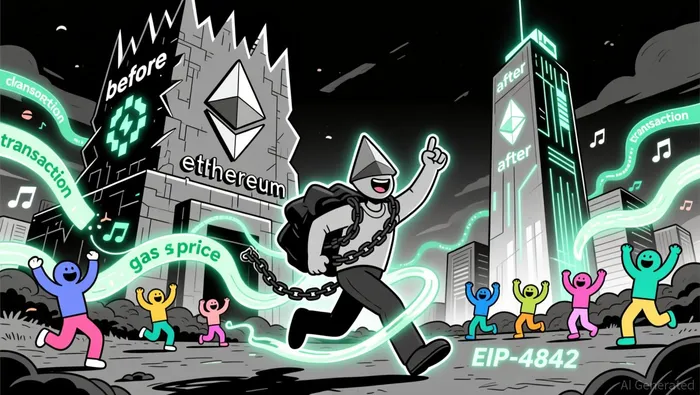
The L1 Surge, spanning 2023–2025, has centered on optimizing Ethereum's base-layer capabilities to support mass adoption. A landmark achievement is EIP-4844 (Proto-Danksharding), implemented in March 2024, which introduced "blob" transactions to reduce data costs for Layer 2 (L2) rollups. This innovation slashed Ethereum's average gas prices by 58.5% and median prices by 67.5% post-upgrade, while cheap gas days surged from 2.2% to 50.8% of all days. By decoupling data availability from execution, EIP-4844 enabled L2s like Arbitrum and Optimism to process transactions at 90% lower costs, directly enhancing user experience and developer incentives.
Complementing this, Ethereum's block gas limit increased from 45 million to 60 million in 2024, boosting base-layer transaction capacity. Vitalik Buterin has emphasized a strategic shift toward "targeted optimization," where future gas limit hikes may be paired with higher costs for computationally intensive operations, ensuring efficiency without compromising scalability. These adjustments lay the groundwork for EthereumETH-- to handle thousands of low-fee transactions per second, a critical threshold for mainstream DeFi and enterprise use cases.
On-Chain Activity: A Barometer of Network Vitality
Ethereum's on-chain metrics in 2023–2025 reflect robust adoption. By 2025, the network processed over 1.5 million daily transactions, up from 950,000 in early 2024, with active addresses surpassing 275 million. This growth is driven by DeFi's resurgence, as total value locked (TVL) in Ethereum's ecosystem peaked at $97 billion in August 2025-the highest since November 2021.
Institutional participation has further amplified network activity. Ethereum ETFs attracted $25 billion in assets by late 2025, with a single-day inflow of $1.02 billion in August 2025. Layer-2 solutions, now handling over 30% of Ethereum's transaction volume, have democratized access to DeFi, enabling users to interact with protocols like UniswapUNI-- and AaveAAVE-- at near-zero costs.
Institutional Adoption: From Staking to ETFs
Ethereum's institutional adoption has accelerated alongside its technical upgrades. Staking, which locks over 34 million ETH (28% of total supply) by mid-2025, offers annual yields of 3–4%, attracting both retail and institutional investors. The Pectra upgrade in May 2025 streamlined staking mechanics, enabling larger entities to consolidate stakes and improving capital efficiency. Liquid staking protocols like Lido and EigenLayerEIGEN-- have further diversified participation, though institutional-grade operators now dominate 4.5% of staked ETH.
Regulatory clarity has been a key enabler. The U.S. SEC's approval of spot Ethereum ETFs in 2024 opened a regulated pathway for institutional capital, with corporate treasuries holding over 10 million ETH collectively by late 2025. Major banks now offer Ethereum custody services, and asset managers have launched Ethereum-focused products, reflecting broader acceptance of the asset class.
The Investment Thesis: Scalability, Utility, and Institutional Momentum
Ethereum's L1 Surge has created a flywheel effect: technical upgrades reduce friction for users and developers, driving on-chain activity and TVL, which in turn attract institutional capital. This virtuous cycle is reinforced by Ethereum's role as the foundation for programmable money and tokenized assets, with DeFi protocols managing hundreds of billions in TVL.
Looking ahead, the Purge and Splurge phases will further simplify Ethereum's protocol and integrate optimizations like EIP-7691, which doubled blob throughput in 2025. These upgrades will sustain Ethereum's position as the leading smart contract platform, even as competition from alternatives like SolanaSOL-- and CosmosATOM-- intensifies.
For investors, Ethereum's combination of technical resilience, network effects, and institutional tailwinds presents a compelling case. The asset's deflationary supply dynamics-35 million ETH staked and ETF inflows reducing circulating supply-add scarcity value. Meanwhile, the maturation of DeFi and tokenized assets opens new avenues for yield generation and financial innovation, aligning Ethereum's growth with the broader shift toward decentralized infrastructure.






Comentarios
Aún no hay comentarios