
Ethereum: Institutional and Whale Accumulation as a Precursor to Bullish Reversal
Whale Accumulation and Institutional Confidence
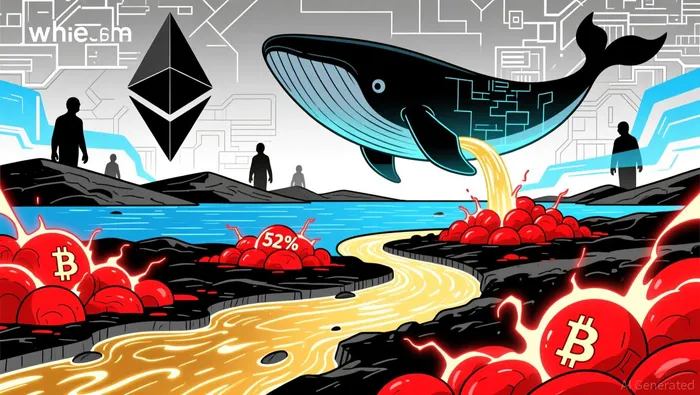
Whale activity has been a standout feature of Ethereum's Q3 performance. Wallets holding between 10,000 to 100,000 ETH-often associated with institutional actors-have accumulated 7.6 million ETH since late April 2025, a 52% increase as prices stabilized near $3,000, according to a BTCC analysis. This contrasts sharply with retail investors, who reduced holdings in the 100–1,000 ETH range by 16%, underscoring a divergence in market sentiment, as noted in the same BTCC analysis.
A notable whale has even opened a $195.7 million long position in Ethereum, a move directly tied to growing optimism ahead of the Fusaka upgrade in December 2025, as reported in the BTCC analysis. This upgrade, expected to enhance scalability and reduce transaction fees, has become a focal point for bullish sentiment. Meanwhile, tokenized funds-driven by major players like BlackRockBLK-- and Fidelity-have surged 2,000% since January 2024, further cementing institutional confidence, as reported in the BTCC analysis.
Institutional ETF Inflows and Regulatory Tailwinds
Ethereum's institutional adoption has been turbocharged by explosive ETF inflows. In Q3 2025, Ethereum ETFs attracted $9.6 billion in inflows, surpassing Bitcoin's $8.7 billion, according to a Coinotag report. This shift reflects a broader appetite for altcoin exposure, particularly as regulatory clarity emerges. The U.S. SEC has received five altcoin ETF applications, including proposals for SolanaSOL-- and XRPXRP--, despite delays caused by the government shutdown, as detailed in the Coinotag report.
Ethereum ETF assets under management (AUM) grew 177% in Q3, reaching $28.6 billion, according to a PowerDrill AI analysis. Analysts attribute this to a transition from speculative allocations to strategic positioning, with smart money traders accumulating tokens like UniswapUNI--, AaveAAVE--, and Chainlink in anticipation of ETF approvals, as reported in the Coinotag report.
On-Chain Metrics and Staking Dynamics
Ethereum's on-chain fundamentals reinforce the bullish narrative. Daily transactions averaged 1.56 million in Q3, a 9% increase from Q2, while active addresses rose 12% quarter-over-quarter, according to an Oak Research report. Staking activity has also surged, with 36.8 million ETH (30.4% of total supply) locked in staking contracts by the end of Q3, as reported in the Oak Research report.
Transaction fees, though declining in ETH terms by 11%, have risen in dollar value due to Ethereum's price appreciation, as noted in the Oak Research report. This suggests growing utility without sacrificing user affordability-a critical factor for long-term adoption.
NVT Ratio and Historical Undervaluation
Ethereum's Network Value to Transaction (NVT) ratio of 37 in Q3 2025 points to undervaluation at a price of $4,700, according to an Intellectia analysis. Historically, low NVT ratios have preceded price rallies, as seen in past cycles. Analysts argue that institutional interest and regulatory progress-such as the GENIUS Act, which provided a stablecoin framework-have created a fertile environment for Ethereum's revaluation, as reported in a Bitwise analysis.
In Q3, Ethereum outperformed BitcoinBTC-- by a staggering margin, rising 65% compared to Bitcoin's 6% gain, according to the Bitwise analysis. This divergence highlights Ethereum's unique positioning as a beneficiary of both technical upgrades and macroeconomic liquidity.
The Fusaka Upgrade: A Catalyst for Growth
The Fusaka upgrade, scheduled for December 3, 2025, is widely viewed as a critical inflection point. Analysts project that improved scalability and reduced fees will drive further adoption, particularly in decentralized finance (DeFi) and tokenized assets, as reported in the BTCC analysis. With total value locked (TVL) in DeFi ecosystems already rising to $30.17 billion, as reported in the Intellectia analysis, the upgrade could unlock new use cases and liquidity.
Conclusion: A Bullish Reversal in the Making
The convergence of whale accumulation, institutional inflows, and favorable on-chain metrics creates a robust case for a bullish reversal. Ethereum's NVT ratio, coupled with the impending Fusaka upgrade, suggests the market is pricing in a future where Ethereum's utility and scalability justify a higher valuation. With institutional AUM and staking dynamics reinforcing this thesis, investors may be on the cusp of a significant re-rating event.





Comentarios
Aún no hay comentarios