
Ethereum's Institutional Dynamics and On-Chain Sell-Pressure: Implications for Price Stability and Investor Strategy
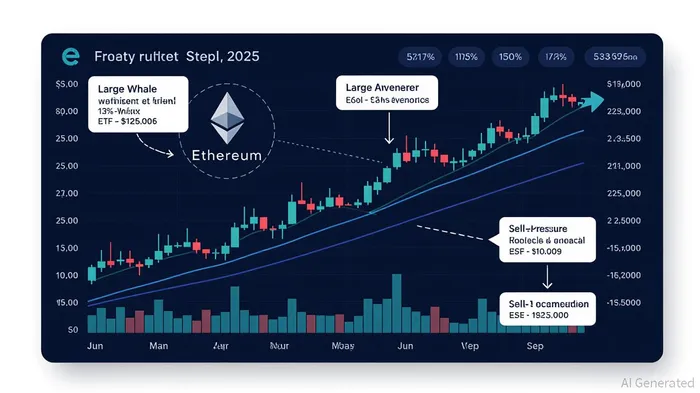
The Rise of Institutional Accumulation and Whale Activity
Ethereum’s institutional adoption and whale-driven dynamics have reshaped its market structure in 2025. A BitcoinBTC-- whale’s $217 million BTC-to-ETH conversion via Hyperliquid on August 30, 2025, underscores a strategic reallocation toward EthereumETH--, driven by staking yields and DeFi growth [1]. Similarly, a $5.43 million USDT-to-ETH purchase on Binance and a 4,000 BTC-to-96,859 ETH swap (valued at $3.8 billion) highlight sustained institutional confidence [2]. These moves have tightened liquidity, creating scarcity-driven momentum as whales and institutions hoard ETH amid macroeconomic uncertainty.
The Ethereum Foundation’s on-chain activity further amplifies this trend. A rare 4,000 ETH transfer ($17.19 million) from a 9-year-old dormant wallet in September 2025 signals potential institutional rebalancing [3]. Historical precedents, such as the 10,000 ETH transfer to Kraken in 2025, have shown mixed price impacts—large sell-offs (e.g., 15K+ ETH) correlate with short-term dips, while smaller sales (<9K ETH) show no significant price drag [4]. This duality reflects Ethereum’s maturing market, where institutional players balance liquidity needs with long-term bullish narratives.
Technical Indicators and On-Chain Sell-Pressure
Ethereum’s technical structure has been increasingly influenced by whale and institutional activity. The Net Taker Volume metric, which measures buying/selling pressure, hit a -$418.8 million sell imbalance in Q3 2025—the largest in Ethereum’s history [5]. This coincided with a breakdown below the Realized Price, a critical on-chain benchmark that acts as a psychological support level. When ETH dips below this metric, short-term holders (STHs) face losses, triggering capitulation and further sell-pressure [5].
Key resistance levels, such as the $4,000 mark, have historically constrained Ethereum’s upward momentum. A recent bearish divergence in the Relative Strength Index (RSI)—where price highs outpace RSI highs—signals weakening bullish momentum [6]. Meanwhile, the Ethereum Foundation’s 4,000 ETH transfer in September 2025 briefly spiked volatility, as traders interpreted the move as a potential liquidity event [3].
Investor Strategies in a Volatile Landscape
Investors navigating Ethereum’s 2025 dynamics are adopting nuanced strategies. Swing traders are leveraging moving averages and Fibonacci retracement levels to time entries. For instance, a whale’s $960,000 profit swing trade (buying at $4,335 and selling at $4,431) utilized the 50-day and 200-day EMAs as key decision points [7]. Long-term investors, meanwhile, are prioritizing staking and ETF inflows. Ethereum’s staking ratio has surged to 12.3% of total supply, with institutional ETFs like BlackRock’s Ether ETF driving $465 million in inflows [5].
For short-term sell-pressure, tools like AI-powered on-chain analytics (e.g., Token Metrics) enable real-time monitoring of metrics like MVRV ratios and BTC Velocity [8]. When Ethereum’s price dips below the STH Realized Price, investors are advised to assess liquidity depth and ETF flows to gauge capitulation risks [5]. Additionally, large ETH withdrawals from exchanges—such as the $1 billion 200,000 ETH outflow in Q3 2025—signal reduced immediate selling pressure and potential bullish catalysts [9].
Conclusion: Balancing Bullish Fundamentals with Short-Term Volatility
Ethereum’s institutional dynamics and whale activity present a complex interplay of bullish and bearish forces. While on-chain sell-pressure and technical divergences pose near-term risks, the asset’s fundamentals—driven by staking yields, ETF inflows, and Pectra upgrades—remain robust. Investors must balance short-term volatility with long-term positioning, leveraging technical indicators and on-chain data to refine strategies. As Ethereum approaches critical resistance levels, the market’s ability to absorb large-scale institutional transactions will be pivotal in determining its trajectory.
Source:
[1] Analyzing Whale Activity and Market Dynamics [https://www.bitget.com/news/detail/12560604942142]
[2] Whale Accumulation Alert: 1,237 ETH Bought at $4,393 on Binance [https://blockchain.news/flashnews/whale-accumulation-alert-1-237-eth-bought-at-4-393-on-binance-using-5-43m-usdt-on-chain-data-nansen]
[3] Ethereum Foundation-Linked Wallet Moves 4,000 ETH ($17.19M) After 9 Years [https://blockchain.news/flashnews/ethereum-foundation-linked-wallet-moves-4-000-eth-17-19m-after-9-years-on-chain-alert-citing-nansen-data]
[4] Impact of Ethereum Foundation Sales on ETH Price [https://www.mitrade.com/insights/news/live-news/article-3-718612-20250326]
[5] Resistance Selling: Key Insights Into Ethereum's Market Dynamics [https://www.okx.com/en-us/learn/resistance-selling-ethereum-market-dynamics]
[6] ETHUSDETH-- Futures Trade Ideas [https://www.tradingview.com/symbols/CRYPTOCOM-ETHUSD1%21/ideas/?contract=ETHUSD31V2025]
[7] The Strategic Power of Ethereum Swing Trading [https://www.ainvest.com/news/strategic-power-ethereum-swing-trading-lessons-960k-whale-profit-2509/]
[8] Latest Crypto News, Blogs, Articles & Stories [https://www.tokenmetrics.com/blog?0fad35da_page=24]
[9] Nearly $1B in ETH Pulled From Exchanges as Ethereum Breakout Signals Altseason [https://www.fastbull.com/news-detail/from-bullish-to-cooldown-bitcoin-remains-in-profittaking-news_6100_0_2025_3_9063_3/6100_SOL-USDT]






Comentarios
Aún no hay comentarios