
Ethereum's Institutional Ascendancy: How BitMine's $20 Billion Raise Could Reshape the Crypto Landscape
In the ever-evolving world of finance, the line between traditional markets and digital assets is blurring. Nowhere is this more evident than in the aggressive institutional adoption of EthereumETH-- (ETH), a trend crystallized by Tom Lee's audacious $20 billion capital-raising effort at BitMine ImmersionBMNR-- Technologies (BMNR). This move, part of a broader corporate strategy to amass 5% of the total Ethereum supply, is not just a bet on crypto—it's a redefinition of how value is captured and preserved in the 21st century.
The Mechanics of Institutional Accumulation
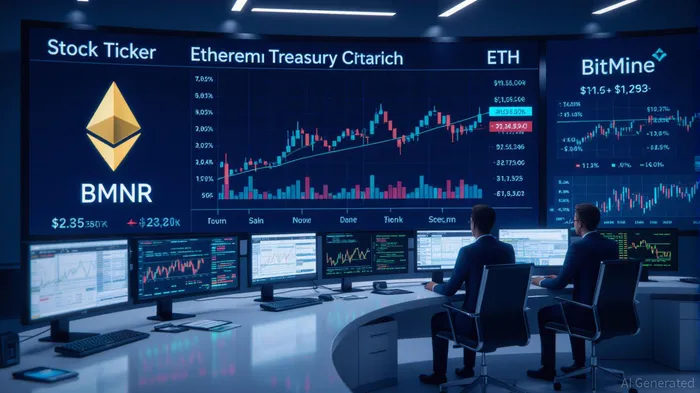
BitMine's strategy mirrors the playbook of BitcoinBTC-- pioneers like MicroStrategy, but with a twist: it's targeting Ethereum, the second-largest cryptocurrency by market cap. By selling shares at $0.0001 each—enabling high liquidity without destabilizing its stock price—the company has raised $24.5 billion in total, with $20 billion newly allocated to expand its Ethereum holdings. As of August 10, 2025, BitMine already holds 1.15 million ETH, valued at $4.96 billion, making it the largest public Ethereum treasury in the world.
This approach leverages a simple but powerful economic principle: scarcity. By reducing the circulating supply of ETH through institutional buy-ins, BitMine is effectively creating a “forced scarcity” model, akin to how companies buy back shares to boost equity value. The implications are clear: as demand for Ethereum outpaces supply, the price is likely to follow.
Scarcity-Driven Price Action: A New Paradigm
Ethereum's transition to a proof-of-stake model has already improved its energy efficiency, but institutional accumulation is now reshaping its value proposition. By locking up a significant portion of the supply, BitMine and its peers are transforming Ethereum from a speculative asset into a strategic reserve. This mirrors the role of gold in central bank portfolios, where scarcity and utility converge.
The math is compelling. At current circulating levels, 5% of Ethereum's supply equates to roughly 12.5 million tokens. If BitMine succeeds in acquiring this amount, it would represent a 10% increase in its current holdings, further tightening supply. Meanwhile, Ethereum's price has surged 70% year-to-date, with much of that growth coinciding with BitMine's fundraising announcements.
Risks and Realities
No strategy is without its pitfalls. BitMine's stock initially dropped 6% after the $24.5 billion offering announcement, signaling concerns about dilution and market saturation. Critics argue that the company's reliance on stock sales to fund ETH purchases could erode shareholder value if the crypto market corrects. Additionally, regulatory scrutiny of corporate crypto treasuries remains a wildcard, with the SEC's stance on digital assets still evolving.
Yet, these risks are arguably secondary to the broader narrative. BitMine's stock has surged 700% year-to-date, driven by institutional confidence in Ethereum's long-term potential. Its high trading volume—now the 25th most active U.S. stock—ensures that capital can be raised efficiently, mitigating short-term volatility.
The Bigger Picture: Ethereum as a Corporate Asset Class
Tom Lee's strategy is part of a larger shift. Companies like Sharplink GamingSBET-- and CoinbaseCOIN-- are also building Ethereum treasuries, collectively accounting for 10% of the total supply. This trend is not just about price—it's about legitimacy. As Ethereum becomes a line item on corporate balance sheets, it gains the credibility of traditional assets, attracting a new wave of institutional investors.
Moreover, Ethereum's utility as a platform for decentralized finance (DeFi) and smart contracts adds a layer of demand that Bitcoin lacks. Unlike Bitcoin, which is purely a store of value, Ethereum is a foundational layer for innovation, making its scarcity-driven price action even more compelling.
Investment Advice: Navigating the New Normal
For investors, the key takeaway is clear: Ethereum is no longer a fringe asset. It is now a core component of institutional portfolios, with BitMine's strategy serving as a bellwether. While the crypto market remains volatile, the scarcity model being tested by BitMine and its peers offers a framework for long-term value creation.
- For the Cautious Investor: Consider allocating a small portion of your portfolio to Ethereum-based treasuries, using dollar-cost averaging to mitigate volatility.
- For the Aggressive Investor: Explore exposure to companies like BitMine, which are directly tied to Ethereum's price action. However, monitor regulatory developments closely.
- For the Skeptical Investor: Diversify across traditional and digital assets, ensuring that no single strategy dominates your risk profile.
Conclusion: A New Era of Value Capture
Tom Lee's $20 billion raise is more than a financial maneuver—it's a statement. By treating Ethereum as a strategic reserve asset, BitMine is redefining how value is captured in the digital age. As institutional demand continues to outpace supply, the implications for Ethereum's price and utility are profound. In this new era, scarcity is no longer a constraint; it's an opportunity.
The question is no longer whether Ethereum will matter—it's how much it will matter. And for those willing to bet on the future, the answer is already being written in the balance sheets of companies like BitMine.





Comentarios
Aún no hay comentarios