
Ethereum's Institutional Adoption and Privacy Innovation: A Catalyst for Long-Term Value
The institutional crypto landscape in 2025 is witnessing a seismic shift, with EthereumETH-- emerging as the preferred blockchain for Wall Street’s evolving demands. While BitcoinBTC-- remains a cornerstone of digital scarcity, Ethereum’s dual focus on privacy innovation and institutional-grade infrastructure is accelerating its dominance in the institutional space. This analysis explores how Ethereum’s strategic upgrades, regulatory tailwinds, and Wall Street’s embrace of its ecosystem are reshaping the crypto asset hierarchy.
Institutional Adoption: Ethereum’s Yield-Driven Edge
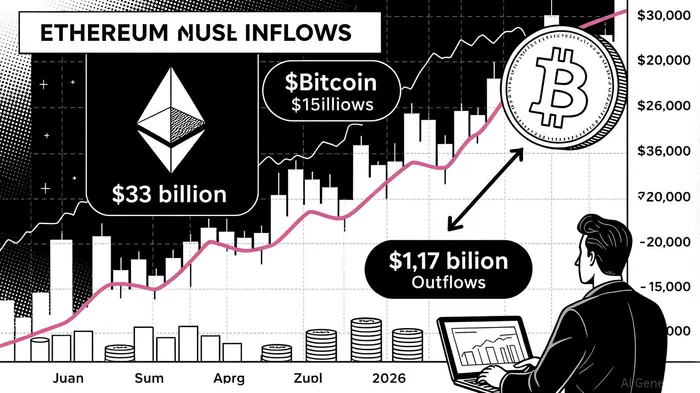
Ethereum’s institutional adoption has been fueled by a confluence of factors: regulatory clarity, attractive staking yields, and scalability upgrades. The U.S. SEC’s Clarity Act, which reclassified Ethereum as a utility token, unlocked $27.6 billion in inflows through Ethereum ETFs by August 2025, transforming it into a normalized macroeconomic hedge [1]. This contrasts sharply with Bitcoin ETFs, which faced outflows of $1.17 billion during the same period [3]. By Q3 2025, Ethereum ETFs had attracted $33 billion in inflows, driving the Ethereum/BTC ETF ratio to 0.12—a sixfold increase from earlier in the year [1].
The appeal lies in Ethereum’s 4.8% annualized staking yield, which dwarfs Bitcoin’s 1.8% [1]. Institutional investors, including corporate treasuries and investment advisors, have staked 1.5 million ETH and 388,358 ETH respectively, with 29% of Ethereum’s total supply now staked [2]. This dual-income model—combining capital appreciation with yield—mirrors traditional assets like dividend-paying equities, making Ethereum a more palatable option for risk-averse institutions [3].
Privacy Innovation: Ethereum’s Institutional-Grade Infrastructure
Wall Street’s demand for privacy and compliance has further cemented Ethereum’s lead. The Ethereum Foundation’s curated grant model has prioritized zero-knowledge (ZK) cryptography, enabling private transactions while maintaining transparency for regulators. For instance, Etherealize, a startup backed by $40 million in funding, is developing ZK-based privacy infrastructure for tokenized asset trading and settlement [4]. This aligns with institutional needs for confidentiality in high-value transactions while adhering to KYC/AML requirements.
JPMorgan’s blockchain initiatives exemplify Ethereum’s institutional-grade appeal. The bank’s Kinexys platform, integrated with Ethereum Layer 2s, facilitates real-time intraday repo trading of cash and collateral, enhancing liquidity management [5]. Additionally, JPMorgan’s USD deposit token on Base (an Ethereum Layer 2) offers institutional clients 24/7 settlement and interest-bearing capabilities, backed by the bank’s balance sheet [5]. These innovations underscore Ethereum’s role as a scalable, secure infrastructure for traditional finance’s digital transformation.
Ethereum’s Deflationary Model and Scalability Upgrades
Ethereum’s Dencun and Pectra upgrades have reduced gas fees on Layer 2 networks by 90%, enabling $13 billion in tokenized real-world asset (RWA) growth and $223 billion in DeFi total value locked [3]. This deflationary model, combined with reduced liquidity on centralized exchanges (only 19.3 million ETH held), creates artificial scarcity, supporting price stability and attracting long-term capital [1]. In contrast, Bitcoin’s fixed supply and proof-of-work (PoW) mechanism, while secure, lack the programmability and scalability required for institutional use cases like tokenized bonds or cross-chain settlements [6].
Institutional Sentiment and Price Projections
Market strategists are bullish on Ethereum’s trajectory. Tom Lee, a prominent Wall Street analyst, predicts Ethereum could reach $6,400–$12,000 by year-end 2025, driven by tightening liquidity and sustained institutional inflows [1]. VanEck’s CEO Jan van Eck has even labeled Ethereum “the Wall Street token,” forecasting its dominance in stablecoin transactions and RWA tokenization [5]. These sentiments are echoed by BlackRock’s expansion of Ethereum-based protocols, including its tokenized U.S. Treasury fund (BUIDL), which leverages Ethereum’s Layer 2s for efficiency [2].
Conclusion: Ethereum’s Long-Term Value Proposition
Ethereum’s institutional adoption is not merely a function of market cycles but a reflection of its technical superiority and strategic alignment with Wall Street’s needs. By addressing privacy, scalability, and yield generation, Ethereum has positioned itself as the backbone of the next-generation financial infrastructure. While Bitcoin retains its role as a store of value, Ethereum’s ability to evolve with institutional demands—through upgrades, partnerships, and regulatory adaptability—makes it a compelling long-term investment. As the crypto ecosystem matures, Ethereum’s dominance in the institutional space is likely to widen, reshaping the asset hierarchy in favor of programmable, privacy-enhanced blockchains.
Source:
[1] The BTC-to-ETH Rotation: Institutional Whale Shifts Signal Ethereum Emerging Dominance
[2] Ethereum (ETH-USD) Eyes $10K as ETF Flows Surge, $4K ...
[3] Ethereum's Institutional Accumulation and Bullish Price
[4] Etherealize Raises $40M to Bring Ethereum to Wall Street
[5] J.P. Morgan USD Token Launch on the Blockchain with
[6] Ethereum at a Crossroads | Institutional Outlook





Comentarios
Aún no hay comentarios