
Ethereum's Institutional Adoption and Price Momentum: Strategic Entry Points for Long-Term Investors in 2025
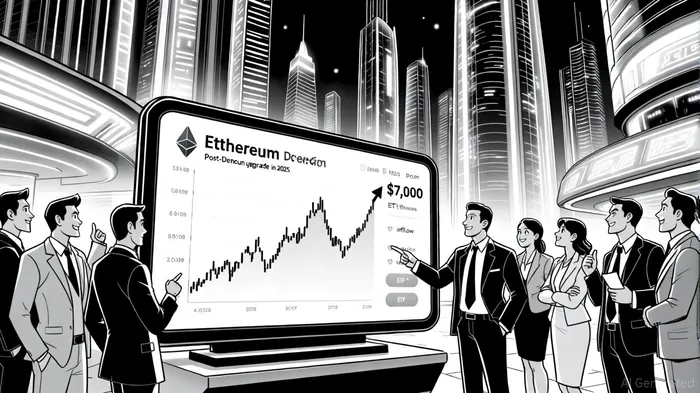
Ethereum's 2025 trajectory has been reshaped by a confluence of institutional adoption, regulatory clarity, and technical innovation. The approval of U.S. spot Ether ETFs in late June 2025 marked a watershed moment, channeling over $20.11 billion in net assets into EthereumETH-- by August 2025, according to NFTevening (NFTevening). These ETFs, now accounting for 72% of ETH calendar futures open interest, according to a Glassnode report (Glassnode report), have transformed Ethereum from a speculative asset into a cornerstone of institutional portfolios. For long-term investors, this shift creates a unique window to capitalize on Ethereum's structural momentum, provided they align entry strategies with macroeconomic and technical signals.
Institutional Adoption: A Catalyst for Structural Demand
The institutionalization of Ethereum is no longer theoretical. By August 2025, U.S. Ether ETFs had attracted $5.43 billion in net inflows during July alone, per the NFTevening analysis, dwarfing BitcoinBTC-- ETF inflows by over tenfold, according to Blockonomi (Blockonomi). This capital influx is driven by Ethereum's unique value proposition: a deflationary supply model, staking yields of 3–6% (Glassnode data), and a robust infrastructure for tokenized real-world assets (RWAs). Platforms like CME GroupCME-- have amplified this trend, with Ether futures contracts hitting an all-time high of $11.2 billion in notional value, as detailed in a Medium article (Medium article).
Ethereum's technical upgrades further solidify its institutional appeal. The Dencun upgrade (EIP-4844), implemented in March 2024, reduced Layer-2 data costs by up to 90%, according to Kenson Investments (Kenson Investments), enabling efficient enterprise applications and cross-chain arbitrage. Institutional players capitalized on this, capturing $868 million in post-Dencun arbitrage profits (per the Medium article). Meanwhile, Ethereum's network security-bolstered by 1 million active validators-makes 51% attacks economically infeasible, according to Crypto.com research (Crypto.com research), addressing a key institutional risk.
Price Momentum: ETFs, Macroeconomics, and Technical Breakouts
Ethereum's price action in 2025 reflects the interplay of institutional demand and macroeconomic tailwinds. By late August 2025, ETH had surged to $4,520 (Blockonomi), a 95% increase from its April 2025 low of $1,750 (NFTevening). This rally coincided with the U.S. Federal Reserve's dovish pivot and a weakening dollar index, which improved risk appetite across asset classes (Glassnode). Analysts project Ethereum could test $5,000 by year-end, with more ambitious targets-$7,300 to $12,200-hinging on sustained ETF inflows and a bullish 200-week moving average crossover (Crypto.com research).
Technical indicators reinforce this optimism. Ethereum has retested a V-bottom pattern and is breaking out of a long-term triangle on the monthly chart (Blockonomi). A sustained close above $5,000 could trigger a multi-year rally, with the 1.618 Fibonacci extension level at $7,331 acting as a near-term target (Blockonomi). Historical backtests of triangle breakouts indicate a 75% hit rate (3 wins out of 4 events) with an average return of +7.83%, surpassing the benchmark ETH buy-and-hold return of +3.00% over the same 30-day period. However, with only four valid signals detected since 2022, the sample size remains limited, and results may not be statistically robust.
Volatility remains a concern. October 2025 saw a single-day inflow of $176.6 million into Ethereum ETFs (NFTevening), yet the ETH/BTC ratio remains at multi-year lows (Glassnode), signaling potential corrections if macroeconomic conditions deteriorate.
Strategic Entry Points: Balancing Risk and Reward
For long-term investors, Ethereum's current price environment offers both opportunities and risks. Key entry points include:
1. Pullback to $4,430–$4,480: This support zone, if consolidated, could confirm bullish momentum (Blockonomi). A staggered entry strategy here-allocating capital in tranches-mitigates downside risk while leveraging Ethereum's low exchange reserves (16.2% of total supply as of July 2025, per NFTevening).
2. Breakout above $5,000: A confirmed close above this level would validate the V-bottom pattern and open the door to $7,300–$9,000 (Blockonomi). Investors should pair this with tight stop-loss orders to protect against sudden volatility.
3. Whale Accumulation Signals: On-chain data shows $5.42 billion in BTC-to-ETH transfers in Q3 2025 (Glassnode), indicating institutional capital is shifting toward Ethereum's smart contract ecosystem. Monitoring whale activity can provide early signals for trend continuation.
Risk management is critical. While Ethereum's institutional adoption reduces retail-driven volatility, macroeconomic headwinds (e.g., Fed policy shifts) and regulatory uncertainties (e.g., potential ETF restrictions) remain. Diversifying across Ethereum's ecosystem-such as Layer-2 solutions and tokenized RWAs-can further hedge against these risks (Crypto.com research).
Conclusion: A Defining Moment for Ethereum
Ethereum's 2025 momentum is underpinned by a structural shift in institutional capital flows and technical innovation. While risks persist-ranging from regulatory scrutiny to competition from SolanaSOL-- and other Layer-1s-the confluence of ETF inflows, Dencun-driven efficiency, and macroeconomic tailwinds creates a compelling case for long-term investors. Strategic entry points, particularly during pullbacks to $4,430–$4,480, offer a disciplined way to participate in Ethereum's next phase of growth. As the line between traditional finance and crypto continues to blurBLUR--, Ethereum's role as a foundational asset is becoming increasingly undeniable.





Comentarios
Aún no hay comentarios