
Ethereum's Institutional Adoption and Its Implications for Price Momentum
The Institutional Onboarding Catalyst
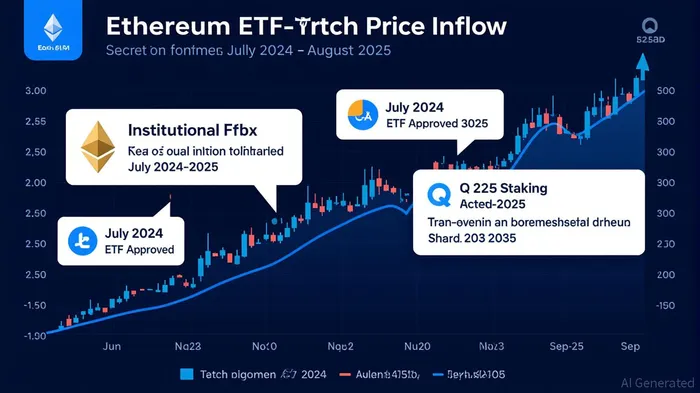
Ethereum's institutional adoption in 2025 has emerged as a seismic shift in the crypto asset landscape, driven by the approval of spot EthereumETH-- ETFs in July 2024. According to a report by Bitget, these ETFs—including BlackRock's ETHAETHA-- and Franklin Templeton's EZET—catalyzed over $12 billion in inflows by August 2025, signaling a structural shift in capital allocation[1]. This influx has not only diversified Ethereum's ownership base but also created a self-reinforcing cycle of demand and price appreciation[2].
The institutional ownership of Ethereum now accounts for approximately 2.5% of its total supply[1], a figure that, while modest, represents a significant departure from the asset's retail-driven history. This shift is underpinned by Ethereum's dual-income model: capital appreciation from price momentum and yield generation through staking. As of Q2 2025, 29% of Ethereum's supply is staked, generating annualized yields of 4–6%[1]. For risk-averse institutional investors, this combination of yield and growth has positioned Ethereum as a compelling alternative to traditional fixed-income assets, particularly in a low-interest-rate environment.
Network Value Dynamics and Technological Resilience
Ethereum's technological upgrades have further solidified its appeal to institutional participants. The Pectra and Dencun upgrades, as detailed in a 2025 analysis by Valr, have enhanced the network's scalability and security, enabling it to support institutional-grade operations[3]. These improvements have directly contributed to Ethereum's dominance in tokenized real-world assets (RWAs), with $8.3 billion in tokenized assets hosted on the platform and 52% of all tokenized RWAs anchored to Ethereum[2].
The network's resilience during market corrections in 2025 has also been a critical factor. Ethereum ETFs outperformed the S&P 500 during these periods, demonstrating the asset's ability to retain value amid macroeconomic volatility[1]. This performance has reinforced institutional confidence, with many investors viewing Ethereum as a hedge against traditional market downturns.
NFTs and the Expanding Digital Economy
Beyond institutional finance, Ethereum's role in the digital economy remains robust. The platform's NFT market, for instance, generated $287 million in sales over the last 30 days of 2025[4], underscoring its continued relevance in creative and digital asset ecosystems. While NFTs may not directly drive institutional adoption, they reinforce Ethereum's network effects, attracting developers and users who contribute to the platform's long-term value proposition.
Future Outlook: Regulatory Engagement and Network Upgrades
Looking ahead, Ethereum's institutional adoption appears poised for further growth. Ongoing regulatory engagement, particularly under the SEC's Project Crypto framework, is expected to streamline compliance for institutional participants[2]. Additionally, upcoming network upgrades—such as the anticipated Verge and Overline upgrades—promise to enhance Ethereum's throughput and reduce gas costs, making it even more attractive for large-scale financial operations[3].
Conclusion
Ethereum's institutional adoption in 2025 represents a confluence of regulatory progress, technological innovation, and financial utility. The approval of spot ETFs, combined with a robust staking infrastructure and network upgrades, has created a virtuous cycle of demand and value creation. As institutional onboarding accelerates, Ethereum's price momentum is likely to remain resilient, supported by its expanding role in traditional finance and the digital economy. For investors, this dynamic presents a compelling case for Ethereum as a core component of a diversified portfolio.





Comentarios
Aún no hay comentarios