
Ethereum's Hidden Levers: Developer Incentives and Security Risks in a Post-Merge World
Ethereum's transition to proof-of-stake (PoS) in 2022 marked a pivotal shift in blockchain sustainability, slashing energy consumption by 99.95% and redefining the network's role as a foundational infrastructure layer[3]. Yet, as the ecosystem matures, investors and developers must grapple with a critical question: How do Ethereum's developer incentives and underappreciated infrastructure components shape its long-term viability? While the Merge and subsequent upgrades like Dencun (EIP-4844) have enhanced scalability and reduced gas fees[1], the network's future hinges on addressing undervalued incentives and systemic security risks that could undermine its dominance.
The Goldilocks Zone: Undervalued Infrastructure Incentives
Ethereum's developer economics are a double-edged sword. On one hand, the network boasts over 1.3 million active developers supporting 4,000 decentralized applications (dApps), cementing its leadership in DeFi and NFTs[4]. On the other, critical infrastructure components remain underfunded or misaligned with long-term goals.
Staking Efficiency and Rollup Synergy
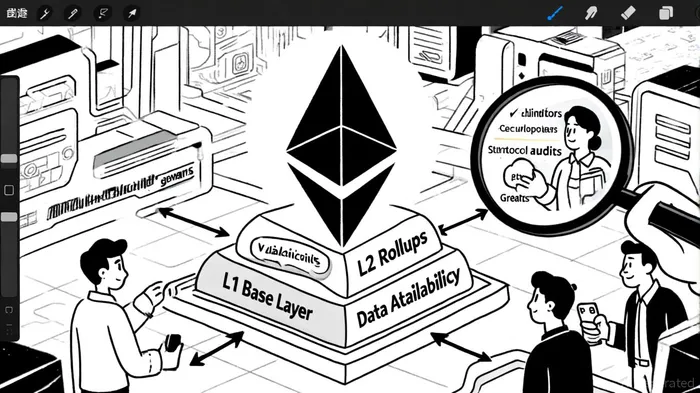
The Dencun upgrade in March 2024 introduced EIP-4844, reducing on-chain costs by over 90% and enabling rollups like Arbitrum and OptimismOP-- to dominate transaction processing[1]. Arbitrum's DAO, for instance, is actively decentralizing its sequencer and exploring ARB token staking to reward validation[2]. These rollups act as “gas siphons,” offloading execution while EthereumETH-- L1 focuses on data availability. However, the economic incentives for rollup developers remain skewed—many rely on token sales and venture capital rather than sustainable protocol funding.Protocol Funding Gaps
Ethereum's core development is partially funded by the Ethereum Foundation and community grants, but these mechanisms lack the scalability of Bitcoin's block reward-driven model. For example, the Pectra upgrade (2024) introduced smart account simplification and multitoken fee payments[4], yet such innovations often depend on sporadic developer grants rather than a consistent funding stream. This creates a risk of underinvestment in critical areas like zero-knowledge (ZK) proof optimization or cross-chain interoperability.Validator Centralization
While PoS reduces energy consumption, it introduces a new risk: validator centralization. As of 2025, over 60% of staked ETH is controlled by a few large entities, including exchanges and institutional stakers[3]. This concentration could lead to governance capture or reduced network resilience if a majority of validators act in self-interest.
The Shadow Risks: Security and Sustainability Challenges
Ethereum's security model, though robust, faces emerging threats that could erode trust:
Underfunded Security Audits
Rapid protocol upgrades often outpace rigorous security testing. For instance, the Pectra upgrade's smart account features required extensive auditing, yet many smaller teams lack the resources to conduct comprehensive reviews[4]. This creates a “race to scale” mentality, where speed trumps safety.Data Availability Dependencies
Ethereum's modular future relies on external data availability solutions like Celestia and EigenDA. While these reduce L1 bloat, they introduce single points of failure. If a data availability layer becomes compromised, Ethereum's security guarantees could be undermined[1].Gas Fee Volatility
Despite EIP-4844, gas fees remain a barrier for mass adoption. During peak usage, fees on L2s like Arbitrum can spike to $10–$20 per transaction[2], deterring retail users. This volatility highlights the need for better fee mechanisms or token-based subsidies.
The Path Forward: Balancing Incentives and Risks
For Ethereum to maintain its edge, stakeholders must prioritize three areas:
- Incentivizing Protocol Funding: Establishing a more predictable funding model for core developers, perhaps through a percentage of staking rewards or a “network tax.”
- Decentralizing Validator Power: Encouraging smaller stakers via lower entry barriers or cooperative staking pools.
- Investing in Security: Allocating more resources to formal verification, bug bounties, and third-party audits for critical upgrades.
Conclusion
Ethereum's post-Merge success is a testament to its adaptability, but the network's future depends on addressing its weakest links. By rethinking developer incentives, decentralizing staking, and prioritizing security, Ethereum can solidify its position as the bedrock of Web3. For investors, this means betting not just on ETH's price action but on the ecosystem's ability to fix its blind spots—a bet that could pay off handsomely in the next crypto cycle.






Comentarios
Aún no hay comentarios