
Ethereum's Growing Institutional Liquidity and Its Implications for Long-Term Value
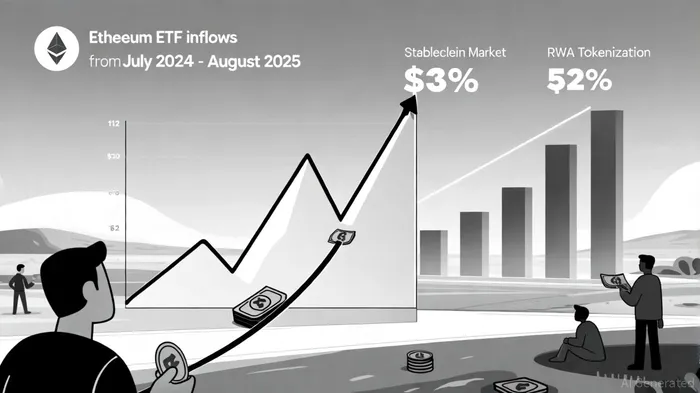
The institutionalization of EthereumETH-- has reached a tipping point. With over $12 billion in inflows by August 2025 following the July 2024 approval of Ethereum ETFs, the network is no longer a speculative asset but a cornerstone of institutional portfolios, according to a Crypto.com report. This seismic shift is not merely a function of capital flows-it reflects a broader redefinition of Ethereum's role in global finance, driven by regulatory alignment, technological resilience, and a growing ecosystem of tokenized assets.
The Catalyst: ETFs and Regulatory Clarity
The U.S. Securities and Exchange Commission's Project Crypto initiative has been pivotal in bridging the gap between crypto and traditional finance (TradFi). By modernizing regulations to align Ethereum ETFs with traditional exchange-traded products (ETPs), the SEC has legitimized Ethereum as a tradable asset class, as outlined in the Crypto.com report. BlackRock's iShares Ethereum Trust (ETHA) exemplifies this trend, recording a single-day net inflow of $726 million on July 17, 2025, according to a ChainUp blog post. These inflows are not isolated events but part of a sustained trend: Ethereum ETFs now hold a record 4.95 million ETH, signaling institutional confidence in the asset's liquidity and utility.
Technological Foundations: Security, Scalability, and Compliance
Ethereum's institutional appeal is underpinned by its technological evolution. The Merge, Surge, Dencun, and VergeXVG-- upgrades have transformed the network into an institutional-grade settlement layer. The Verge upgrade, in particular, introduced quantum-resistant signatures and reduced node storage requirements by 90%, addressing long-term security concerns, as noted in the ChainUp blog post. Meanwhile, the integration of ERC-3643 and zero-knowledge proofs (ZK) has enhanced transaction privacy while maintaining compliance with regulatory frameworks. The Depository Trust & Clearing Corporation (DTCC) has already adopted ERC-3643 for tokenized securities, and the SEC's engagement with the ERC-3643 Association underscores the network's alignment with compliance priorities, according to the Crypto.com report.
Staking as a Dual-Income Mechanism
Ethereum's staking infrastructure has further solidified its institutional footprint. With 29% of the total supply staked as of Q2 2025, the network offers annual yields of 4-6%, making it an attractive dual-income asset for investors, per the Crypto.com report. This model not only incentivizes capital retention but also enhances network security, as a validator set exceeding 1 million nodes reinforces decentralization. The Ethereum Foundation's new security initiative, coupled with EIP-7732 and zkEVM integration, is further bolstering censorship resistance-a critical factor for institutional adoption noted in the Crypto.com report.
Dominance in Stablecoins and Real-World Assets
Ethereum's dominance in stablecoin and real-world asset (RWA) tokenisation cements its role as the backbone of institutional-grade digital finance. The network processes trillions of dollars in stablecoin volume annually, maintaining a 53% share of total stablecoin supplies, according to the Crypto.com report. In RWA tokenisation, Ethereum leads with $8.3 billion in tokenized assets, driven by initiatives from BlackRockBLK-- and OndoONDO-- Finance, as the Crypto.com report highlights. This utility extends beyond speculative use cases, positioning Ethereum as a settlement layer for tangible assets like real estate and corporate bonds.
Challenges and the Path Forward
Despite these advancements, Ethereum faces hurdles. Regulatory ambiguities persist, and scalability challenges-though mitigated by Dencun and Verge-remain under scrutiny. However, the network's ability to capture productive work (e.g., tokenization, staking, and DeFi activity) will determine its long-term viability. Institutions are betting on Ethereum's capacity to evolve: its security hardening, ecosystem expansion, and alignment with regulatory frameworks create a moat that rivals like SolanaSOL-- or AvalancheAVAX-- struggle to replicate.
Conclusion
Ethereum's institutional liquidity is no longer a niche phenomenon but a macroeconomic force. The confluence of regulatory clarity, technological innovation, and asset utility has created a self-reinforcing cycle: increased adoption drives network effects, which in turn justify higher valuations. For investors, this signals a shift from volatility-driven speculation to value-driven accumulation. As Ethereum continues to anchor TradFi's transition into Web3, its long-term value proposition becomes increasingly inextricable from the institutional capital now flowing into its ecosystem.





Comentarios
Aún no hay comentarios