
Ethereum's Green Revolution: How Energy Efficiency and Institutional Adoption Are Fueling Long-Term Value Creation
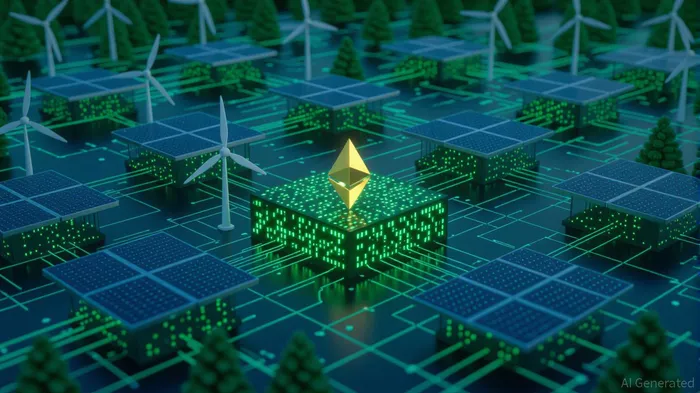
Ethereum’s transition to a proof-of-stake (PoS) model post-Merge has redefined its role in the global blockchain landscape, positioning it as a leader in sustainability and institutional-grade infrastructure. By slashing energy consumption by 99.95% compared to its proof-of-work predecessor, EthereumETH-- now consumes just 0.0026 terawatt-hours (TWh) annually—equivalent to a small town’s energy use [1]. This shift not only aligns with global decarbonization goals but also creates a compelling narrative for long-term value creation, as energy efficiency becomes a critical differentiator in the crypto asset class.
The technical underpinnings of Ethereum’s post-Merge success are equally robust. Daily transaction volumes surged to 1.74 million in August 2025, a 32% increase from Q1 levels, driven by DeFi interactions and real-world asset (RWA) experimentation [1]. Gas fees, once a barrier to adoption, have plummeted to an average of $0.08 due to Layer 2 (L2) solutions handling 60% of transactions and the Pectra and Fusaka upgrades boosting scalability [3]. These improvements have made Ethereum more accessible to retail and institutional users alike, with 680,000 active addresses now participating in the network [1].
Institutional adoption has further accelerated Ethereum’s ascent. The CLARITY Act’s reclassification of Ethereum as a utility token unlocked $33 billion in ETF inflows, with Ethereum ETFs outpacing BitcoinBTC-- ETFs in July 2025 [1]. Goldman SachsGS--, now the largest holder of Ethereum ETF assets, manages $721.8 million in ETH—equivalent to 288,294 ETH [2]. This institutional confidence is rooted in Ethereum’s deflationary mechanics: 36 million ETH staked (29% of the circulating supply) and a 1.32% annualized burn rate from EIP-1559 [1]. The result is a network that rewards long-term holders while maintaining security and scalability.
Ethereum’s dominance in tokenized RWAs (53% market share) and its $97 billion DeFi total value locked (TVL) underscore its role as a foundational asset in the digital economy [1][4]. As L2 solutions like Arbitrum secure 72% of total value, Ethereum’s ecosystem is evolving into a multi-layered infrastructure capable of supporting global financial innovation [3]. For investors, this translates to a blockchain that balances environmental responsibility with economic resilience—a rare combination in the crypto space.
**Source:[1] Ethereum's Post-Merge Resurgence: A Confluence of On-Chain Strength and Technical Momentum [https://www.ainvest.com/news/ethereum-post-merge-resurgence-confluence-chain-strength-technical-momentum-2508/][2] Goldman Sachs' Surging Ethereum ETF Holdings Signal ..., [https://www.bitget.site/news/detail/12560604936350][3] Ethereum's 2025 Technical Renaissance: On-Chain Activity and Sentiment Fueling a Bull Run [https://www.ainvest.com/news/ethereum-2025-technical-renaissance-chain-activity-sentiment-fueling-bull-run-2508/][4] Ethereum On-Chain Activity Hits 2025 High with $97 Billion Locked in DeFi [https://thedefiant.io/news/blockchains/ethereum-on-chain-activity-hits-2025-high-with-usd97-billion-locked-in-defi]






Comentarios
Aún no hay comentarios