
Ethereum's Next-Gen Roadmap and Its Implications for Long-Term Value: A Deep Dive into Technical Innovation and Institutional Adoption Potential
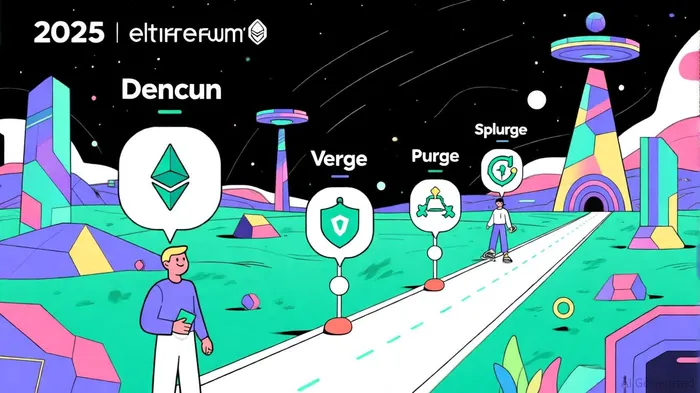
Ethereum's evolution in 2025 has positioned it as a cornerstone of the blockchain ecosystem, driven by a meticulously executed roadmap that balances technical innovation with institutional adoption. From the groundbreaking Dencun upgrade to the impending Verge and Purge phases, Ethereum's next-gen roadmap is not just a technical overhaul—it's a strategic pivot toward scalability, security, and sustainability. For investors, understanding these upgrades and their implications is critical to assessing Ethereum's long-term value proposition.
Technical Upgrades: Dencun and Beyond
The Cancun-Dencun upgrade (March 2024) marked a turning point, introducing Proto-Danksharding (EIP-4844) to revolutionize Layer 2 (L2) scalability. By enabling temporary data storage via “blobs,” the upgrade slashed L2 gas fees by up to 90% on platforms like ArbitrumARB-- and Optimism[1]. This reduction in transaction costs has directly lowered barriers for developers and users, accelerating the adoption of decentralized finance (DeFi), gaming, and NFT platforms[2].
Looking ahead, the Surge initiative aims to push Ethereum's throughput to over 100,000 transactions per second (TPS) through full Danksharding, which will distribute rollup data storage across the network[3]. Complementing this, the Scourge roadmap focuses on mitigating miner extractable value (MEV) risks and censorship, while the Verge upgrade introduces Verkle Trees to reduce node storage requirements by 95%[4]. These advancements not only enhance scalability but also democratize node operation, enabling smartphones and low-end hardware to participate in network validation[5].
Institutional Adoption: ETFs, Staking, and Security
Ethereum's technical strides have dovetailed with a surge in institutional interest. The approval of Spot Ethereum ETFs in 2024 has injected over $12.1 billion in assets under management by July 2025, with 60% of Ethereum's supply reportedly held in ETF portfolios[6]. Institutions like BlackRockBLK--, Fidelity, and VanEck now offer regulated exposure to ETH, leveraging in-kind redemptions to minimize transaction costs[7]. This institutional influx underscores Ethereum's growing recognition as a liquid, secure digital assetDAAQ--.
Staking innovations further bolster institutional adoption. The Pectra upgrade (May 2025) introduced account abstraction, enabling smart contract wallets with multi-signature and social recovery features[8]. These enhancements address institutional concerns around security and custody, while Ethereum's validator network—comprising over 1 million participants—ensures robust resistance to 51% attacks[9]. Additionally, evolving staking models and validator incentives aim to maintain decentralization, even as institutional capital grows[10].
MEV Resistance and Future-Proofing
Institutional engagement with EthereumETH-- is also shaped by strategies to mitigate MEV risks. Post-Dencun, institutions have adopted private relays, order-flow auctions, and transaction batching to reduce sandwich attack risks by up to 95%[11]. Private transaction channels, now used in 50% of high-value Ethereum transactions, further limit information leakage[12].
Ethereum's roadmap includes long-term quantum resistance measures and EVM simplifications, such as restricting the SELFDESTRUCT opcode and modernizing transaction types via EIP-4844[13]. These steps not only future-proof the network but also align with institutional demands for predictable, secure execution environments.
The Path to Long-Term Value
Ethereum's 2025 roadmap is a masterclass in balancing innovation with practicality. The Purge phase, set to clean up outdated data, will streamline the network, while the Splurge will introduce experimental upgrades to sustain growth[14]. Collectively, these efforts position Ethereum to achieve its vision of 100,000 TPS, making it a scalable foundation for decentralized applications (dApps) and real-world asset (RWA) tokenization[15].
For investors, the implications are clear: Ethereum's technical resilience and institutional tailwinds create a flywheel effect. As gas fees plummet and security improves, Ethereum's utility as a settlement layer and application platform will expand, driving demand for ETH. Meanwhile, the convergence of ETF inflows, staking accessibility, and MEV mitigation strategies ensures that institutional capital remains a net positive for the network.
Conclusion
Ethereum's next-gen roadmap is more than a technical agenda—it's a blueprint for dominance in the decentralized future. By addressing scalability, security, and institutional needs, Ethereum is not just surviving but thriving in a competitive landscape. For investors, the combination of cutting-edge upgrades and institutional adoption signals a strong case for long-term value creation. As the network transitions from Dencun to Splurge, Ethereum's journey is far from over—it's just beginning.






Comentarios
Aún no hay comentarios