
Ethereum as the Next-Gen Digital Infrastructure
In the evolving landscape of digital infrastructure, EthereumETH-- has emerged as a foundational layer for decentralized applications, financial systems, and institutional-grade trust. By combining the Linux-like trust model-characterized by open-source collaboration and institutional adoption-with the BitTorrent-scale decentralization of peer-to-peer (P2P) networks, Ethereum is positioning itself as a durable long-term value capture engine. This analysis explores how Ethereum's unique architecture, economic sustainability, and strategic upgrades in 2025 solidify its role as the backbone of the next-generation digital economy.
Linux-Like Trust: Institutional Adoption and Regulatory Clarity
Ethereum's trust model mirrors the open-source ethos of Linux, where decentralized governance and institutional-grade security converge. By 2025, over 50 non-crypto enterprises, including BlackRockBLK--, PayPalPYPL--, and Deutsche BankDB--, have integrated Ethereum for tokenized real-world assets (RWAs), stablecoins, and on-chain finance. This adoption is driven by Ethereum's ability to provide a secure, programmable infrastructure that aligns with institutional requirements for transparency and compliance.
Regulatory clarity further strengthens this trust. The U.S. SEC's "Clarity Act", enacted in 2025, legally defined Ethereum (ETH) as a digital commodity under CFTC jurisdiction, resolving long-standing securities ambiguities. This shift has enabled institutional investors to deploy capital with confidence, with Ethereum hosting $67 billion in USDT and $35 billion in USDC-cementing its role as the primary settlement layer for stablecoin transactions.
BitTorrent-Scale Decentralization: Network Resilience and Global Participation
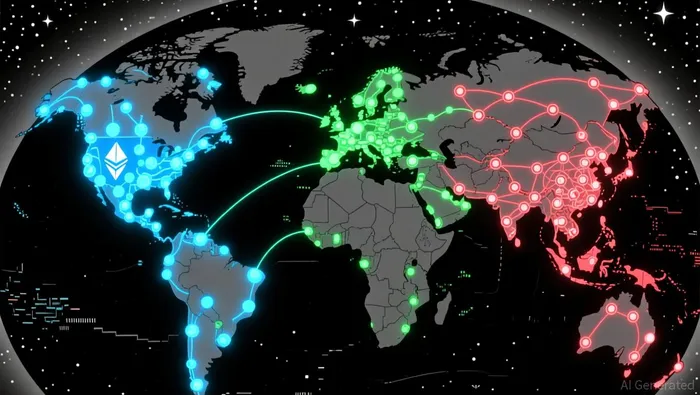
While Ethereum's decentralization metrics differ from BitTorrent's P2P file-sharing model, the two share a common goal: maximizing network resilience and accessibility. As of mid-2025, Ethereum operates approximately 6,300 nodes globally, with the U.S. accounting for 33.2% and the Asia-Pacific region showing growing participation. This geographic diversity, combined with a wide range of software clients, mitigates centralization risks and ensures robust node uptime (99.2–99.5%).
BitTorrent, by contrast, boasts 500 million nodes and 800 petabytes of storage capacity through its BTFS platform. While Ethereum does not manage static file distribution, its dynamic state management-critical for smart contracts and DeFi-requires a different kind of resilience. The Fusaka upgrade in December 2025 addressed Ethereum's "income paradox" by tying blob data costs to L1 gas fees, ensuring the base layer captures value while Layer 2 solutions scale transactions. This innovation mirrors BitTorrent's efficiency in distributing large files, but with the added complexity of maintaining a globally consistent ledger.
Economic Sustainability: From Transactions to Asset Security
Ethereum's value capture has evolved from a transaction-based model to one centered on asset security. In 2025, the network secured $6 billion in RWAs, including tokenized gold (PAXG) and real estate (BUIDL), while its RWA market cap approached $6 billion. This shift reflects Ethereum's repositioning as a secure settlement layer for high-value transactions, where its decentralization and cryptographic guarantees become critical.
The DeFi and NFT sectors further underscore this transition. DeFi has matured into a durable financial system, with perpetuals and solver-based liquidity systems driving institutional-grade infrastructure. NFTs, meanwhile, have moved beyond speculative hype to scalable use cases in luxury fashion and automotive industries, with brands like Louis Vuitton and Porsche leveraging Ethereum's platform. These developments highlight Ethereum's ability to integrate with traditional markets while maintaining its decentralized ethos.
The Future: A Macro Asset with Institutional Legitimacy
Ethereum's 2025 challenges-such as post-Dencun revenue erosion and identity crises-were mitigated by strategic upgrades and regulatory clarity. The Fusaka upgrade's "B2B tax model" and PeerDAS scalability solutions ensured Ethereum remains a viable settlement layer. Meanwhile, its transition to a macro asset-subject to the same cyclical forces as traditional markets-has been offset by institutional adoption and ETF structures that absorb sell pressure.
As Ethereum approaches securing $10 trillion in assets, its value capture becomes less about transactions per second and more about the scale of assets it protects. This aligns with Vitalik Buterin's vision of Ethereum as a "Linux-like trust model" combined with "BitTorrent-scale decentralization," enabling it to serve as a censorship-resistant platform for programmable logic and institutional finance.
Conclusion
Ethereum's unique position as a hybrid of Linux's institutional trust and BitTorrent's decentralized scale positions it as a durable long-term value capture engine. By addressing scalability, regulatory ambiguity, and revenue models through innovations like the Fusaka upgrade, Ethereum has solidified its role as the backbone of the digital economy. For investors, this evolution underscores Ethereum's potential to outperform traditional assets in a world increasingly reliant on decentralized infrastructure.





Comentarios
Aún no hay comentarios