
Ethereum's Low Gas Fees: A Double-Edged Sword for Traders and Network Sustainability
Short-Term Gains: Accessibility and Scalability for Users
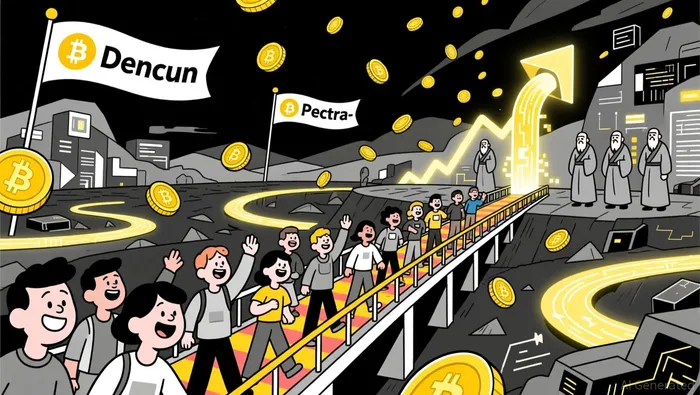
The Dencun upgrade's introduction of blobspace-a mechanism to store large data off-chain-has slashed L2 settlement costs by 95%, making Ethereum's ecosystem more scalable, according to Okx. This shift has spurred a surge in L2 adoption, with platforms like ArbitrumARB-- and Base now handling over 46 million monthly transactions, as reported by Coinlaw. For traders, the reduced fees have lowered barriers to entry, enabling high-frequency trading and microtransactions that were previously uneconomical. Additionally, the Pectra upgrade's doubling of blob capacity in May 2025 further amplified these benefits, cutting L2 fees by 50%, according to Coinotag.
Institutional investors have also capitalized on these conditions. Ethereum's price stabilization above $3,300, coupled with bullish RSI patterns and a $1.37 billion influx of institutional staking, signals growing confidence in the asset's long-term value, as detailed in Coinotag. These factors, combined with regulatory tailwinds like the 2025 Ethereum ETF approvals, have fueled projections of a 40% price rally to $4,811.71, as noted in the same Coinotag article.
Long-Term Risks: Revenue Decline and Validator Incentives
While low fees enhance user experience, they have precipitated a 99% drop in Ethereum's Layer 1 (L1) network revenue since the Dencun upgrade, according to Coinotag. This decline stems from a 30% reduction in mainnet gas usage as activity migrates to L2s, as noted in Coinlaw, coupled with a slowing ETH burn rate-a critical mechanism for reducing supply inflation-according to Coinmetrics. The economic implications are profound: validators, who secure the network, now earn lower rewards. The average annual staking yield in 2025 is projected at 3.9% to 5.1%, down from previous years, due to increased validator participation and EIP-7514 caps, as detailed in the UEEX validator report.
This revenue erosion raises concerns about network security. Validators' financial incentives are crucial for maintaining decentralization and resilience against attacks. The Pectra upgrade's consolidation of validators (allowing up to 2,048 ETH per validator) aims to mitigate decentralization risks, as noted in the UEEX validator report, but it also centralizes control among fewer entities. Meanwhile, the recent MEV exploit trial involving the Peraire-Bueno brothers underscores vulnerabilities in Ethereum's design, where profit-seeking behaviors could undermine network integrity, as reported in the Coinotag MEV trial report.
Balancing the Trade-Off: Innovation vs. Sustainability
Ethereum's ecosystem is navigating a delicate balance between innovation and sustainability. On one hand, the Pectra upgrade's expanded blob capacity and L2 adoption have positioned Ethereum as the dominant DeFi platform, with $70.6 billion in TVL and $1.021 billion in Q1 2025 DApp fee revenue, according to Okx. On the other, the shift to L2s has created a "revenue vacuum" on L1, threatening validator participation and long-term security.
The upcoming Pectra upgrade's potential to double blob capacity again could reignite demand for L1 data availability, but this remains speculative. For now, the network relies on institutional staking and macroeconomic tailwinds to offset declining validator yields. Bit Digital, Inc., for instance, reported 2.93% annualized staking rewards in October 2025, demonstrating that institutional participation remains robust, as detailed in the Morningstar report.
Conclusion: A Path Forward
Ethereum's post-Dencun ecosystem exemplifies the classic trade-off between short-term user benefits and long-term network sustainability. While low gas fees and L2 scalability have unlocked new opportunities for traders and developers, the decline in L1 revenue and validator incentives poses existential risks. Investors must weigh these factors carefully: Ethereum's bullish technical indicators and institutional adoption suggest resilience, but the network's economic model requires continuous adaptation to ensure security and decentralization.
As the blockchain landscape evolves, Ethereum's ability to innovate-whether through further upgrades, regulatory clarity, or novel revenue streams-will determine whether its low fees remain a blessing or a harbinger of deeper challenges.







Comentarios
Aún no hay comentarios