
Ethereum's Low Gas Fees as a Catalyst for Onchain Growth and Developer Innovation
The Technical Foundations of Ethereum's Fee Revolution
Ethereum's gas fee renaissance is rooted in two pivotal upgrades: Pectra (May 2025) and Dencun (March 2024). Pectra doubled the blob capacity for Layer 2 (L2) solutions, slashing transaction costs by 50%, while Dencun optimized data availability, further reducing fees, according to a Coinotag report. These upgrades have enabled Ethereum to process over 1.6 million daily transactions with minimal costs, a stark contrast to its pre-2024 struggles with congestion and high fees.
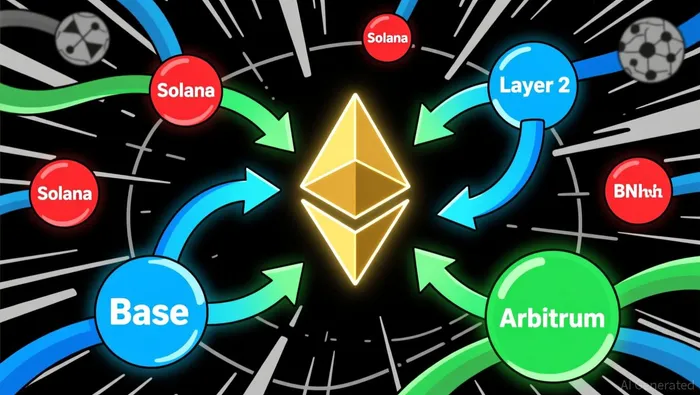
Layer 2 solutions like Base, ArbitrumARB--, and Optimism have become the backbone of this transformation. For instance, Base now generates $185,291 in daily revenue, driven by decentralized exchange (DEX) activity and priority fees, as noted in a Coinlaw analysis. Meanwhile, Arbitrum processes 3.56 million transactions monthly, with token swaps costing as little as $0.0031. These L2s have notNOT-- only reduced fees but also diversified Ethereum's revenue streams, with projects like LineaLINEA-- implementing deflationary mechanisms that burn 20% of gas fees as ETHETH--, as reported by Coinotag.
Developer Innovation and Ecosystem Growth
Low gas fees have unlocked a surge in developer activity. The Ethereum Foundation distributed $32.6 million in grants during Q1 2025-a 63% increase from Q4 2024, according to a SQ Magazine analysis. This funding has fueled the launch of over 1,000 new decentralized applications (dApps), including DeFi protocols, NFT marketplaces, and real-world asset (RWA) platforms. For example, UniswapUNI-- v4 on L2 reported a 300% growth in swap volume, while Ethereum's RWA sector now holds $12.2 billion in tokenized value, a 55% market share, according to a ZyCrypto report.
The network's accessibility has also attracted institutional players. Mantle, an Ethereum L2, partnered with Anchorage Digital to offer institutional-grade custody for $MNT tokens, as reported in a PR Newswire release. Similarly, Bitget integrated Morph Chain, an Ethereum L2, to expand its trading infrastructure, as noted in an Investor Empires article. These partnerships highlight Ethereum's growing appeal to traditional finance, bolstered by its security and regulatory clarity.
Competitive Positioning in a Multi-Chain World
While Ethereum's low fees are impressive, it faces stiff competition from blockchains like SolanaSOL-- and BNBBNB-- Chain. Solana's average fee of $0.00025 per transaction and BNB Chain's $0.05–$0.20 range challenge Ethereum's cost efficiency, according to a Medium article. However, Ethereum's dominance in total value locked (TVL) and stablecoin issuance remains unmatched. Over $84.9 billion in new stablecoins were issued on Ethereum in the past year, outpacing all other chains combined, according to a Coinotag report. This liquidity advantage, coupled with Ethereum's 55% share of the RWA tokenization market, according to a ZyCrypto report, underscores its role as the "de facto" infrastructure for global finance.
Critics argue that Ethereum's low fees threaten validator incentives and network security, as mainnet revenue dropped 99% post-Dencun, according to a Coinotag report. Yet, the rise of L2s has mitigated this risk by decentralizing transaction processing and creating new revenue streams. For instance, Lighter, an Ethereum L2, achieved 24,192 TPS in November 2025, demonstrating the network's scalability potential, according to a CryptoBasic article.
Challenges and the Road Ahead
Ethereum's long-term success hinges on addressing two key challenges: sustainability and competition. The Fusaka upgrade (November 2025) aims to enhance scalability further with EIPs like 7883 and 7825, as reported in a Medium article, but developers must ensure validator rewards remain attractive. Additionally, Ethereum must defend against chains like Hyperliquid and BNB Chain, which are gaining traction in derivatives trading and cross-chain payments, as noted in a CoinMarketCap article.
Despite these hurdles, Ethereum's ecosystem shows resilience. Whale activity, with figures like Machi and the Anti-CZ Whale accumulating $139 million in ETH positions, according to a Coinotag report, signals confidence in its future. Meanwhile, the VanEck Onchain Economy ETF (NODE) reflects growing institutional interest in Ethereum-related infrastructure, according to a StockTitan article.
Conclusion
Ethereum's low gas fees are not just a technical achievement-they are a catalyst for onchain growth, developer innovation, and institutional adoption. While competitors offer cheaper transactions, Ethereum's combination of security, liquidity, and continuous upgrades positions it as the cornerstone of the multi-chain future. For investors, the key takeaway is clear: Ethereum's ability to adapt and scale will determine its dominance in the years ahead.







Comentarios
Aún no hay comentarios