
Ethereum's Fusaka Upgrade and Its Potential to Catalyze a New Bullish Cycle
Technical Foundations: PeerDAS and Blob Data Expansion
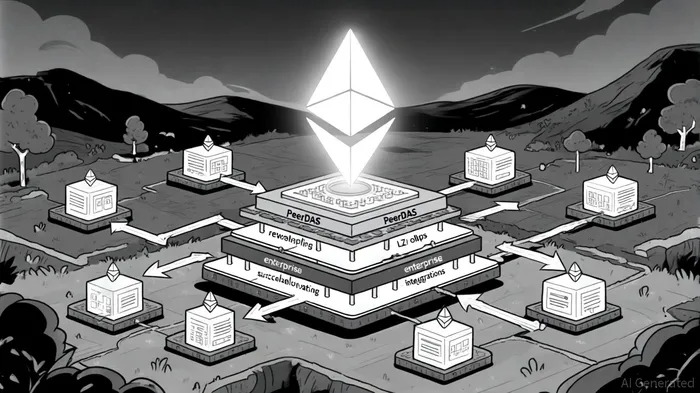
The Fusaka upgrade introduces PeerDAS (EIP-7594), a mechanism that allows validators to sample data availability without downloading full datasets. This reduces computational overhead while maintaining security, a critical step in scaling Ethereum's data layer, according to a Coinotag article. Complementing this is the block gas limit increase from 30 million to 150 million units, effectively doubling the capacity for blob data used in Layer 2 (L2) solutions, according to a Coinotag analysis. These changes are notNOT-- incremental but foundational: they enable EthereumETH-- to process up to 2.4 million daily settlements on L2 networks, with transaction costs potentially approaching zero.
The upgrade also includes EIP-7825 and EIP-7935, which optimize performance for parallel execution-processing multiple smart contracts simultaneously. This prepares Ethereum for a future where enterprise-grade applications can leverage the network's security without compromising speed, as previously reported. Crucially, these improvements align with the broader "Surge" roadmap, positioning Fusaka as a stepping stone toward full danksharding, which aims to expand network capacity by orders of magnitude, according to a Cryptopolitan report.
Institutional Adoption: A Tipping Point for Network Value
The Fusaka upgrade's scalability gains are already attracting institutional attention. U.S. spot Ethereum ETFs, approved in July 2025, have drawn $26.5 billion in inflows, surpassing Bitcoin's institutional adoption in Q3 for the first time, according to Bitget data. Corporate treasuries, led by BitMine Immersion Technologies, now hold $13.8 billion in ETH, reflecting a strategic shift toward Ethereum as a foundational asset, as Bitget also reports.
Enterprise partnerships are further solidifying Ethereum's institutional footprint. BlackRock's tokenized money-market fund and Visa's cross-border payment pilots highlight the network's versatility in real-world use cases, per the Bitget coverage. Meanwhile, 35.7 million ETH-valued at $138 billion-is currently staked, underscoring confidence in Ethereum's long-term utility, according to a Coinotag analysis. These metrics suggest that Fusaka's enhancements are not just technical but economic, creating a flywheel effect where scalability attracts capital, which in turn fuels further innovation.
Market Indicators and Analyst Projections
Despite current bearish sentiment, on-chain data tells a different story. The Market Value to Realized Value (MVRV) ratio reveals that staked ETH holders have stronger unrealized gains than circulating ETH, signaling long-term holder conviction, according to a Coinpedia analysis. Funding rates and short-position metrics also hint at a potential short squeeze, historically linked to major price bounces, as the Coinpedia piece notes.
Analysts are bullish on Ethereum's trajectory. A $5,600 price target for year-end 2025 is gaining traction, contingent on key support levels holding, per the Coinpedia projection. This aligns with broader trends: institutional holdings have grown by 145% since July 2025, with total assets under management reaching $26 billion, according to Coinotag data. As Layer 2 adoption accelerates and blob data throughput expands, Ethereum's deflationary supply dynamics-combined with staking yields-could drive sustained demand, as earlier Coinotag reporting suggests.
Conclusion: A High-Conviction Long-Term Play
The Fusaka upgrade represents more than a technical milestone; it is a catalyst for Ethereum's repositioning as a scalable, enterprise-ready blockchain. By reducing L2 costs, enhancing data availability, and attracting institutional capital, the upgrade addresses Ethereum's historical scalability limitations while aligning with macroeconomic trends. Investors who position for this next phase-despite near-term volatility-stand to benefit from a network that is not only technically robust but economically resilient.
As the December 3 activation date approaches, Ethereum's ecosystem is demonstrating the kind of innovation and adoption that could redefine its role in global finance. For long-term investors, the question is no longer if Ethereum can scale, but how quickly the market will price in its next phase of growth.







Comentarios
Aún no hay comentarios