
Ethereum's Fusaka Upgrade and PeerDAS Scaling Potential: A Catalyst for Institutional Adoption and Gas Economics
Ethereum's Fusaka Upgrade, scheduled for activation on December 3, 2025, marks a pivotal evolution in the blockchain's scalability roadmap. By introducing PeerDAS (Peer Data Availability Sampling) and increasing block gas limits, the upgrade aims to address long-standing bottlenecks in data availability and transaction throughput. These innovations are not merely technical refinements-they represent a strategic shift toward institutional-grade efficiency and cost predictability, positioning EthereumETH-- to compete with high-speed Layer 1 (L1) networks while retaining its decentralized ethos.
PeerDAS: Redefining Data Availability for Scalability
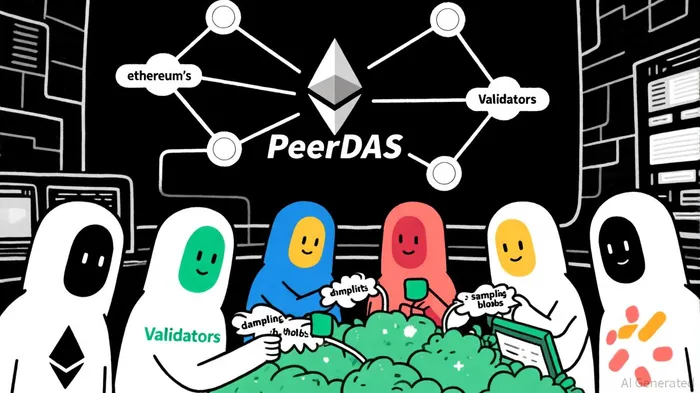
At the core of Fusaka is PeerDAS, a protocol that allows validators to verify data availability by sampling small portions of data blobs rather than downloading entire datasets. This approach drastically reduces bandwidth and storage requirements for nodes, enabling Ethereum to scale Layer 2 (L2) rollups without compromising decentralization. According to a report by Crypto.com, PeerDAS could increase data throughput by eightfold, lowering L2 transaction costs to as little as $0.01–$0.10 from the current $0.10–$1.00 range[4]. For institutions, this translates to a more cost-effective infrastructure for deploying decentralized applications (dApps) and tokenized assets.
The upgrade also introduces Blob Parameter Only (BPO) forks, which allow incremental increases in blob capacity without requiring full network upgrades. This flexibility ensures Ethereum can adapt to growing L2 demand while maintaining stability. As stated by CoinDesk, these changes are expected to reduce validator hardware costs by up to 30%, further lowering barriers to entry for institutional stakers[2].
Gas Economics: From Congestion to Predictability
Fusaka's impact on gas economics is equally transformative. The block gas limit will rise from 45 million to 60 million initially, with plans to scale up to 150 million in subsequent phases[5]. This expansion directly correlates with increased transaction throughput, reducing congestion during peak usage and stabilizing gas prices. For example, data from Gate.com suggests that the average gas fee during high-traffic periods could drop by 40–60% post-upgrade[3].
Additionally, EIP-7918 introduces a bounded base fee model for blob transactions, ensuring predictable pricing for developers and enterprises. This innovation aligns with institutional demands for cost transparency, particularly in sectors like DeFi and tokenized real-world assets (RWA). As noted by InsideCrypto, the combination of higher gas limits and PeerDAS will enable Ethereum to process 15,000–20,000 transactions per second (TPS), rivaling chains like SolanaSOL-- while preserving security[5].
Institutional Adoption: A New Era of Participation
The Fusaka Upgrade's efficiency gains are already attracting institutional interest. Major asset managers such as BlackRock and VanEck have increased their ETH exposure, citing the upgrade's potential to enhance Ethereum's cost structure and network performance[3]. According to The Economic Times, institutional staking activity has surged by 200% since late 2024, driven by EIP-7251, which raises the maximum effective validator balance from 32 ETH to 2,048 ETH, simplifying large-scale staking operations[3].
Moreover, the upgrade's focus on reducing validator costs aligns with institutional priorities for operational efficiency. As highlighted by CryptoRobotics.ai, PeerDAS and BPO forks could lower node participation barriers, enabling broader validator diversity and reinforcing Ethereum's long-term sustainability[4]. This democratization of staking is critical for attracting institutional capital, which often prioritizes risk mitigation and regulatory compliance.
Projected Outcomes and Investment Implications
The cumulative effect of Fusaka's innovations is a more scalable, cost-effective, and institutionally friendly Ethereum. Analysts project that these improvements could drive ETH's price above $5,000 in the near term, with potential to reach $10,000 by late 2025[3]. For investors, the upgrade represents a strategic inflection point: Ethereum is transitioning from a speculative asset to a foundational infrastructure layer for Web3, with institutional adoption metrics (e.g., ETF inflows, staking participation) serving as leading indicators of its success.
Conclusion
Ethereum's Fusaka Upgrade is more than a technical milestone-it is a catalyst for institutional adoption and a redefinition of gas economics. By leveraging PeerDAS, BPO forks, and gas limit expansions, the upgrade addresses scalability without sacrificing decentralization, creating a fertile ground for enterprise-grade use cases. As institutions increasingly view Ethereum as a viable backbone for digital assets and DeFi, the network's value proposition-and its token's utility-will only strengthen. For investors, the time to act is now: Fusaka is not just a technical upgrade; it is a harbinger of Ethereum's next phase of growth.






Comentarios
Aún no hay comentarios