
Ethereum's Fusaka Upgrade and the Layer 2 Shakeout: A Strategic Inflection Point for ETH and Rollup Investors
Ethereum's Fusaka Upgrade, activated on December 3, 2025, represents a seismic shift in the blockchain's evolution. By introducing PeerDAS (Peer Data Availability Sampling) and expanding blob capacity, the upgrade has redefined the economics of Ethereum's Layer 2 (L2) ecosystem, creating new value pools and reshaping investment opportunities. For investors, this is not just a technical milestone-it's a strategic inflection point where infrastructure innovation meets capital reallocation.
The Technical Catalyst: PeerDAS and Blob Capacity
At the heart of the Fusaka Upgrade is PeerDAS, a mechanism that allows Ethereum validators to verify data availability by sampling only 12.5% of blob data instead of downloading entire datasets. This reduces bandwidth and storage requirements by 80%, enabling Ethereum to process up to 24 blobs per block. Combined with a 40–60% reduction in L2 transaction fees, PeerDAS has unlocked a new era of scalability.
The upgrade also introduced EIP-7918, which sets a reserve price for blob fees, aligning L2 data costs with Ethereum's actual operational expenses. This ensures that every L2 transaction contributes to ETH burn, reinforcing Ethereum's deflationary narrative while stabilizing revenue for validators. As a result, Ethereum's Layer 1 (L1) gas limit was doubled to 60 million per block, allowing the network to handle 20–30% more transactions directly on the mainnet while offloading high-volume activity to L2s.
Layer 2 Consolidation: Winners and Losers
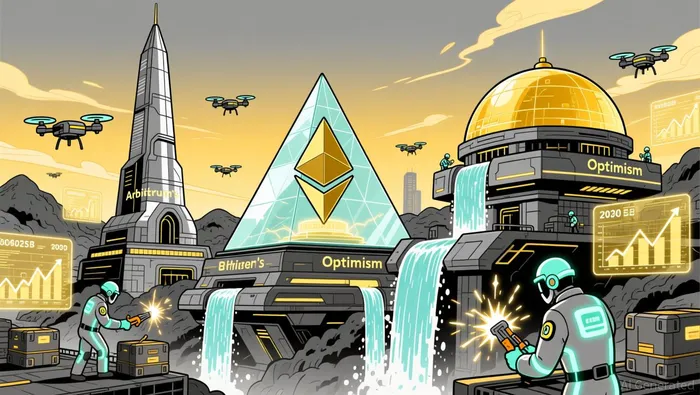
The Fusaka Upgrade has accelerated consolidation in the L2 market. Projects like Arbitrum, Base, and Optimism are leading the charge, leveraging reduced fees and increased throughput to capture market share. For instance, Base alone processes 8 million daily transactions, a testament to Ethereum's growing accessibility for retail users.
However, not all L2s are equal. The upgrade's economic incentives-such as blob fee reserve pricing-favor projects that optimize for data efficiency and user volume. Arbitrum has seen a 60% surge in transaction throughput since Fusaka's activation, while Optimism's focus on developer tooling has attracted a 35% increase in dApp deployments. Meanwhile, smaller or less-optimized L2s face pressure to innovate or risk obsolescence.
This consolidation is not just about user growth-it's about capital reallocation. Post-Fusaka, Ethereum's L2 ecosystem is projected to generate 76% of the network's revenue by 2030, creating a flywheel effect where increased L2 adoption directly benefits ETH holders through higher burn rates and fee capture.
Capital Inflows and the Road to $12,000+
The Fusaka Upgrade has already triggered a surge in capital inflows. Ethereum's price broke above $3,000 shortly after activation, driven by institutional confidence in the network's scalability and economic model. BlackRock's transfer of 44,000 ETH into Coinbase and the success of EthereumETH-- ETFs further underscore this trend.
For investors, the key insight is that Fusaka has positioned Ethereum as a cash-flowing infrastructure asset. By tying L2 activity to ETH demand, the upgrade ensures that growth in the L2 ecosystem translates into value accrual for the base layer. This dynamic is particularly compelling for rollup investors: projects that optimize for data efficiency and user adoption will see disproportionate returns as Ethereum's L2 market matures.
Why Now Is the Time to Act
The Fusaka Upgrade is not an endpoint but a catalyst. Upcoming upgrades like Glamsterdam (2026) will further decentralize block-building processes, while AI-driven dApps and institutional finance adoption will amplify demand for Ethereum's scalable infrastructure. For investors, the window to capitalize on this transition is narrowing.
Those who act now-by allocating to high-growth L2s, ETH itself, or infrastructure protocols-will benefit from Ethereum's next phase of growth. The question is no longer if Ethereum can scale, but how quickly capital will flow into its newly optimized ecosystem.





Comentarios
Aún no hay comentarios