
Ethereum's Fusaka Upgrade and Its Implications for Network Scalability and Investor Value
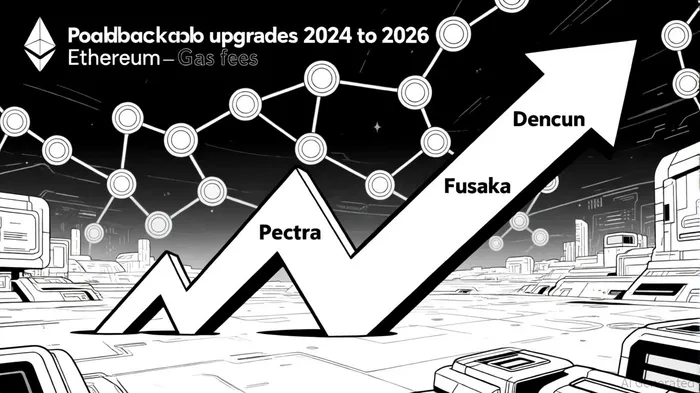
Ethereum's Fusaka Upgrade, scheduled for December 3, 2025, represents a pivotal step in the network's long-term vision to become a scalable, efficient, and resilient blockchain infrastructure. As the successor to the Dencun (March 2024) and Pectra (May 2025) upgrades, Fusaka introduces 11–12 EthereumETH-- Improvement Proposals (EIPs) aimed at optimizing data availability, transaction throughput, and node efficiency. For investors, the upgrade's success could redefine Ethereum's utility as a global settlement layer and layer-2 (L2) backbone, with potential implications for ETH's price action and market dominance.
Fusaka's Core Innovations: PeerDAS, Blob Scaling, and Gas Dynamics
The most transformative feature of Fusaka is EIP-7594 (PeerDAS), which introduces peer data availability sampling. This mechanism allows validator nodes to verify data availability by sampling subsets of data blobs rather than downloading entire datasets, reducing bandwidth and storage requirements by up to 80%. This innovation is critical for L2 rollups, enabling them to process transactions at scale without overburdening the network.
Complementing PeerDAS is a gas limit increase from 30 million to 150 million units, a 5x expansion that directly correlates with higher transaction throughput. By 2026, Ethereum's combined layer-1 and layer-2 networks could achieve 12,000 transactions per second (TPS), rivaling centralized payment systems. Additionally, Blob Parameter Only (BPO) forks will incrementally raise blob capacity from 6/9 to 14/21, doubling data availability for L2s without requiring full hard forks. These changes ensure Ethereum remains adaptable to growing demand while minimizing disruption for developers and users.
Security remains a priority, with a $2 million bug bounty program incentivizing researchers to identify vulnerabilities in the upgrade's code. This proactive approach underscores Ethereum's commitment to maintaining decentralization and resilience, two pillars that underpin its value proposition.
Historical Context: Past Upgrades and Market Reactions
To assess Fusaka's potential impact, it's instructive to examine Ethereum's recent upgrades. The Dencun upgrade (March 2024), which introduced EIP-4844 (Proto-Danksharding), slashed gas fees by 95% but coincided with a 53% drop in ETH's price. This divergence highlights a key challenge: infrastructure improvements alone may notNOT-- drive price appreciation if broader market sentiment is bearish or if competition from chains like SolanaSOL-- intensifies.
In contrast, the Pectra upgrade (May 2025)—which enhanced staking efficiency and introduced account abstraction—correlated with a 10% ETH price increase. Technical indicators like RSI and MACD suggested bullish momentum, though ETHETH-- faced resistance at $2,030. This suggests that when upgrades directly enhance user experience (e.g., lower fees, higher throughput) and align with favorable macro conditions, Ethereum's native token can outperform.
Investor Implications: Utility, Competition, and Long-Term Value
Fusaka's focus on scalability and efficiency positions Ethereum to better compete with layer-1 rivals like Solana and TronTRX--, which have leveraged low fees and high TPS to attract developers and users. By reducing L2 costs and enabling more complex use cases (e.g., real-time payments, DeFi composability), Fusaka could drive network adoption and increase ETH's utility as a settlement asset.
However, investors must also consider Ethereum's evolving economic model. The Dencun upgrade shifted ETH from a deflationary asset to one with 0.74% annual inflation, diluting its scarcity premium. Fusaka's gas dynamics and blob pricing mechanisms (e.g., EIP-7918) aim to stabilize transaction costs during congestion, but their success will depend on real-world adoption and market demand.
Price Action and Future Outlook
While Fusaka's technical merits are robust, its price impact will hinge on macroeconomic factors and market psychology. If the upgrade coincides with a broader crypto bull market (e.g., ETF approvals, macroeconomic easing), ETH could see a re-rating. Historical data suggests that Ethereum's price often consolidates post-upgrade before breaking out—Pectra's 10% rally followed a period of sideways movement.
Looking ahead, Fusaka sets the stage for the Glamsterdam upgrade (2026), which will further optimize consensus and execution layers. For now, investors should monitor key metrics:
- Gas fee trends on L2s like ArbitrumARB-- and Optimism.
- Validator participation in BPO forks.
- On-chain activity (e.g., dApp usage, blob transaction volume).
Conclusion
Ethereum's Fusaka Upgrade is a foundational step toward realizing the “Surge” roadmap, addressing scalability bottlenecks while preserving decentralization. For investors, the upgrade's success could translate into higher network utility, reduced fees, and increased adoption—factors that historically correlate with ETH's price performance. However, the token's value will ultimately depend on how well Ethereum executes its roadmap and navigates competition. As the December 3 activation date approaches, the market will likely price in Fusaka's potential, making it a critical event for both technical and financial observers.






Comentarios
Aún no hay comentarios