
Ethereum's Fusaka Upgrade and Its Implications for Mobile Crypto Adoption
The EthereumETH-- Fusaka Upgrade, set to activate on December 3, 2025, represents a pivotal step in the blockchain's journey toward mainstream adoption. By introducing innovations like PeerDAS, gas limit expansions, and biometric authentication support, the upgrade directly addresses scalability, cost efficiency, and user experience-three critical barriers to mass-market crypto adoption. For investors, this upgrade signals Ethereum's strategic alignment with mobile-first use cases, positioning it as a foundational infrastructure for Web3's next phase.
PeerDAS: Redefining Data Availability for Mobile Networks
At the core of Fusaka is PeerDAS (Peer Data Availability Sampling), a protocol that allows nodes to verify data availability by sampling portions of blobs rather than downloading entire datasets. This reduces bandwidth and storage requirements by up to 85% for validators, enabling Layer 2 (L2) networks to process tens of thousands of transactions per second according to Coingecko. For mobile users, this means lighter node operations and faster transaction confirmations, even on low-bandwidth connections. According to a report by Coingecko, PeerDAS could reduce L2 transaction fees by 40-60%, making Ethereum's ecosystem more accessible to casual users and developers.
Gas Limit Expansion and BPO Forks: Scaling for Global Demand
The upgrade also raises the default block gas limit from 36 million to 60 million units, allowing more transactions and complex smart contracts to be processed on Layer 1 (L1) according to CoinMetrics. This increase, combined with Blob Parameter Only (BPO) forks, provides a flexible framework for scaling blob capacity. BPO1 (December 9, 2025) and BPO2 (January 7, 2026) will incrementally raise per-block blob targets and maximums, ensuring Ethereum can adapt to surges in L2 usage without destabilizing the network according to Phemex. For mobile platforms, this translates to predictable transaction throughput and lower latency, critical for applications like decentralized finance (DeFi) and gaming.
Biometric Authentication: Bridging Web2 and Web3
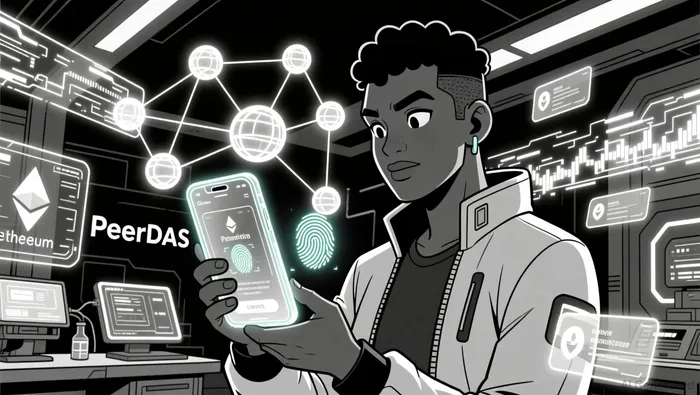
One of the most transformative features of Fusaka is EIP-7951, which introduces native support for the secp256r1 elliptic curve. This enables biometric authentication via hardware like Apple's Secure Enclave and Android's Keystore, aligning Ethereum with Web2 security standards according to Bankless. MetaMask and Trust Wallet are already integrating this feature, allowing users to sign transactions with Face ID or fingerprint sensors without compromising security according to Stakely. Trust Stamp, a digital identity firm, is leveraging EIP-7951 to develop the StableKey Wallet, a biometrically secured solution slated for 2026 according to Phemex. Such integrations eliminate the friction of seed phrase management, a key hurdle for non-technical users.
Pre-Confirmations and Deterministic Lookahead: Enhancing User Experience
Fusaka also introduces EIP-7917, which enables deterministic proposer lookahead. This allows future block proposers to be precomputed, supporting pre-confirmation mechanisms that reduce transaction uncertainty according to Dypto. For mobile apps, this means near-instant feedback for users-critical for time-sensitive interactions like in-game purchases or DeFi swaps. Additionally, EIP-7918 sets a reserve price for blob fees, preventing L2 costs from collapsing during low demand and ensuring economic sustainability according to IQ Wiki.
Wallet Integrations and Partnerships: A Mobile-Centric Future
The upgrade's focus on mobile adoption is further underscored by partnerships with major wallet providers. MetaMask has announced plans to integrate secp256r1-based biometric authentication, while Trust Wallet is optimizing its app for lower gas costs and faster sync times post-Fusaka according to Crypto Economy. These developments are not just technical upgrades but strategic moves to position Ethereum as the default blockchain for mobile-first applications. As stated by a Phemex analysis, "The Fusaka Upgrade's emphasis on light clients and biometric security directly addresses the pain points of mobile users, making Ethereum a more viable platform for global-scale apps."
Conclusion: A Catalyst for Mass Adoption
Ethereum's Fusaka Upgrade is more than a technical milestone-it is a blueprint for scaling blockchain to meet the demands of a mobile-centric world. By reducing costs, enhancing security, and improving user experience, the upgrade creates a flywheel effect: lower barriers to entry attract more users, which in turn drives network value. For investors, this signals Ethereum's continued dominance in the smart contract space and its ability to adapt to evolving market needs. As mobile adoption accelerates in 2026, the Fusaka Upgrade will likely serve as a cornerstone for Ethereum's next phase of growth.







Comentarios
Aún no hay comentarios