
Ethereum's Fusaka Upgrade: A Game-Changer for Layer-2 Scalability and ETH Value Capture
Technical Innovations: PeerDAS and Gas Limit Expansion
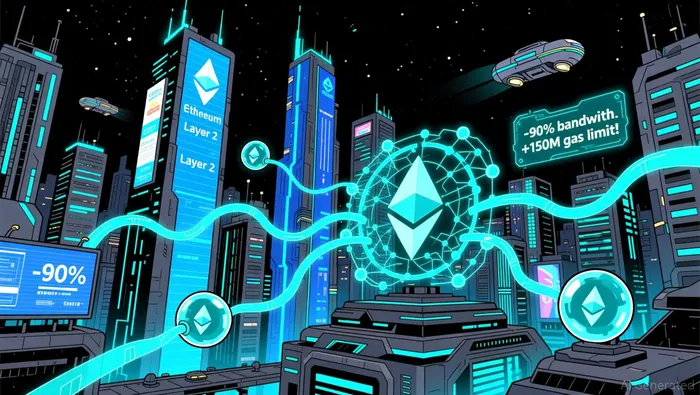
At the core of the Fusaka Upgrade is PeerDAS, a mechanism that allows validators to verify only portions of data (referred to as "blobs") from L2 transactions, rather than processing entire datasets. This reduces bandwidth requirements by up to 90% and slashes operational costs for validators, making the network more sustainable and accessible for smaller stakeholders, as CoinDesk reported. Coupled with a block gas limit increase from 30 million to 150 million, Ethereum's throughput capacity is set to double, enabling faster and cheaper transactions on L2 platforms like ArbitrumARB-- and OptimismOP--, as Coinotag noted.
These changes are critical for scaling Ethereum's ecosystem. For instance, fintech startups in Asia-where microtransactions and cross-border payments dominate-could see transaction costs drop by 60%, making Ethereum-based solutions more competitive against traditional financial systems, according to OneSafe. However, the upgrade also demands infrastructure upgrades, such as support for Verkle Trees, which could pose short-term challenges for smaller developers, as Cryptopolitan observed.
Economic Implications: From Scalability to Value Capture
The Fusaka Upgrade's impact extends beyond technical metrics. By reducing L2 costs, Ethereum is poised to attract institutional capital and enterprise adoption. For example, spot Ethereum ETFs have already seen $1.32 billion in inflows in 2025, driven by firms like BlackRock and Fidelity, as CryptoGlobe reported. Post-Fusaka, these inflows could accelerate as L2 networks become more viable for high-volume use cases like decentralized finance (DeFi) and tokenized assets.
Moreover, the upgrade aligns with Ethereum's strategy to become a global settlement layer. By preparing for danksharding-a future upgrade that will further expand data capacity-Ethereum is laying the groundwork for a network where ETH functions as both a utility token and a store of value, as Oak Research noted. This dual role enhances ETH's scarcity and utility, two key drivers of long-term value capture.
Infrastructure Investment Trends and Institutional Adoption
Infrastructure investment in Ethereum-related projects is already on an upward trajectory. For instance, Ethereum Treasury Companies-entities that hold and stake ETH for yield-have increased their holdings from 1.2 million ETH to 4.36 million ETH in Q3 2025 alone, representing 3.6% of total supply, according to Coinotag. These companies are leveraging Ethereum's staking rewards (3.5–5% annualized) to generate passive income, a trend that will likely intensify post-Fusaka as validator costs decline.
Institutional adoption is further bolstered by regulatory clarity. While Europe's MiCA framework introduces compliance hurdles, the U.S. and Asia are seeing rapid adoption of Ethereum-based solutions. For example, DeFi total value locked (TVL) has surged to $114.9 billion in Q3 2025, with over 45% of this TVL concentrated in liquid staking protocols, as Oak Research reported. This maturation of the DeFi ecosystem underscores Ethereum's role as a foundational infrastructure layer, attracting capital from both retail and institutional investors.
Risks and Mitigations
Despite the optimism, risks persist. Regulatory uncertainty, particularly in Europe, could delay L2 adoption for SMEs. Additionally, while PeerDAS reduces validator costs, it may also lower the barrier to entry for malicious actors, necessitating robust security measures. However, Ethereum's developer community has prioritized sustainability and resilience in the Fusaka Upgrade, with nearly a dozen EIPs addressing these concerns, as Coin-Turk reported.
Conclusion: A Compelling Investment Thesis
The Fusaka Upgrade is more than a technical milestone-it's a strategic inflection point for Ethereum's value proposition. By enhancing scalability, reducing costs, and preparing for future upgrades, Ethereum is solidifying its position as the leading blockchain for decentralized infrastructure. For investors, this translates to a compelling long-term thesis: as L2 networks scale and institutional capital flows into Ethereum-based solutions, ETH's value capture potential will only grow.
With the upgrade just weeks away, now is the time to position for Ethereum's next phase of growth.







Comentarios
Aún no hay comentarios