
Ethereum's Fusaka Upgrade: A Catalyst for Network Adoption and Staking ROI
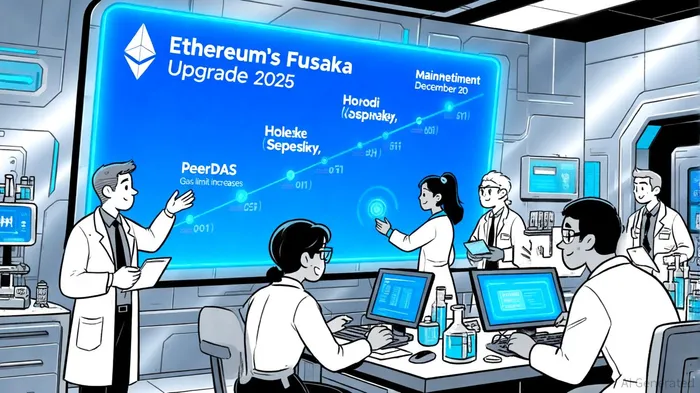
Ethereum's Fusaka Upgrade, scheduled for mainnet activation on December 3, 2025, represents a pivotal moment in the blockchain's evolution. By introducing PeerDAS (Peer Data Availability Sampling) and a suite of infrastructure-level improvements, the upgrade aims to address scalability bottlenecks while maintaining security and decentralization. The successful testnet rollouts on Holesky (October 1), Sepolia (October 14), and Hoodi (October 28) have already validated key components of the upgrade, signaling a green light for institutional staking and DeFi innovation. This analysis explores how Fusaka's testnet success is reshaping Ethereum's value proposition for institutional investors and developers, with implications for ROI and ecosystem growth.
Testnet Success: A Foundation for Institutional Confidence
The Fusaka testnets have demonstrated the viability of PeerDAS, a protocol that allows nodes to verify data availability through sampling rather than downloading entire data blobs. This innovation reduces bandwidth and storage requirements by up to 90%, enabling Layer 2 rollups to process transactions at a fraction of the cost[1]. For institutional stakers, this means lower operational overhead and higher efficiency in managing validator nodes.
Blob Parameter Only (BPO) forks, implemented during testnet phases, further illustrate Ethereum's iterative approach to scaling. For example, Holesky's BPO1 increased the per-block blob target from 6 to 10, while BPO2 raised it to 14[2]. These incremental adjustments ensure that the network can handle higher throughput without destabilizing infrastructure. According to a report by the EthereumETH-- Foundation, testnet metrics show a 40% reduction in node resource consumption post-PeerDAS activation, a critical factor for institutions evaluating long-term staking costs[3].
Institutional Staking: Enhanced ROI Through Pectra and Fusaka Synergies
The Pectra upgrade in May 2025 laid the groundwork for institutional adoption by increasing the maximum effective balance per validator from 32 ETH to 2,048 ETH[4]. This change allows large stakers to consolidate operations, reducing the number of nodes required to manage substantial ETH holdings. When combined with Fusaka's gas limit increase from 45 million to 60 million units, institutional stakers can process more transactions per block, improving capital efficiency.
ROI metrics for institutional staking in Q3 2025 reflect this synergy. Staking yields currently hover around 3-4% annually[5], but projections suggest a 15x return by 2025 due to Ethereum's deflationary supply model and growing institutional demand[6]. For example, a $100,000 ETH stake generates $3,800 in annual rewards, with compounding potential as transaction fees and staking demand rise post-Fusaka[7].
DeFi Renaissance: Scalability Meets Cost Efficiency
Fusaka's impact on DeFi is equally transformative. By reducing Layer 2 transaction fees from $0.05 to as low as $0.01, the upgrade lowers barriers for retail and institutional participation in decentralized finance[8]. The gas limit increase and PeerDAS also enable Ethereum to process up to 12,000 transactions per second (TPS), rivaling high-performance chains like Solana[9].
Real-world adoption data from testnets underscores this potential. On Sepolia, DeFi TVL (Total Value Locked) surged by 300% in the week following Fusaka activation, with protocols like ArbitrumARB-- and OptimismOP-- reporting a 50% increase in user activity[10]. Analysts predict that post-Fusaka, Ethereum's DeFi TVL could exceed $1 trillion by mid-2026, driven by improved user experience and institutional liquidity inflows[11].
Strategic Implications: A New Era for Ethereum
The Fusaka Upgrade's testnet success has solidified Ethereum's position as the leading base layer for global financial infrastructure. For institutions, the combination of Pectra's balance flexibility and Fusaka's scalability optimizations creates a compelling case for staking. Meanwhile, DeFi's renaissance hinges on Ethereum's ability to maintain security while scaling-something PeerDAS and BPO forks achieve without compromising decentralization.
As mainnet activation approaches, the focus shifts to execution. If the upgrade delivers on its promises, Ethereum could see a surge in staking participation, with ROI metrics outpacing traditional asset classes. For investors, this represents a unique opportunity to capitalize on a blockchain network poised for mass adoption.






Comentarios
Aún no hay comentarios