
Ethereum's Fusaka Upgrade: A Catalyst for Mainstream Adoption and Institutional Investment
The EthereumETH-- Fusaka Upgrade, set to activate on December 3, 2025, represents a pivotal milestone in the blockchain's evolution. By addressing critical scalability bottlenecks and reducing transaction costs, this upgrade is poised to catalyze mainstream adoption and attract institutional capital. For investors, the implications are profound: a network capable of processing 100,000+ transactions per second according to analysis while slashing Layer 2 fees by up to 95% as reported is not just a technical achievement-it is a macroeconomic game-changer.
Blockchain Scalability Breakthroughs: PeerDAS and Beyond
At the heart of the Fusaka Upgrade is Peer Data Availability Sampling (PeerDAS), a protocol innovation that redefines how Ethereum verifies data. Traditionally, nodes required full downloads of data blobs-temporary storage units used by Layer 2 rollups-to ensure integrity. Fusaka replaces this with a probabilistic sampling approach, allowing nodes to verify only small, randomly selected portions of each blob according to technical documentation. This reduces bandwidth and storage demands by approximately 85% as detailed, enabling Ethereum to handle an eightfold increase in blob throughput as predicted.
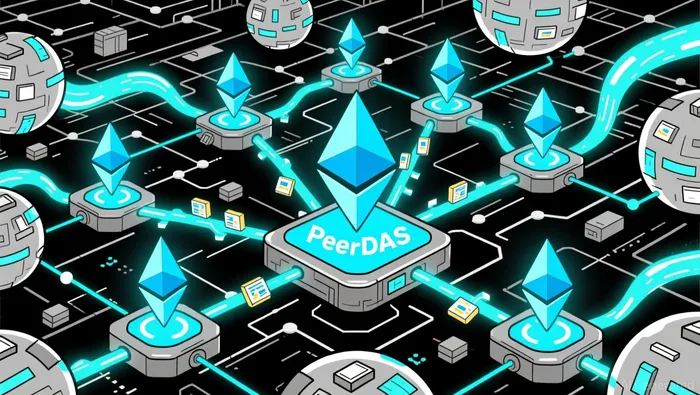
The impact on Layer 2 ecosystems is transformative. Rollups like ArbitrumARB--, Optimism, and Base can now process transactions at 40-60% lower costs according to market analysis, with the potential to scale to 100,000+ transactions per second as forecasted. This leap in efficiency is not merely theoretical-it is a structural shift that aligns Ethereum's infrastructure with the demands of global financial systems. As stated by the Ethereum Foundation, "PeerDAS ensures that data availability remains decentralized while enabling unprecedented scalability" according to official statements.
Complementing PeerDAS are gas limit increases and execution-layer optimizations. The block gas limit has been raised from 36 million to 60 million units as documented, supported by EIPs like EIP-7825 (transaction gas limit cap) and EIP-7883 (adjusted ModExp gas costs). These changes prevent resource abuse while accommodating more transactions per block. Additionally, the introduction of the CLZ opcode (EIP-7939) and secp256r1 curve support (EIP-7951) enhances smart contract efficiency and enables biometric authentication for wallets as described, further broadening Ethereum's appeal to enterprise and retail users.
Macroeconomic Impact: From Transaction Costs to Institutional Inflows
The Fusaka Upgrade's technical advancements translate directly into macroeconomic benefits. By reducing Layer 2 fees, Ethereum becomes a more viable platform for real-world asset tokenization, DeFi protocols, and institutional-grade applications. Data from Fidelity Digital Assets indicates that the upgrade could drive a 60–95% reduction in Layer 2 transaction costs according to research, making Ethereum-based services competitive with traditional financial infrastructure.
This cost reduction is already attracting institutional capital. In the week leading up to the upgrade, major firms like Goldman Sachs, Millennium Management, and Jane Street added $680 million in Ethereum holdings as reported, signaling confidence in post-upgrade performance. While ETF outflows reached $79 million according to market data, strong accumulation by institutional players has offset downward pressure, with Ethereum trading around $2,800–$3,000 as of early November 2025 according to financial reports. Analysts at Phemex predict that the upgrade could push ETH prices toward $3,500 in the short term and $7,000–$12,000+ by mid-2026, contingent on sustained Layer 2 adoption as projected.
The upgrade also introduces EIP-7918, a blob fee reserve mechanism that stabilizes pricing by aligning blob gas fees with processing costs according to technical analysis. This innovation prevents extreme price swings, ensuring predictable costs for users and developers. As a result, Ethereum's fee revenue model becomes more sustainable, directing value accrual to ETH holders rather than Layer 2 networks as observed. This shift strengthens the token's economic fundamentals, a critical factor for institutional investors prioritizing long-term value.
Institutional Investment Trends and Future Outlook
The Fusaka Upgrade is not an isolated event but part of Ethereum's broader scaling roadmap. Follow-up upgrades like Blob Parameter Only (BPO) forks will incrementally increase blob capacity, with BPO1 (December 9, 2025) and BPO2 (January 7, 2026) raising blob targets to 14 per block according to official announcements. These phased adjustments allow the network to scale safely while monitoring performance.
Looking ahead, the Glamsterdam upgrade is expected to build on Fusaka's foundation, further reducing Layer 2 fees and accelerating block confirmation times as forecasted. This trajectory positions Ethereum as a primary infrastructure layer for global finance, with institutional adoption likely to accelerate in 2026. On-chain data already shows declining exchange reserves and rising institutional ownership as reported, suggesting a shift from speculative trading to strategic accumulation.
For investors, the key takeaway is clear: Ethereum's technical progress is creating a flywheel effect. Scalability breakthroughs reduce costs, attract users and developers, and drive demand for ETH. As institutional capital flows into this ecosystem, the network's value proposition becomes increasingly compelling.
Conclusion
The Fusaka Upgrade is more than a technical milestone-it is a catalyst for Ethereum's transition into a mainstream financial infrastructure. By solving scalability challenges and reducing costs, it unlocks new use cases for institutions and developers alike. For investors, the upgrade represents a rare convergence of technological innovation and macroeconomic tailwinds. As Ethereum continues to evolve, the question is no longer if it will achieve mass adoption, but how quickly institutions will capitalize on its potential.






Comentarios
Aún no hay comentarios