
Ethereum's Fusaka Upgrade: A Catalyst for Institutional Adoption and Scalability-Driven Growth
Ethereum's Fusaka Upgrade, activated on December 3, 2025, represents a pivotal milestone in the blockchain's evolution toward scalable, institutional-grade infrastructure. By introducing innovations like PeerDAS (Peer Data Availability Sampling) and Blob Parameter Only (BPO) forks, the upgrade addresses critical bottlenecks in data availability and transaction throughput. These advancements, coupled with institutional-friendly features such as native secp256r1 support, position EthereumETH-- to attract deeper capital inflows from traditional finance while enabling Layer 2 rollups to process transactions at unprecedented speeds. For investors, this marks a strategic inflection point in Ethereum's journey to becoming a foundational asset in the global financial system.
Technical Innovations: Scaling Without Compromise
The Fusaka Upgrade's most transformative feature is PeerDAS, which allows validators to sample small portions of data rather than downloading entire blobs. This reduces bandwidth and storage requirements by approximately 80%, enabling the network to scale blob throughput by eightfold without increasing hardware demands. 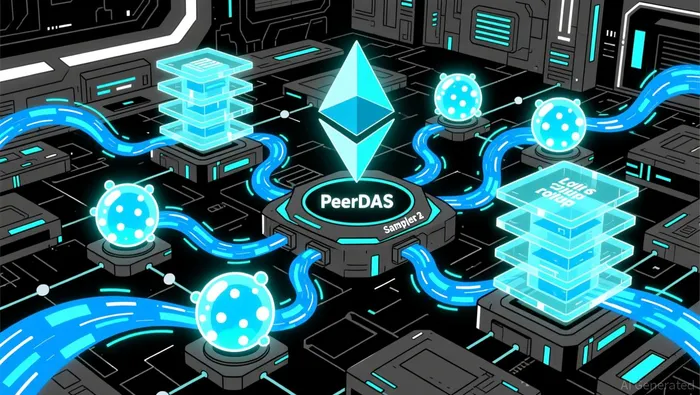 This innovation directly benefits Layer 2 solutions like ArbitrumARB-- and Optimism, which now process up to 100,000+ transactions per second while slashing costs by 40-60%.
Complementing PeerDAS, BPO forks allow incremental adjustments to blob capacity without requiring full network hard forks. This flexibility ensures Ethereum can adapt to growing demand while maintaining decentralization. The block gas limit was also increased from 36 million to 60 million, enabling more transactions to be processed directly on the mainnet. These changes collectively enhance Ethereum's throughput and efficiency, addressing long-standing criticisms about its scalability.
Institutional Adoption: Bridging the Gap to Mainstream Finance
The Fusaka Upgrade introduces native support for the secp256r1 cryptographic standard, a critical enabler for institutions seeking to integrate Ethereum into existing compliance frameworks. This feature allows users to validate transactions via biometric tools like Apple's FaceID and TouchID, removing a major barrier to adoption for enterprises.
Data from industry reports indicates that 43% of circulating ETHETH-- is already held by major institutions, including Goldman Sachs and Jane Street. The upgrade's focus on reducing transaction costs-projected to decline by 60-90% by January 2026-further incentivizes institutional participation, particularly in use cases like DeFi microtransactions and gamified ecosystems. Analysts at MEXC note that these developments align with Ethereum's broader strategy to become a "financial infrastructure layer," attracting capital from traditional markets.
Scalability Metrics: A Foundation for Long-Term Growth
Post-Fusaka, Ethereum's scalability metrics have shown immediate and measurable improvements. The network's theoretical TPS capacity now exceeds 100,000, with Layer 2 rollups benefiting from reduced settlement costs and faster finality. Additionally, the gas limit increase to 60 million has already enabled a 30% rise in on-chain transaction volume, according to CoinMetrics.
Planned BPO forks in December and January 2026 will further expand data availability, ensuring Ethereum can sustain growth without compromising security or decentralization. These incremental upgrades contrast with the disruptive hard forks of the past, offering a more sustainable path for long-term investors.
Investment Implications: A Strategic Buy for the Future
For investors, the Fusaka Upgrade underscores Ethereum's transition from a speculative asset to a utility-driven infrastructure protocol. The combination of institutional adoption, cost reductions, and throughput improvements creates a flywheel effect: higher usage drives network value, which in turn attracts more capital.
Price targets reflect this optimism. With ETH surging above $3,000 post-upgrade, analysts project a potential $5,000 threshold by mid-2026, driven by increased institutional engagement and Layer 2 efficiency gains. Moreover, the upgrade's focus on economic coherence-aligning blob fees with processing costs via EIP-7918-ensures ETH's value accrual remains robust in a high-throughput environment.
Conclusion: A Cornerstone of the Crypto Ecosystem
Ethereum's Fusaka Upgrade is more than a technical milestone-it is a strategic repositioning for institutional adoption and sustained scalability. By reducing operational costs, enhancing security, and enabling seamless integration with traditional finance tools, the upgrade lays the groundwork for Ethereum to dominate the next phase of blockchain innovation. For investors, this represents a rare opportunity to capitalize on a protocol that is not only solving its own limitations but also reshaping the global financial landscape.






Comentarios
Aún no hay comentarios