
Ethereum's Fusaka and BPO-1 Upgrades: A Catalyst for Layer 2 Growth and Fee Efficiency
Ethereum's Fusaka and BPO-1 upgrades, activated in late 2025, represent a seismic shift in the blockchain's scaling trajectory. These upgrades are not merely technical optimizations-they are foundational pillars for Ethereum's transition into a high-throughput, economically sustainable platform. For investors, the implications are profound: a reinvigorated Layer 2 (L2) ecosystem, deflationary fee dynamics, and a competitive edge over rivals like SolanaSOL-- and BitcoinBTC--. Let's dissect the investment case.
Technical Innovations: PeerDAS, BPO-1, and the New Fee Market
At the core of the Fusaka upgrade is PeerDAS (EIP-7594), a data availability sampling mechanism that reduces bandwidth and storage requirements by up to 90%. By allowing nodes to verify only fragments of blob data, PeerDAS enables EthereumETH-- to process up to 8× more data than before. This directly translates to L2 scalability: rollups like ArbitrumARB--, OptimismOP--, and Base can now handle tens of thousands of transactions per second at sub-cent costs.
Complementing this is the Blob Parameter Only (BPO) forks (EIP-7892), which allow incremental increases in blob capacity without full network hard forks. Planned updates in early 2026 will boost blob capacity from 12 to 21 per block, ensuring Ethereum adapts to surging L2 demand. Meanwhile, EIP-7918 introduces a reserve price for blob fees, stabilizing the fee market and aligning L2 usage with Ethereum's execution costs. This creates a flywheel: higher L2 adoption → more blob throughput → sustainable fee revenue for ETHETH-- holders.
L2 Growth Metrics: Volume, Users, and Cost Reductions
Post-Fusaka, Ethereum's L2 ecosystem has seen explosive growth. Daily transaction volumes on Arbitrum, Optimism, and Base now exceed 506 million transactions, with L2s accounting for 58.5% of all Ethereum activity. Transaction fees have plummeted by 40–95%, with some rollups offering sub-$0.02 per transaction. This cost parity with Solana's $0.001 fees has driven user migration, particularly in DeFi and real-world asset (RWA) tokenization(https://coinmetrics.substack.com/p/state-of-the-network-issue-336).
User growth metrics are equally compelling. By Q4 2026, L2 networks are projected to surpass 1.8 million daily active users, driven by institutional adoption of RWA platforms and retail-friendly apps. For example, Arbitrum's TVL (Total Value Locked) surged 300% post-Fusaka, while Optimism's user base expanded by 200% year-over-year. These trends underscore Ethereum's ability to scale without compromising decentralization-a critical differentiator in a crowded blockchain market.
Economic Implications: Value Accrual and Deflationary Dynamics
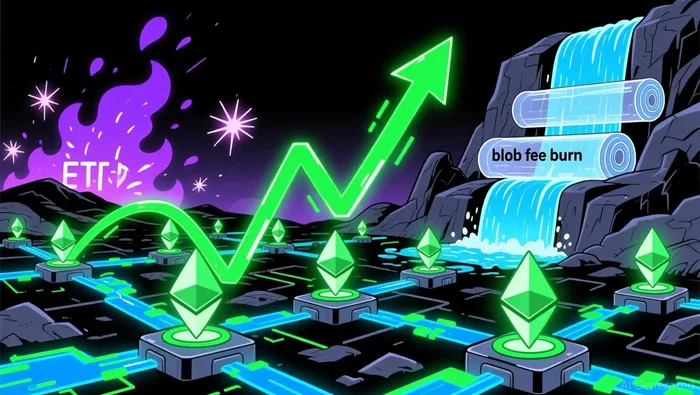
The Fusaka upgrade's economic design is a masterstroke for ETH holders. By tying blob fees to L1 gas costs via EIP-7918, Ethereum creates a self-sustaining fee market that prevents underpricing during low-demand periods. This ensures that L2 growth directly translates to fee revenue, with blob burns under EIP-1559 creating deflationary pressure. Analysts estimate that if L2 adoption continues at current rates, Ethereum's annual fee burn could exceed $10 billion by 2026, dwarfing Bitcoin's halving-driven scarcity model.
Moreover, the upgrade's 60 million gas limit increase (from 45 million) enhances L1 throughput, supporting complex smart contracts and reducing congestion. This dual-layer approach-scaling L1 for execution and L2 for throughput-positions Ethereum as a hybrid platform, capturing value from both on-chain and off-chain activity.
Comparative Analysis: Ethereum vs. Solana and Bitcoin
While Solana's native high-throughput architecture offers blistering speed and low fees, its centralized validator model and lack of L2 infrastructure pose long-term risks. Ethereum's L2-centric strategy, by contrast, maintains decentralization while achieving similar scalability. For instance, Ethereum's post-Fusaka L2s now rival Solana's 65,000 TPS with 100,000+ TPS, but with the security of a decentralized base layer.
Bitcoin, meanwhile, remains a store of value with limited scalability. Its Layer 2 solutions (e.g., Lightning Network) handle only 1% of on-chain volume, far behind Ethereum's L2 dominance. As institutional demand for programmable money grows, Ethereum's fusion of security, scalability, and economic incentives gives it a clear edge.
Investment Outlook: Price Targets and Adoption Trajectories
The Fusaka upgrade has already triggered a "dip-then-rip" pattern in ETH's price action, a historical trend post-major upgrades. Analysts at Fidelity Digital Assets and Phemex project ETH could reach $7,000–$12,000 by late 2026, contingent on L2 adoption and macroeconomic conditions. If RWA tokenization and institutional ETF inflows accelerate, the upper bound could extend to $14,000, driven by fee revenue and deflationary dynamics(https://247wallst.com/investing/2025/11/26/ethereum-vs-solana-2026-which-blockchain-will-deliver-better-returns/).
For investors, the key metrics to monitor are:
1. L2 transaction volumes (targeting 100,000 TPS by mid-2026).
2. Blob fee stability (ensuring EIP-7918's reserve price prevents underpricing).
3. Institutional adoption (ETF inflows and RWA platform growth).
Conclusion: A New Era for Ethereum
The Fusaka and BPO-1 upgrades are not just technical milestones-they are catalysts for Ethereum's next phase of growth. By enabling L2 scalability, stabilizing fee markets, and aligning value accrual with network usage, Ethereum has positioned itself as the go-to infrastructure for Web3. For investors, this translates to a compelling long-term thesis: a blockchain that scales without sacrificing decentralization, and a token (ETH) that captures value from both on-chain and off-chain activity. As the 2026 roadmap unfolds, Ethereum's dominance in the scaling race is no longer a question-it's a certainty.






Comentarios
Aún no hay comentarios