
Ethereum's Exit Queue Surge and Institutional Staking Dynamics: A Balancing Act for Price Stability and Investor Confidence
Ethereum's Exit Queue Surge and Institutional Staking Dynamics: A Balancing Act for Price Stability and Investor Confidence
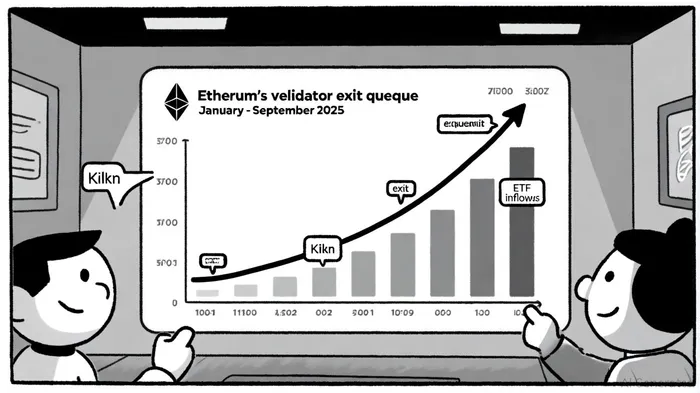
Ethereum's validator exit queue has surged to record levels in Q3 2025, with over 2.6 million ETH-valued at approximately $12 billion-waiting to unstake, according to a Coindesk report. This backlog has pushed exit wait times to 44 days, the longest in Ethereum's staking history, and was initially triggered by infrastructure provider Kiln's precautionary exit of 1.6 million ETHETH-- following recent security breaches. The surge also reflects broader market dynamics: a 160% price rally for ETH since April 2025 and a shift toward liquid staking solutions like stETH and rETH, according to a Migalabs analysis.
The Dual Forces of Exit and Activation Queues
Ethereum's proof-of-stake design enforces a churn limit of 256 ETH per epoch (about 57,600 ETH per day), ensuring orderly processing of validator exits and entries, Figment notes. However, the current exit queue congestion-combined with a 13-day activation backlog for new validators-has created a dual-side bottleneck. If 75% of the exiting ETH is redeposited as new validators, the activation queue could extend to 35 days. This dynamic underscores Ethereum's institutionalization: while exits signal profit-taking and risk mitigation, activation demand reflects renewed confidence in staking yields, now averaging 4.8% annualized, Bitget reports.
Institutional Staking: A Stabilizing Force Amid Volatility
Institutional participation has emerged as a critical counterweight to exit-driven sell pressure. EthereumETH-- ETFs attracted $33 billion in inflows during Q3 2025, contrasting with Bitcoin's outflows. These inflows, coupled with corporate treasuries staking 1.5 million ETH ($6.6 billion) and strategic reserves absorbing 116% more ETH since July, have reduced circulating supply and created artificial scarcity. As [FinancialContent] (https://www.financialcontent.com/article/marketminute-2025-9-9-ethereum-staking-explodes-in-2025-institutional-inflows-and-whale-activity-drive-supply-squeeze) notes, this trend has elevated Ethereum's role as a hybrid asset-both a growth vehicle and an income-generating instrument.
Liquid staking protocols like Lido and Rocket PoolRPL-- now manage $50 billion in staked ETH, accounting for 31.1% of the total staked supply. This shift has allowed institutional investors to maintain liquidity while earning yields, mitigating the risk of large-scale sell-offs. For example, Grayscale's Ethereum ETFs began staking ETH in Q3 2025, though liquidity constraints limited staking to a fraction of holdings due to 40-day withdrawal queues.
Risks and Resilience in a Maturing Ecosystem
Despite these stabilizing forces, systemic risks persist. The July 2025 AaveAAVE-- liquidity shock-triggered by a $518 million ETH withdrawal-highlighted vulnerabilities in leveraged liquid staking strategies, causing a temporary depeg of Lido's stETH token. Analysts warn that high-leverage trading and institutional restaking could amplify cascading liquidation risks. However, Ethereum's institutional adoption has also reinforced its resilience. Treasury holdings surged to $11.32 billion in Q3 2025, while 22% of Ethereum's supply is now controlled by whales, signaling deepened market participation.
Price Stability and Investor Confidence: A Delicate Equilibrium
Ethereum's price has remained resilient, trading near $4,239 despite the exit queue surge. This stability is partly attributable to the interplay between exit pressures and institutional demand. The activation queue's growth-exceeding the exit queue for the first time since July 2025-demonstrates confidence in Ethereum's staking model, particularly with anticipated ETF approvals and regulatory clarity. Meanwhile, the Dencun and Pectra upgrades have optimized validator efficiency and reduced layer-2 costs, further enhancing Ethereum's appeal.
Conclusion: Navigating Growth and Governance
Ethereum's exit queue surge and institutional staking dynamics illustrate a maturing network grappling with the complexities of scale. While exit congestion raises short-term concerns about sell pressure, the parallel surge in activation demand and institutional inflows suggests a long-term equilibrium is forming. Investors must weigh the risks of systemic fragility against Ethereum's structural advantages-its deflationary model, yield potential, and institutional adoption-as the ecosystem evolves. For now, the network's design appears to balance stability and innovation, positioning Ethereum as a cornerstone of the digital economy.






Comentarios
Aún no hay comentarios