
Ethereum's Evolution into the World Computer: A Decade of Innovation and Future Resilience
Ethereum's journey over the past decade has been nothing short of revolutionary. From its inception as a programmable blockchain to its transformation into a sustainable, scalable, and quantum-resistant infrastructure, EthereumETH-- has cemented itself as the backbone of the next-generation digital economy. For long-term investors, understanding Ethereum's evolution is critical to grasping its enduring value proposition and its role in shaping the future of decentralized systems.
Sustainability: The Merge's Environmental Revolution
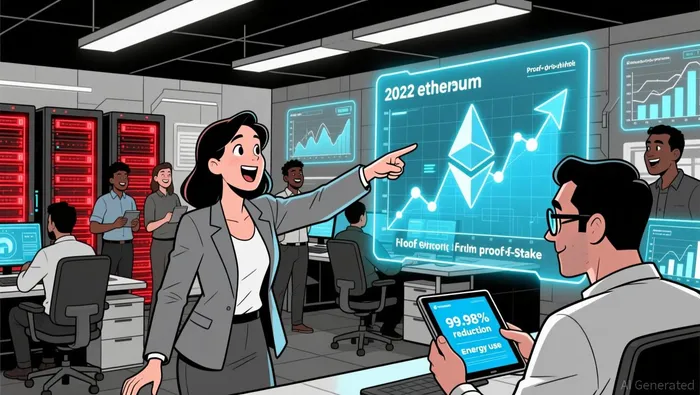
Ethereum's transition to a proof-of-stake (PoS) consensus mechanism in 2022 marked a pivotal shift in its environmental footprint. By 2025, the network's annual energy consumption had plummeted to 0.0026–0.01 TWh/year, a 99.95% reduction compared to its proof-of-work (PoW) era. This translates to a per-transaction energy usage of just 0.03 kWh, a stark contrast to 84,000 kWh per transaction under PoW. The Cambridge Centre for Alternative Finance reports that Ethereum's carbon emissions now stand at 2.8 kilotonnes of CO₂e annually, down from millions of tonnes under PoW-a 99.97% reduction.
This sustainability leap has not only aligned Ethereum with global ESG (Environmental, Social, and Governance) standards but also made it one of the most energy-efficient blockchains, consuming energy equivalent to a small neighborhood. Moreover, 48% of Ethereum's energy now comes from renewables, further solidifying its green credentials. For investors, this positions Ethereum as a responsible infrastructure asset in an era where environmental impact is a key consideration.
Scalability: Layer 2 Solutions and the Dencun Upgrade
Ethereum's scalability challenges have long been a focus of innovation. In 2025, Layer 2 (L2) solutions like ZKsyncZK-- and OptimismOP-- have become central to the network's growth. Zero-knowledge rollups, which bundle multiple transactions into a single proof, have reduced gas fees and increased throughput. For instance, Ethereum's daily transaction volume hit 2.2 million in Q3 2025, with average fees dropping to $0.17.
The Dencun upgrade (Cancun + Deneb) in late 2024 further optimized scalability by improving data compression and reducing L2 costs. These advancements have enabled Ethereum to support a thriving DeFi ecosystem, with $166 billion in TVL as of mid-2025-60% of the total DeFi market. Protocols like Lido, which alone holds $41 billion in staked ETH, exemplify the network's capacity to attract and retain value.
Quantum Resistance: Future-Proofing the Network
As quantum computing advances, Ethereum is proactively integrating quantum-resistant cryptography. The "The Splurge" phase of development has prioritized lattice-based cryptography, a method resistant to quantum attacks due to its complex mathematical structure. Additionally, Ethereum is testing quantum-resistant algorithms like zk-STARKs on L2 networks. Unlike traditional ECDSA or BLS signatures, zk-STARKs rely on collision-resistant hash functions and require no trusted setup, making them inherently secure in a post-quantum world.
The Ethereum Foundation has invested $12 million in STARKware to accelerate zk-STARK adoption. Meanwhile, protocols like Winternitz signatures and SPHINCS+ are being explored as replacements for existing cryptographic schemes vulnerable to quantum threats. By piloting these solutions on L2s first, Ethereum ensures a stable transition without disrupting the mainnet. For investors, this forward-looking approach underscores Ethereum's commitment to long-term security and resilience.
Ecosystem Growth and the Next-Gen Digital Economy
Ethereum's dominance in the digital economy is evident in its market share and institutional adoption. It hosts over 50% of non-Bitcoin digital assets, including stablecoins and tokenized real-world assets. DeFi protocols on Ethereum process nearly 50% of DEX volumes, while NFT platforms and tokenized securities continue to expand its use cases.
Beyond finance, Ethereum is enabling innovations in IoT and AI. Its blockchain provides immutable, tamper-proof records for IoT devices, enabling autonomous contract execution. In AI, Ethereum's transparent ledger ensures auditability for machine learning models and data transactions. The concept of "Trustware"-infrastructure that industrializes trust-has allowed Ethereum to digitize assets and financial systems, reducing trust-related costs globally.
Investment Thesis: Sustained Value Capture
Ethereum's evolution into a sustainable, scalable, and quantum-resistant platform positions it as a foundational asset for the next decade. Its ability to adapt to emerging technologies-from AI to IoT-ensures its relevance in a rapidly digitizing world. For investors, Ethereum represents more than a cryptocurrency; it is a decentralized infrastructure with a proven track record of innovation and value capture.
As the network continues to optimize its energy efficiency, expand its ecosystem, and future-proof its security, Ethereum's role as the "World Computer" becomes increasingly indispensable. In a landscape where trust, scalability, and sustainability are paramount, Ethereum's long-term value proposition is both robust and enduring.






Comentarios
Aún no hay comentarios