
Ethereum's Evolution: Low-Risk DeFi and the Future of On-Chain Capital Efficiency
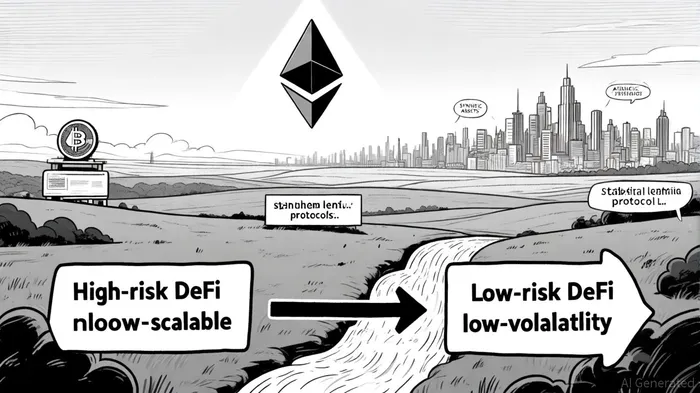
Ethereum's journey from a speculative playground to a foundational financial infrastructure is accelerating. At the heart of this transformation lies the rise of low-risk decentralized finance (DeFi)—protocols that prioritize capital efficiency, stability, and institutional-grade reliability. Vitalik Buterin, Ethereum's co-founder, has framed this shift as the network's “Google Moment,” a metaphor for a sustainable revenue model that aligns with Ethereum's core ethos while ensuring long-term viability[1]. This narrative is notNOT-- just theoretical; it is being validated by on-chain data, regulatory tailwinds, and innovations in capital structures that are redefining DeFi's role in global finance.
The “Google Moment” Narrative: From Speculation to Stability
Buterin's analogy draws a stark contrast between Ethereum's past reliance on high-fee-generating applications—such as NFTs and memecoins—and its potential to become a platform for low-volatility, mission-aligned financial tools[1]. Just as Google's search and advertising revenue subsidize its broader ecosystem, low-risk DeFi protocols like AaveAAVE-- and MakerMKR-- are creating a self-sustaining model. For example, Aave now offers competitive yields (5.2% on stablecoins[3]) while reducing systemic risks through matured security practices and declining hack incidents[1]. This shift is critical: EthereumETH-- has historically struggled to balance its ideological roots with economic sustainability, but low-risk DeFi bridges that gap by generating revenue without compromising openness[5].
The appeal of this model is amplified by global instability in traditional finance. Inflationary pressures, banking crises, and geopolitical tensions have made DeFi's transparent, rule-based systems increasingly attractive to users seeking alternatives[1]. As Buterin notes, Ethereum's low-risk DeFi could evolve into advanced tools like undercollateralized lending, inflation-indexed stablecoins, and prediction markets, all while preserving its ethos of financial inclusion[4].
Scalability and Layer 2s: The Infrastructure for Growth
Ethereum's transition to low-risk DeFi is underpinned by scalability solutions that reduce friction for users and developers. Layer 2 (L2) networks like OptimismOP--, ArbitrumARB--, and StarkNetSTRK-- have slashed transaction fees and increased throughput, with Coinbase's BASE L2 now processing more daily transactions than Ethereum itself[2]. These L2s are not just sidecars—they are reshaping Ethereum's economics. By introducing native tokens (e.g., STRK, MNT) for fee settlements, they reduce Ethereum's direct utility in some ecosystems. However, Ethereum still benefits via value accrual: a significant portion of L2 transaction fees flows back to the base layer, and blob space usage is nearing its target, signaling renewed demand for Ethereum's infrastructure[2].
Gas efficiency has also improved dramatically. While peak fees during the 2021 NFT boom hit 500 gwei[4], today's average fees are a fraction of that, thanks to the Dencun upgrade and L2 adoption. This maturation has enabled Ethereum to process over 1 million daily transactions, with 25 million ETHETH-- staked on the Beacon Chain—a testament to user confidence[4].
Emerging On-Chain Capital Structures: Redefining Efficiency
The most transformative developments in Ethereum's DeFi ecosystem are its capital-efficient innovations. Protocols like Wildcat V2 and Maple Finance are pioneering undercollateralized lending, allowing borrowers to access liquidity without overcollateralization[6]. Wildcat's $368 million in credit originations (as of Q3 2025) highlights growing institutional demand for flexible, on-chain credit[6]. Meanwhile, synthetic assets (e.g., Synthetix's real-world asset representations) and risk-mitigated yield protocols (e.g., Ethena's USDe) are diversifying DeFi's liability structure and expanding its utility beyond crypto-native assets[5].
Capital efficiency is further enhanced by protocols like f(x) Protocol and Mitosis. f(x)'s dual-token model redistributes volatility between a stablecoin (fxUSD) and a leveraged asset (xPOSITION), solving the “Stablecoin Trilemma” of decentralization, stability, and efficiency[7]. MitosisMITO--, on the other hand, optimizes cross-chain liquidity, reducing fragmentation and enabling simultaneous asset utilization across multiple protocols[7]. These innovations are not just technical feats—they are redefining how capital is deployed in DeFi, prioritizing fluidity and accessibility.
Academic and Institutional Validation
Ethereum's evolution is supported by both academic research and institutional adoption. The Ethereum Foundation's 2025 Academic Grants Round is funding projects in economics, cryptography, and scalability—directly addressing capital efficiency challenges[8]. Meanwhile, regulatory frameworks like the Digital Asset Market Clarity Act and Europe's MiCA are fostering institutional participation, with surveys indicating that 40% of U.S. investors would consider DeFi with clearer rules[5]. This convergence of technical innovation and regulatory clarity is critical for Ethereum's long-term success.
Conclusion: A New Era for Ethereum
Ethereum's transition to low-risk DeFi is not a speculative detour—it is a strategic repositioning toward becoming the global financial backbone of the internet. By aligning financial success with its founding ideals, Ethereum is creating a model where scalability, stability, and capital efficiency coexist. For investors, this means Ethereum is no longer just a bet on blockchain's future; it is a bet on a sustainable, institutional-grade infrastructure that can rival traditional finance.
As Buterin's “Google Moment” narrative gains traction, the question is no longer if Ethereum will dominate DeFi—it is how quickly the rest of the world will catch up.






Comentarios
Aún no hay comentarios