
Ethereum (ETH): The Overlooked Powerhouse for 2026 Wealth Creation
In the evolving landscape of cryptocurrency, EthereumETH-- (ETH) has emerged as a quiet but formidable force for long-term wealth creation. While BitcoinBTC-- (BTC) dominates headlines as a store of value and altcoins struggle with speculative volatility, Ethereum's technical upgrades, utility-driven growth, and favorable positioning amid regulatory and macroeconomic trends position it as a cornerstone of the 2026 crypto narrative. This analysis examines why Ethereum, often overshadowed by its more hyped counterparts, is uniquely poised to deliver risk-adjusted returns in the coming year.
Technical Upgrades: The Foundation for Scalability and Security
Ethereum's 2025 network upgrades-Pectra and Fusaka-have redefined its scalability and security, addressing long-standing bottlenecks. The Pectra update introduced account abstraction via EIP-7702, enabling more flexible transaction structures, while also raising validator stake limits and expanding blob throughput to bolster Layer 2 (L2) infrastructure according to The Block. Fusaka further advanced these goals with PeerDAS, a data availability sampling mechanism that allows nodes to verify rollup data without downloading it in full. This innovation increased blob capacity by up to 8x, reducing validator burdens and enhancing throughput. 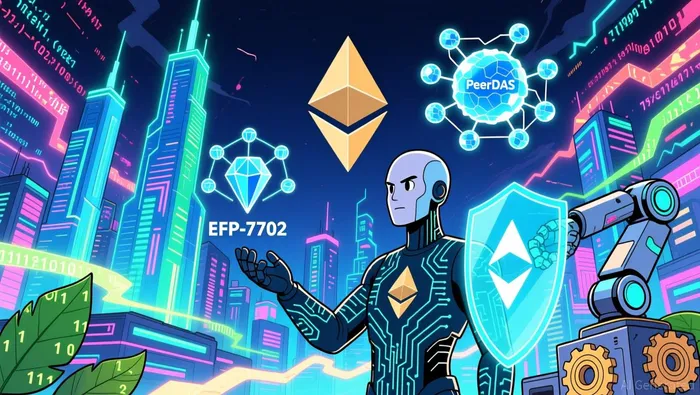
These upgrades are not just technical tweaks but strategic shifts. By anchoring blob fees to execution gas costs via EIP-7918, Ethereum ensures predictable pricing for data availability, a critical factor for institutional adoption according to Amina Group. The result? A network capable of processing over 3,780 user operations per second through rollups, far outpacing the base layer's capacity. Such improvements solidify Ethereum's role as a foundational infrastructure for decentralized finance (DeFi), non-fungible tokens (NFTs), and emerging applications like decentralized AI.
Regulatory and Macroeconomic Positioning: A Hedge Against Uncertainty
Ethereum's alignment with macroeconomic trends and regulatory clarity in 2025 has further strengthened its appeal. While Bitcoin's institutionalization via spot ETFs has normalized its role as a strategic reserve asset according to Vaneck, Ethereum's programmable infrastructure makes it more adaptable to liquidity-driven markets. For instance, stablecoins-30% of all on-chain transaction volume- reached $4 trillion in year-to-date volume by August 2025, driven by their use in payments and enterprise settlements. This utility positions Ethereum as a bridge between traditional finance and decentralized systems, a role Bitcoin cannot replicate.
Regulatory developments in the U.S. and EU have also favored Ethereum's growth. The "Trillion Dollar Security" initiative, aimed at identifying protocol-level risks, underscores Ethereum's commitment to security without sacrificing user experience according to The Block. Meanwhile, Bitcoin's narrative, though robust, remains slower-moving and more susceptible to macroeconomic corrections, as evidenced by its 30% Q4 2025 price correction. Ethereum's dual focus on scalability and security offers a more balanced approach to navigating regulatory and macroeconomic headwinds.
Utility-Driven Growth: DeFi, NFTs, and Enterprise Adoption
Ethereum's real-world utility in 2025 has been a silent engine of growth. The DeFi sector, despite a 66.5% decline in the MarketVector Decentralized Finance Leaders Index year-to-date, continues to generate substantial economic activity. Platforms like Hyperliquid earned $45 million in December 2025 alone, highlighting the network's capacity to sustain real-world transactions. Meanwhile, NFT adoption has expanded into enterprise partnerships, with major institutions leveraging Ethereum's infrastructure for supply chain management and digital identity solutions.
Enterprise adoption has been a game-changer. Financial giants like JPMorgan and BlackRock have deepened their crypto services, integrating Ethereum-based solutions for institutional-grade applications. This trend is not speculative-it reflects Ethereum's ability to meet the demands of a global financial system increasingly reliant on programmable money.
Developer Activity: The Engine of Innovation
Ethereum's developer ecosystem remains a critical differentiator. As of September 2025, the network hosts 31,869 active developers, surpassing Solana (17,708) and Bitcoin (11,036). Over 16,000 new developers joined the ecosystem between January and September 2025, driven by robust L2 infrastructure and EVM compatibility. While Solana's developer growth rate is faster, Ethereum's mature ecosystem and transparency-evidenced by its dominance in Latin America's blockchain transactions-ensure sustained innovation.
However, challenges persist. Median salaries for Ethereum developers ($140,000) lag behind private-sector averages ($359,000), risking talent attrition. Yet, the Ethereum Foundation's push to group EVM-compatible ecosystems suggests a long-term strategy to retain and expand its developer base.
Risk-Adjusted Returns: Ethereum vs. Bitcoin and Altcoins
In 2025, Ethereum's risk-adjusted returns outperformed altcoins but trailed Bitcoin's institutional-driven gains. Bitcoin's ETF-driven normalization improved its risk profile, though a Q4 correction limited its upside. Ethereum ETFs, while slower to gain traction, still attracted $9.8 billion in net inflows for the year. Altcoins, represented by the MarketVector Smart Contract Leaders Index, fell 37.39% year-to-date, underscoring their speculative nature.
Ethereum's edge lies in its utility-driven valuation. Unlike altcoins, which rely on fragmented narratives, Ethereum's upgrades and enterprise adoption create a flywheel effect: improved scalability attracts more users, which in turn drives demand for ETH as a settlement layer. This dynamic is less dependent on macroeconomic cycles than Bitcoin's store-of-value narrative, offering a more resilient long-term proposition.
Conclusion: The 2026 Opportunity
As 2026 approaches, Ethereum's combination of technical innovation, regulatory alignment, and utility-driven growth positions it as the most compelling long-term investment in crypto. While Bitcoin will remain a critical asset class, its slower-moving narrative and macroeconomic sensitivity make it less suited for wealth creation in a world increasingly reliant on programmable infrastructure. Altcoins, meanwhile, lack the ecosystem depth and institutional credibility to justify their risk profiles.
For investors seeking risk-adjusted returns, Ethereum offers a unique blend of scalability, security, and real-world adoption. Its 2025 upgrades have laid the groundwork for a new era of decentralized finance and enterprise-grade applications. In 2026, the overlooked powerhouse may finally get the attention it deserves.







Comentarios
Aún no hay comentarios