
Ethereum's ETF Outflows and Structural Sellers: Why Institutional Pressure Outweighs Short-Term Bounces
Ethereum's price action in late 2025 has been a study in contrasts. On one hand, the network's technical upgrades-most notably the Dencun hard fork-spurred a 22% quarterly gain in Q3, pushing the price above $4,200. On the other, a relentless wave of institutional selling and ETF outflows has since dragged the asset into a consolidation phase, with ETH now trapped below $3,000 and key technical indicators pointing to a bearish bias. This divergence between short-term optimism and structural pessimism raises a critical question: Why do institutional selling patterns and market structure dynamics outweigh fleeting price bounces?
The ETF Exodus: A $560M Selloff in December 2025
Ethereum's ETF outflows in Q3 2025 tell a story of institutional disengagement. According to data from Farside Investors and CoinEdition, net outflows reached nearly $854 million since mid-December, with single-day redemptions peaking at $225 million. This selling pressure accelerated in December, eroding $560 million in ETF assets despite occasional inflows. The result? A price correction of 23% from November highs to $2,928, with ETH now languishing below both its 50-period and 200-period moving averages.
The decline is not merely technical. Institutional investors, facing macroeconomic uncertainty and shifting monetary policy, have been systematically reducing exposure. A negative Coinbase Premium Index-a gauge of institutional demand-further underscores this trend. Even as Ethereum's network upgrades boosted scalability and layer-2 TVL, the asset's price failed to keep pace with chain revenue growth, signaling a divergence in market fundamentals.
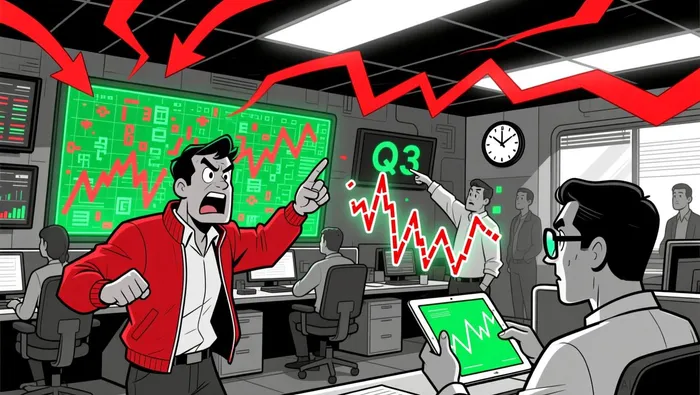
Structural Sellers: Beyond ETFs, a Broader Exodus
While ETF outflows dominate headlines, structural sellers-such as long-term holders and institutional arbitrageurs-have played an equally critical role. In Q3, long-term Ethereum holders selectively took profits as liquid supply increased by 8%, while illiquid supply shrank by 6%. This repositioning reflects a maturing market structure where institutional flows, macroeconomic tailwinds, and on-chain behaviors are increasingly aligned.
The data also reveals a paradox: EthereumETH-- ETFs saw $9.6 billion in net inflows during Q3, driven by the CLARITY Act's regulatory clarity and a 177% surge in AUM to $28.6 billion. Yet by late December, this momentum reversed. A single-day redemption of $422 million in August 2025 foreshadowed the broader trend, as macroeconomic headwinds and rising exchange reserves amplified selling pressure.
Price Action and Technical Indicators: A Bearish Consensus
Ethereum's price action in late 2025 paints a grim picture. After a Q3 rally, the asset faced a sharp correction, with the 200-period SMA at $3,012.68 and the 50-period SMA at $2,947.08 forming a descending trendline. The Williams %R indicator, hovering at -58.16, highlights market indecision, with neither bulls nor bears gaining conviction.
This technical weakness is compounded by on-chain metrics. Staking participation hit 29.4% of total supply by Q3, reflecting institutional confidence in Ethereum's infrastructure. Yet decentralized exchanges (DEXs) now account for 87% of Ethereum trading volume, signaling a shift in liquidity depth and price discovery mechanisms. These structural changes suggest that institutional selling is not just a short-term phenomenon but a reflection of deeper market dynamics.
The Bigger Picture: Why Institutional Pressure Matters
Short-term bounces-such as Ethereum's Q3 rally-are often driven by speculative flows or technical rebounds. However, institutional selling patterns and structural market forces tell a different story. The CLARITY Act's regulatory clarity initially spurred adoption, but macroeconomic headwinds and rising leverage have since eroded confidence. Meanwhile, elevated exchange reserves and a negative premium index indicate that institutional investors are prioritizing risk mitigation over growth.
For Ethereum to break free from its $3,000–$3,150 range, it will need more than a technical rebound. It will require a reversal in institutional sentiment, a stabilization of exchange reserves, and a rekindling of demand from long-term holders. Until then, the bearish bias remains intact, with structural sellers poised to dictate the asset's trajectory.
Conclusion
Ethereum's ETF outflows and structural selling pressure in late 2025 underscore a critical truth: Institutional behavior and market structure often outweigh short-term price bounces. While the network's technical upgrades and regulatory progress offer long-term promise, the immediate outlook is clouded by macroeconomic uncertainty and a lack of conviction among key market participants. For investors, the lesson is clear: In a market dominated by structural sellers, technical rebounds are fleeting-until the underlying forces shift.





Comentarios
Aún no hay comentarios