
Ethereum ETF Outflows and the Broader Implications for Crypto Asset Allocation: Risk Sentiment Shifts and Strategic Rebalancing in Digital Portfolios
Drivers of Ethereum ETF Outflows: Macroeconomic and Institutional Factors
The recent outflows from Ethereum ETFs are not isolated events but part of a larger narrative of risk-off sentiment in global markets. A Decrypt report recorded a $428.5 million outflow on October 13, 2025, with BlackRock's ETHA leading the exodus at $310.1 million, as noted by Decrypt. This marked one of the largest single-day outflows since September 5, when CryptoNews reported a $446.71 million drain. Analysts attribute these redemptions to a combination of factors:
- Macroeconomic Uncertainty: The Trump administration's proposed 100% tariff on Chinese imports triggered a wave of liquidations across asset classes, including crypto. Geopolitical tensions and the delayed timeline for Federal Reserve rate cuts further exacerbated risk aversion, according to The Coin Republic.
- Profit-Taking and Arbitrage Dynamics: Ethereum's structural advantages-such as its deflationary supply model and staking yields-initially attracted speculative and arbitrage-driven capital. However, as prices approached key resistance levels, institutional investors began locking in gains, as highlighted above.
- Portfolio Rebalancing: Ethereum ETFs now hold 5.56% of the total ETH supply, a significant concentration that may have prompted institutions to reduce exposure amid heightened volatility, according to Crypto Economy.
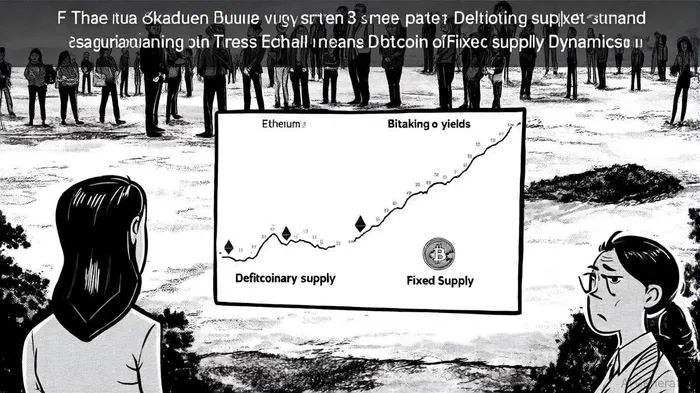
Divergence in ETF Flows: Ethereum vs. Bitcoin
The outflows from Ethereum ETFs contrast sharply with the performance of BitcoinBTC-- ETFs, which recorded net inflows during the same period. Earlier reporting showed Ethereum ETFs captured $33 billion in Q3 2025 while Bitcoin saw $1.17 billion in outflows, a dynamic that reversed in Q4 when Ethereum ETFs lost roughly $1.1 billion in late September while Bitcoin ETFs maintained steady inflows. OKX's market commentary highlights the latter point and the differing investor intents. This divergence underscores a shift in institutional preferences:
- Bitcoin ETFs reflect directional conviction, with investors viewing Bitcoin as a hedge against macroeconomic instability.
- Ethereum ETFs attract capital tied to speculative and DeFi-linked narratives, making them more sensitive to short-term volatility.
Resilience and Rebound Potential: A Tale of Two Phases
Despite the outflows, Ethereum ETFs have demonstrated resilience. On October 14, 2025, Ethereum ETFs saw a dramatic $338.8 million inflow, reversing part of the prior week's redemptions, as reported by CryptoNews. This suggests that institutional confidence in Ethereum's long-term fundamentals-such as its role in DeFi and real-world asset tokenization-has not been entirely eroded. Recent upgrades like Dencun and Pectra have reduced gas fees and boosted on-chain activity, reinforcing Ethereum's utility as a foundational blockchain, as noted above.
However, the path to recovery depends on macroeconomic stability and Ethereum's ability to reclaim key price levels. If the asset stabilizes above $3,800, ETF inflows could resume, potentially pushing Ethereum's ETF penetration closer to Bitcoin's 6–7% market share, according to CryptoSlate.
Strategic Rebalancing in Digital Portfolios
The Ethereum ETF outflows highlight the need for strategic rebalancing in crypto portfolios. Institutions are increasingly adopting a dual approach:
- Reducing Exposure to Speculative Allocations: Ethereum ETFs, while still holding 5% of the total ETH supply, are being treated with caution as short-term volatility persists.
- Increasing Bitcoin ETF Allocation: Bitcoin's dominance in ETF inflows reflects its role as a "safe haven" within crypto, akin to gold in traditional markets.
For investors, this means diversifying across both directional and utility-driven assets. Ethereum's structural advantages and DeFi ecosystem provide long-term upside, but its ETFs require careful monitoring of macroeconomic triggers.
Conclusion
Ethereum ETF outflows in Q4 2025 signal a complex interplay of risk sentiment shifts and strategic rebalancing in digital portfolios. While short-term uncertainty persists, Ethereum's foundational strengths-deflationary supply, staking yields, and DeFi integration-position it for a potential rebound. Investors must balance caution with conviction, leveraging ETFs as tools to navigate both the turbulence and opportunities in the evolving crypto landscape.







Comentarios
Aún no hay comentarios