
Ethereum ETF Outflows and the Bearish Risks to ETH Price Momentum
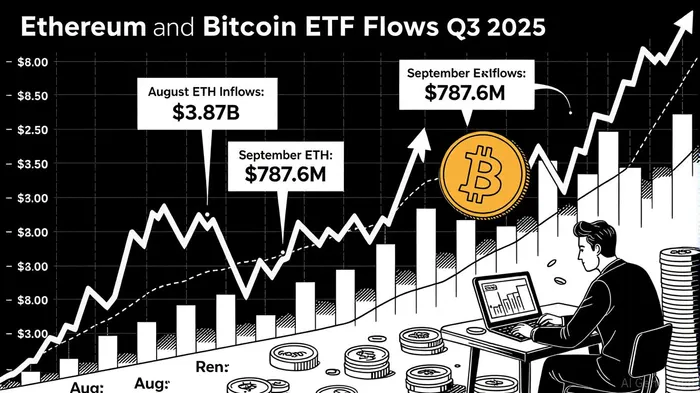
The EthereumETH-- ecosystem is facing a critical juncture as spot Ether ETFs experienced a dramatic reversal in sentiment during Q3 2025. While institutional adoption and technological upgrades have historically positioned Ethereum as a cornerstone of the crypto market, recent outflows and shifting capital flows signal emerging bearish risks to its price momentum.
Macroeconomic Uncertainty and the Flight to Safety
The first red flag emerged in September 2025, when Ethereum ETFs recorded a staggering $787.6 million in outflows over four trading days, with a single-day withdrawal of $446.71 million on September 5 [1]. This marked a sharp contrast to August’s $3.87 billion inflows [1], underscoring the fragility of investor sentiment amid macroeconomic headwinds. Rising recession fears, weak U.S. jobs data, and expectations of Federal Reserve easing triggered a broader flight to safe-haven assets. During the same week, BitcoinBTC-- ETFs attracted $246.4 million in net inflows [1], while Ethereum’s price plummeted to $4,209—a level not seen since mid-August [3].
The divergence in ETF flows reflects a strategic reallocation of capital toward perceived “safe” assets. Bitcoin’s dominance in this environment is not surprising, as its historical role as a macro hedge has been reinforced by institutional investors. Meanwhile, Ethereum’s higher beta (4.7 vs. Bitcoin’s 2.8) [1] made it more vulnerable to volatility, compounding the outflows.
Institutional Behavior: A Tale of Two Narratives
Despite the September outflows, Ethereum’s institutional narrative remains robust. Data from Q3 2025 reveals a $33 billion inflow into Ethereum ETFs, driven by whale activity, regulatory clarity, and technological upgrades [1]. The SEC’s informal commodity classification of Ethereum under the CLARITY Act unlocked $27.6 billion in ETFs by August 2025 [1], while the Dencun and Pectra hard forks reduced Layer 2 gas fees by 90% and boosted DeFi TVL to $223 billion [1]. These fundamentals attracted corporate treasuries staking 1.5 million ETH ($6.6 billion) and investment advisors adding 388,358 ETH in Q2 2025 [2].
However, the September outflows highlight a critical tension: while long-term institutional confidence in Ethereum’s deflationary model and staking yields remains intact, short-term macro risks are forcing a defensive posture. For instance, Ethereum whales now control 22% of the supply [1], and exchange reserves have fallen to multi-year lows [1], creating artificial scarcity. Yet, the same period saw $5.42 billion in BTC-to-ETH transfers [1], suggesting that Ethereum’s appeal as a high-yield asset persists—even as investors hedge against broader market risks.
Sentiment Indicators: Greed and Fear in a Volatile Market
Market sentiment oscillated between caution and optimism during Q3 2025. The Fear & Greed Index for Ethereum hovered at a neutral 48 in August [4], but surged to a “Greed” reading of 60 by late September [5], driven by dovish Fed comments and a rebound in key price levels. This shift coincided with Ethereum reclaiming $4,000–$4,100 resistance [1], though analysts warned of volatility near $3,800 support [1].
Retail FOMO also intensified, with a 2:1 bullish-to-bearish sentiment ratio [5], mirroring meme stock dynamics. However, institutional behavior tells a more nuanced story. While Ethereum ETFs attracted $1.8 billion in inflows over five days in September [3], Bitcoin whales increasingly moved assets into cold storage, with $4.35 billion in BTC transfers in July 2025 [1]. This defensive strategy underscores a broader risk-off environment, where Ethereum’s higher beta and exposure to macroeconomic cycles make it a more volatile play.
The Path Forward: Balancing Risks and Resilience
Ethereum’s price action in Q3 2025 illustrates a classic tug-of-war between short-term bearish risks and long-term bullish fundamentals. The September outflows, though significant, are best viewed as a temporary correction rather than a rejection of Ethereum’s value proposition. Institutional adoption, regulatory progress, and ecosystem upgrades continue to drive capital inflows, with analysts projecting Ethereum could reach $6,400–$12,000 by year-end 2025 [1].
However, investors must remain vigilant. The interplay between macroeconomic uncertainty and Ethereum’s beta exposure means further volatility is likely. For now, the market is testing whether Ethereum’s long-term narrative can withstand the headwinds of a risk-off environment.
**Source:[1] Ether ETFs Face $952M Outflows as Bitcoin Funds Gain [https://www.bitget.com/news/detail/12560604954913][2] Why Ethereum is Winning Over Bitcoin in Q3 2025 [https://www.bitget.com/news/detail/12560604946875][3] Ethereum Price Prediction: Analysts Target $6K If $4450 Resistance Breaks [https://coincentral.com/ethereum-price-prediction-analysts-target-6k-if-4450-resistance-breaks/][4] Ethereum's 2025 Price Outlook and the Rise of Disruptive Altcoins [https://www.bitget.com/news/detail/12560604933405][5] Crypto Sentiment Returns to Greed as Bitcoin and Ether Rally [https://www.fastbull.com/news-detail/crypto-sentiment-returns-to-greed-as-bitcoin-and-news_6300_0_2025_3_8321_3]






Comentarios
Aún no hay comentarios