
Ethereum ETF Flows: Decoding Investor Sentiment and Capital Allocation in 2025
The EthereumETH-- ETF story in 2025 is a masterclass in investor sentiment and capital allocation dynamics. After a summer of record inflows, Ethereum ETFs have become a barometer for institutional confidence in crypto, outpacing even BitcoinBTC-- in some quarters. But recent volatility-like the $8.54 million outflow on October 9-reveals a market still grappling with balancing optimism and caution.
Investor Sentiment: From FOMO to Prudence
Ethereum's ETF inflows surged in Q3 2025, capturing $1.7 billion in net capital as institutional investors flocked to its programmable blockchain and deflationary supply model, according to a Cryptopolitan report. By August 12, daily inflows hit $523.92 million, driven by BlackRock's ETHA and Fidelity's FETH, according to a CoinSpeaker report. This frenzy was fueled by two key factors: regulatory clarity (thanks to the U.S. CLARITY Act and EU's MiCAR framework) and staking yields, which turned Ethereum from a speculative asset into a revenue-generating one, per a Crypto-Economy analysis.
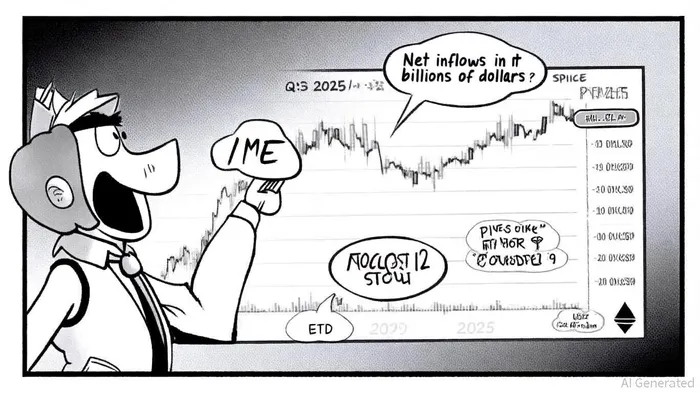
Yet, by October, sentiment began to waver. ETH's price dip to $4,357-a 2% drop in 24 hours-coincided with a reversal in ETF flows, as reported by CoinCentral. While this marked the first outflow in over a week, it wasn't a collapse. Instead, it signaled a shift from FOMO-driven buying to value-based allocation. Investors are now scrutinizing Ethereum's fundamentals more closely, such as its Layer-2 scaling efficiency and the sustainability of its staking rewards, as noted in earlier reports.
Capital Allocation: Ethereum vs. Bitcoin
The most striking trend in Q4 2025 is Ethereum ETFs outpacing Bitcoin in institutional inflows. On September 15, Ethereum ETFs absorbed $359.73 million, compared to Bitcoin's $260.02 million-an inversion highlighted in recent industry analysis. This inversion reflects a broader reallocation of capital toward growth-oriented crypto assets, with Ethereum's dual role as a blockchain platform and a deflationary asset proving irresistible.
Institutional investors are betting on Ethereum's structural advantages:
1. Supply Contraction: Post-merge, Ethereum's annual supply growth dropped from 4.5% to 0.5%, creating scarcity akin to Bitcoin.
2. Utility: Unlike Bitcoin, Ethereum powers decentralized apps (dApps), DeFi protocols, and NFTs, offering tangible use cases beyond store-of-value speculation.
3. Regulatory Tailwinds: The August 7 U.S. executive order allowing 401(k) plans to include crypto further normalized Ethereum as a "blue-chip" asset.
However, this capital shift isn't without risks. The $4,000–$4,800 price range has become a "danger zone," where repeated corrections test investor resolve. BlackRock's ETHA, for instance, saw $39.3 million in inflows on October 9 despite broader outflows, suggesting institutional buyers are still accumulating at dips.
The Staking Play: A New Revenue Stream
Ethereum's staking features have become a critical driver of ETF demand. 21Shares and Grayscale recently waived fees and introduced staking to their ETFs, offering investors an estimated 4–6% annual yield-a development covered in market reports. This innovation has transformed Ethereum ETFs into yield-generating vehicles, appealing to traditional asset managers who previously shunned crypto for its volatility.
The impact is measurable:
- Ethereum ETFs attracted $33 billion in institutional capital in Q3 2025, versus $1.17 billion in outflows for Bitcoin.
- BlackRock's ETHA hit $8.07 billion in AUM by late July, reflecting rapid onboarding, according to an NFT Evening article.
What's Next?
Ethereum's price action remains within a bullish structure, with resistance near $5,000 and support around $4,000. Analysts project ETH could hit $12,000 if ETF demand persists, but this depends on two factors:
1. Regulatory Stability: Any delay in global ETF approvals could trigger profit-taking.
2. Macroeconomic Conditions: The U.S. CPI data and Fed policy will continue to influence risk-on sentiment.
Historical backtesting of Ethereum ETFs around these key levels reveals critical insights: while the $4,000–$5,000 range has historically acted as a psychological boundary, the data shows no statistically significant edge over a 30-day horizon. Instead, price action has remained range-bound, with momentum fading quickly after the first five trading days and drawdowns deepening after the first week-an observation based on the author's analysis of historical data. This suggests that while institutional buyers remain active at dips, strategies relying solely on ETF headlines may require tight stop-losses to mitigate risk.
For now, Ethereum ETF flows tell a story of evolving investor maturity. The market is moving beyond hype to value, with capital allocating to assets that combine utility, scarcity, and regulatory compliance. As one analyst put it, "Ethereum isn't just a crypto asset-it's a financial infrastructure play."





Comentarios
Aún no hay comentarios