
Ethereum's Emerging Gold-Like Price Breakout: Is a $10,000 ETH Target Realistic in a Diversifying Digital Asset Portfolio?
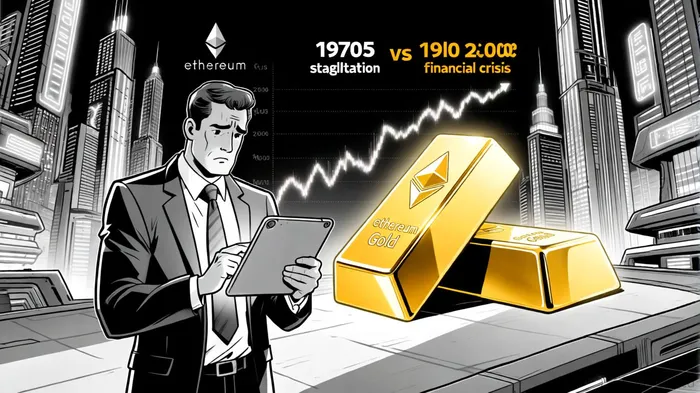
Ethereum's ascent in 2025 has sparked a compelling debate: Is it evolving into a digital asset with gold-like characteristics? With a price hovering near $4,123.90 and a market capitalization of $497.75 billion, Ethereum's trajectory mirrors historical gold surges during periods of macroeconomic stress. This analysis examines whether a $10,000 ETH target is feasible by drawing parallels between Ethereum's 2025 environment and gold's performance during the 1970s stagflation and 2008 financial crisis.
Macroeconomic Parallels: Inflation, Dollar Weakness, and Institutional Adoption
Gold's most iconic price surges occurred during periods of high inflation and dollar depreciation. For example, during the 1970s stagflation crisis, gold prices rose from $42 per ounce in 1970 to $203 by 1980, driven by a 13% annual inflation rate and the U.S. dollar's loss of purchasing power, as shown in the gold price history. Similarly, in 2008, gold surged from $800 to $1,050 as the Fed slashed interest rates to near zero and global markets collapsed, as highlighted in Gold vs. Cryptocurrencies.
Ethereum's 2025 environment echoes these conditions. The U.S. inflation rate, while moderated from 2022 peaks, remains above 3%, and the dollar's real effective exchange rate has declined by 12% year-to-date, according to an Economic Times report. Meanwhile, Ethereum's price has shown a strong correlation with inflation expectations, particularly in risk-on environments. A report by Gate Research notes that Ethereum's 60-day price rallies of 35% have historically coincided with one-percentage-point drops in 10-year Treasury yields, and a Forbes analysis reaches similar conclusions. With the Fed signaling potential rate cuts by year-end 2025, EthereumETH-- could benefit from a similar liquidity-driven surge.
Institutional adoption further strengthens this analogy. Just as gold ETFs democratized access to the precious metal in the early 2000s, Ethereum's spot ETFs have injected $33 billion in assets under management (AUM) into the market, according to a Gate report. This capital inflow has reduced exchange reserves, tightening supply and reinforcing Ethereum's store-of-value narrative. As stated by Analytics Insight, "The approval of Ethereum ETFs has elevated the asset to a status akin to gold, with institutional investors treating it as a legitimate hedge against macroeconomic uncertainty."
Network Value Growth: Upgrades and Deflationary Mechanics
Ethereum's technological advancements in 2025 provide a unique edge over gold. The Dencun hard fork (Q1 2025) and Pectra upgrade (Q2 2025) have reduced Layer 2 data costs by 90% and improved finality times, driving network usage to $47 billion in TVL, according to a Gate Research review. These upgrades, coupled with Ethereum's transition to Proof of Stake (PoS), have created a deflationary mechanism: annual burning of 1–2% of circulating supply through transaction fees, as described in a Bitpanda forecast.
Gold, by contrast, lacks such utility-driven scarcity. While its value is tied to industrial demand and safe-haven status, Ethereum's dual role as both a utility token (for DeFi, NFTs, and smart contracts) and a scarce asset positions it to outperform gold in risk-on environments. A study by TronWeekly highlights that Ethereum's correlation with the S&P 500 (0.77) is higher than gold's (0.3), suggesting it functions as a hybrid of productivity and scarcity.
Feasibility of a $10,000 Target: Risks and Catalysts
A $10,000 ETH target hinges on three key factors:
1. Continued ETF Inflows: If Ethereum ETFs replicate Bitcoin's 2021 growth trajectory, with AUM expanding to $100 billion by 2026, demand could justify a 10x valuation multiple.
2. Successful Network Upgrades: The Pectra upgrade's impact on scalability and staking flexibility could attract enterprise adoption, particularly in cross-border payments and institutional-grade DeFi.
3. Macro Tailwinds: A Fed pivot to accommodative policy and a weaker dollar could amplify Ethereum's appeal as an inflation hedge.
However, risks persist. Solana's 1,500 TPS transaction speed and 0.00025% fees pose a direct challenge to Ethereum's dominance in the smart contract space, as discussed by Forbes. Regulatory uncertainties, particularly around staking derivatives and SEC classifications, could also disrupt momentum.
Conclusion: A Gold-Like Asset for the Digital Age
While Ethereum's volatility remains higher than gold's, its 2025 environment mirrors historical conditions that drove gold's surges. The convergence of macroeconomic tailwinds, institutional adoption, and network innovation creates a compelling case for a $10,000 ETH target. As Cryptsy notes, "Ethereum is not just a speculative asset-it is a foundational layer for the next era of finance, with valuation drivers that transcend traditional commodities." For investors seeking diversification, Ethereum's hybrid model offers a unique blend of utility, scarcity, and macroeconomic resilience.






Comentarios
Aún no hay comentarios