
Ethereum's Re-Emergence as a Global Settlement Platform: A 2025 Investment Analysis
Ethereum's evolution in 2025 has positioned it as a formidable contender in the global settlement landscape, driven by a confluence of on-chain infrastructure advancements and a resurgence in Layer 1 (L1) utility. As the blockchain ecosystem matures, Ethereum's strategic upgrades—ranging from sharding to account abstraction—are not only addressing long-standing scalability challenges but also redefining its role as a backbone for institutional finance and cross-border transactions.
Infrastructure Overhaul: Scaling for a Global Network
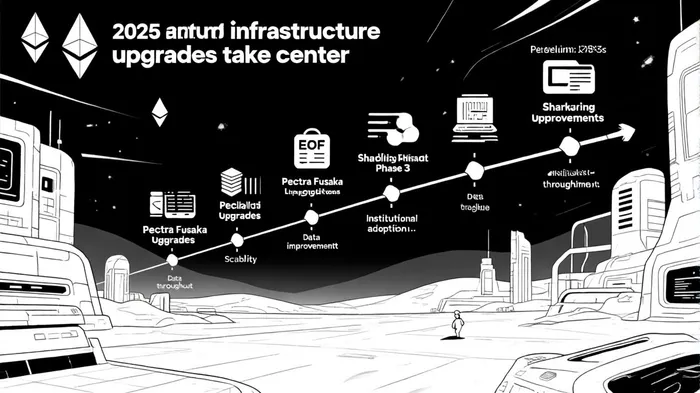
Vitalik Buterin's 2025 roadmap underscores Ethereum's pivot toward a more robust L1 network, with Sharding Phase 3 aiming to push transaction throughput to 100,000 transactions per second (TPS) and enhance inter-shard communication[2]. The Pectra upgrade in May 2025 marked a pivotal milestone, increasing data throughput via EIP-7691 and enabling 8.15GB of daily blob data capacity—a critical enabler for rollups and scalable applications[3]. Complementing this, the upcoming Fusaka upgrade will further optimize data availability through PeerDAS and EOF (Ethereum Object Format) upgrades, ensuring faster execution and reduced gas costs[3].
These improvements are part of a broader strategy to make Ethereum's mainnet more efficient. The EthereumETH-- Foundation has shifted from a purely rollup-centric model to one that prioritizes user experience (UX) and L1 scalability[3]. For instance, zero-knowledge (zk) proofs are being integrated into the L1 layer to bolster privacy and scalability, while validator consolidation efforts aim to reduce centralization risks[5].
Layer 1 Utility Resurgence: Transaction Volumes and Smart Contracts
Post-Pectra, Ethereum's L1 utility has seen a dramatic resurgence. As of September 2025, daily transaction volumes averaged 1.634 million, a 50.51% increase year-over-year and a 22% rise from the previous day[2]. This growth is fueled by decentralized finance (DeFi) and NFT platforms, with smart contract interactions accounting for 62% of all transactions[1]. The Pectra upgrade's expanded blob capacity has also benefited rollups like Base and ArbitrumARB--, which now handle over 1.66 billion transactions and $15 billion in total value locked (TVL), respectively[5].
However, challenges remain. While blob data capacity has increased, the average number of blobs per block is 33% below the target of six, indicating untapped potential[3]. Analysts suggest that as rollups optimize their use of blob space, transaction fees could drop further, incentivizing broader adoption.
Institutional Adoption and Cross-Border Payments
Ethereum's appeal extends beyond developers and traders. Institutional investors are increasingly leveraging Ethereum for asset tokenization, with firms like BlackRockBLK-- and Franklin Templeton exploring Ethereum-based funds to streamline asset management[2]. Meanwhile, Ethereum-based stablecoins and blockchain payment networks are disrupting traditional cross-border systems. Companies like SendFriend utilize Ethereum to facilitate near-instant, low-cost international transfers, reducing settlement times from days to seconds[4].
Governments are also taking notice. The United Arab Emirates and Saudi Arabia have piloted Ethereum-based cross-border CBDC transactions, demonstrating the blockchain's potential to modernize interbank settlements[2]. Compared to traditional systems like SWIFT, Ethereum offers a decentralized infrastructure that cuts costs by up to 70% while enabling programmable smart contracts for automated settlements and multi-currency hedging[3].
Conclusion: A New Era for Ethereum
Ethereum's 2025 upgrades and institutional adoption trends signal a paradigm shift in its role as a global settlement platform. By addressing scalability bottlenecks and enhancing L1 utility, Ethereum is not only competing with traditional financial systems but also enabling a new era of programmable money. For investors, the confluence of technical progress, real-world use cases, and institutional interest presents a compelling case for Ethereum's long-term value. As the network continues to evolve, its ability to balance innovation with security will be critical in solidifying its position as the backbone of a decentralized financial ecosystem.






Comentarios
Aún no hay comentarios