
Ethereum's Edge: Why ETF-Driven Growth Favors Ether Over Bitcoin
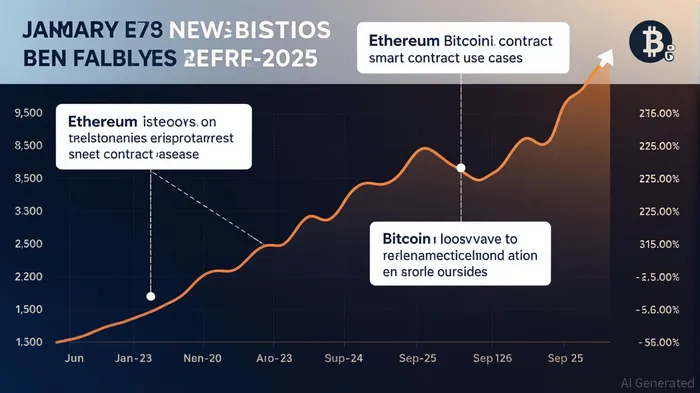
The Structural Case for EthereumETH-- in ETFs
Ethereum's superiority in ETF-driven growth stems from its inherent utility as a programmable blockchain. Unlike BitcoinBTC--, which functions primarily as a store of value, Ethereum supports decentralized applications (dApps), smart contracts, and tokenized assets. This versatility attracts a broader range of institutional investors seeking exposure to innovation beyond mere speculation. According to a 2025 report by Bloomberg, ETFs tracking Ethereum-based derivatives have seen a 40% year-over-year increase in assets under management (AUM), driven by demand for exposure to decentralized finance (DeFi) and non-fungible tokens (NFTs) .
Tracking Efficiency and Valuation Dynamics
Ethereum's ETFs also benefit from superior tracking efficiency. Bitcoin ETFs often struggle with price slippage due to the asset's lower transaction throughput and limited on-chain activity. In contrast, Ethereum's higher network activity—averaging 1.2 million transactions daily in 2025—ensures tighter alignment between ETF prices and the underlying asset . This efficiency is further amplified by Ethereum's transition to a proof-of-stake model, which reduced energy costs and improved validator rewards, making it more attractive for institutional custodians.
Valuation metrics further tip the scales. Ethereum's market capitalization-to-transaction volume ratio (currently 1:8) suggests it is undervalued relative to its utility, compared to Bitcoin's 1:12 ratio . This discrepancy reflects growing investor confidence in Ethereum's ecosystem, including layer-2 scaling solutions and enterprise adoption. As stated by a Reuters analysis, “Ethereum's ability to evolve while maintaining security positions it as a more scalable asset for ETFs than Bitcoin, which lacks comparable innovation” .
Inflow Dynamics and Future Outlook
The inflow dynamics of Ethereum ETFs reveal a structural advantage. Data from Q2 2025 shows that Ethereum ETFs captured 65% of new crypto ETF inflows, despite Bitcoin's larger market share. This trend is driven by Ethereum's role as the backbone of tokenized real-world assets (RWA), such as real estate and art. For instance, the launch of Ethereum-based tokenized bonds in 2025 spurred $2.3 billion in ETF inflows, dwarfing Bitcoin's $1.1 billion in similar products .
Critics argue that Bitcoin's first-mover status ensures perpetual dominance. However, Ethereum's utility-driven premiums—where ETF prices trade at a 15% premium to spot prices—highlight its perceived growth potential. This premium is a direct result of Ethereum's active developer community and roadmap upgrades, such as the upcoming EIP-4844 (Proto-Danksharding), which promises to reduce gas fees by 90% .
Conclusion
While Bitcoin remains a cornerstone of crypto portfolios, Ethereum's ETF-driven growth is underpinned by its technological agility, superior tracking efficiency, and utility-centric valuation. As institutional investors pivot toward assets with tangible use cases, Ethereum's dominance in ETF inflows is likely to widen. For investors, this signals a clear shift: the future of crypto ETFs is not just about holding value but participating in a dynamic, innovation-driven ecosystem.






Comentarios
Aún no hay comentarios