
Ethereum's Dual Challenge: Scaling for Global Use Without Sacrificing Decentralization
Ethereum's evolution into a global infrastructure layer hinges on its ability to balance scalability with decentralization. The 2025 Fusaka upgrade, a pivotal milestone, has introduced innovations that aim to address this tension while reinforcing Ethereum's censorship resistance and governance resilience. However, the path forward remains fraught with trade-offs, particularly as Layer 2 (L2) solutions gain traction and centralization risks emerge.
Scaling Innovations: The Fusaka Upgrade and Beyond
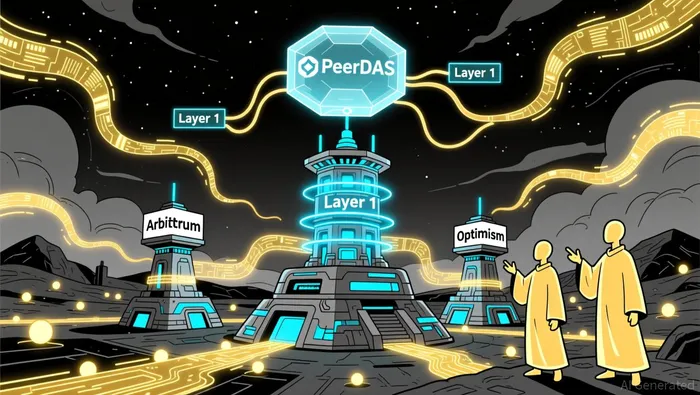
The Fusaka upgrade, activated on December 3, 2025, marked a strategic shift in Ethereum's scaling approach. By introducing 12 EthereumETH-- Improvement Proposals (EIPs), including PeerDAS (EIP-7594), the upgrade optimized data availability sampling, enabling nodes to verify rollup data without downloading entire datasets. This innovation increased blob capacity by up to 8x while reducing bandwidth requirements, allowing Ethereum to support L2 rollups like ArbitrumARB-- and OptimismOP--, which now handle over 70% of user activity.
Additionally, EIP-7918 introduced a reserve price for blob gas fees, aligning economic incentives between Layer 1 and L2 networks. This change not only enhances throughput but also strengthens the DA market, ensuring sustainable revenue for ETHETH-- holders. The block gas limit was also raised to 60 million, boosting L1 throughput and execution efficiency. These upgrades position Ethereum as a modular, high-throughput platform capable of competing with centralized alternatives without compromising its decentralized ethos.
Decentralization Trade-offs: The L2 Dilemma
While L2 solutions like Arbitrum and Optimism have achieved impressive scalability-processing up to 40,000 transactions per second-they introduce centralization risks. Most L2 rollups rely on a single, centralized sequencer to bundle and submit transactions to Layer 1. This creates a single point of failure, undermining Ethereum's core principle of censorship resistance. For instance, if a sequencer is compromised or censored, user transactions could be delayed or blocked entirely.
The Fusaka upgrade attempts to mitigate this by decentralizing data availability through PeerDAS, but the reliance on centralized sequencers remains a critical vulnerability. Investors must weigh the benefits of L2 scalability against the potential erosion of decentralization, particularly as institutions increasingly adopt these solutions for high-volume use cases.
Governance Resilience and Real-World Adoption
Ethereum's governance model has evolved to support its scaling ambitions. The Fusaka upgrade demonstrated a more cohesive development roadmap, with EIPs strategically aligned to scalability, usability, and value accrual for ETH holders. This focus on economic sustainability has attracted institutional interest, as seen in Amundi's launch of a tokenized money market fund on Ethereum in November 2025. Such adoption underscores Ethereum's maturation as infrastructure for institutional-grade applications, including DeFi, tokenization, and AI-integrated financial systems.
However, governance resilience is not without challenges. The dynamic scaling introduced by Blob Parameter Only forks allows real-time adjustments to data capacity but requires ongoing community consensus. This flexibility is a double-edged sword: while it enables rapid adaptation, it also risks fragmentation if stakeholders disagree on scaling priorities.
Economic and Market Considerations
Despite infrastructure improvements, Ethereum's price performance in 2025 highlights the influence of macroeconomic and regulatory factors. By December 2025, ETH had declined by 12% year-over-year, dropping to $2930 from $3336. This suggests that while technical upgrades bolster Ethereum's foundational strength, broader market dynamics-including regulatory clarity and macroeconomic conditions-will dictate its long-term value proposition.
Investors should also consider the economic trade-offs embedded in the Fusaka upgrade. By prioritizing value accrual for ETH holders through mechanisms like blob gas fees, Ethereum risks alienating users seeking low-cost, high-speed transactions. Striking a balance between these objectives will be critical to maintaining both adoption and decentralization.
Conclusion: A Platform in Transition
Ethereum's dual challenge-scaling for global use without sacrificing decentralization-remains unresolved. The Fusaka upgrade has laid the groundwork for a rollup-centric future, enhancing throughput and data efficiency while reinforcing governance resilience. However, the centralization risks in L2 sequencers and the economic trade-offs between scalability and value accrual present ongoing hurdles.
For Ethereum to evolve into durable, censorship-resistant infrastructure, its ecosystem must continue innovating in areas like sequencer decentralization, hybrid consensus models, and institutional-grade security. Investors who recognize these dynamics will be better positioned to navigate the complexities of Ethereum's next phase, where technical execution and governance adaptability will determine its success.






Comentarios
Aún no hay comentarios