
Ethereum’s Downward Slide: A Strategic Reassessment of Risk and Reward in the Crypto Market
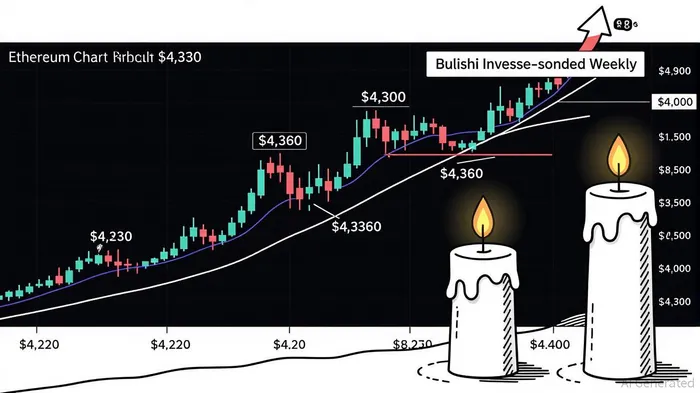
Ethereum’s recent price action has painted a complex picture for investors, blending cautious optimism with lingering bearish pressures. As the cryptocurrency consolidates near $4,300 in early September 2025, technical indicators and market sentiment suggest a critical juncture for the asset. This analysis examines Ethereum’s downward trajectory through the lens of technical analysis and evolving investor behavior, offering a strategic framework for assessing risk and reward in the current market environment.
Technical Analysis: A Fragile Bullish Case
Ethereum’s price has been testing key support and resistance levels in recent weeks. Immediate support lies at $4,220 and $4,270, with a breakdown below $4,220 potentially triggering a retest of $4,200 or even $4,160 [1]. Conversely, a sustained move above $4,400 could reignite bullish momentum, targeting $4,500 and beyond [1]. A broader weekly chart reveals a potential inverse head-and-shoulders pattern, which, if confirmed, could signal a rally toward $10,000—a level last seen during the 2021 bull market [4].
However, technical indicators remain mixed. The Stochastic RSI is in slightly overbought territory (82.09), while the MACD line remains below its signal line, indicating bearish momentum [2]. The 50-day moving average crossing above the 200-day moving average—a “golden cross”—suggests a long-term bullish trend, but this must be weighed against short-term volatility [2]. Notably, the Exchange Flux Balance has turned negative, signaling reduced sell-side pressure and increased long-term holding behavior [4]. Institutional accumulation by entities like BMNR further reinforces this narrative, though traders must remain wary of ETF outflows and regulatory uncertainties [4].
Market Sentiment: Neutral Emotions and Divergent Signals
Market sentiment for EthereumETH-- remains neutral, with the Fear and Greed Index at 56, reflecting no extreme investor behavior [5]. This aligns with Ethereum’s range-bound price action around $4,300, as buyers and sellers remain in equilibrium. Yet, underlying bullish activity is evident. Whale accumulation and institutional buying have increased, with entities such as BMNR amassing large ETH positions [4]. These developments suggest confidence in Ethereum’s long-term fundamentals, particularly with the Pectra upgrade enhancing scalability and staking flexibility [2].
Macroeconomic factors, however, introduce volatility. Global economic uncertainties—such as U.S. trade policy shifts and ETF outflows—have amplified Ethereum’s price swings [1]. A study on cryptocurrency volatility spillovers underscores how macroeconomic shocks disproportionately affect Ethereum compared to BitcoinBTC--, highlighting its sensitivity to risk-off environments [3]. Meanwhile, the potential inclusion of staking in Ethereum ETFs remains a pivotal catalyst. If approved, this could drive institutional adoption and push the price toward $6,000–$10,000 in the medium term [2].
Resolving the Price Discrepancy: From $1,891 to $4,300
A critical question arises: Why did Ethereum’s price surge from $1,891 in March 2025 to $4,300 by September? The answer lies in shifting market dynamics. The Dencun upgrade reduced gas fees by 95%, improving Ethereum’s utility and attracting DeFi activity [2]. Additionally, macroeconomic conditions—such as reduced ETF outflows and a stabilizing Exchange Flux Balance—contributed to a fair-value reassessment of the asset [1]. By September, Ethereum’s total locked value in DeFi had rebounded to $45 billion, reinforcing its role as a foundational blockchain [2].
Strategic Considerations for Investors
For investors, Ethereum’s current positioning demands a balanced approach. Technically, the asset must break above $4,400 to validate the bullish inverse head-and-shoulders pattern [4]. Failure to do so could result in a retest of $4,200, where further support is critical. On the sentiment side, the neutral Fear and Greed Index suggests no immediate panic selling, but macroeconomic risks—such as regulatory actions or ETF outflows—remain elevated [5].
A strategic reassessment should prioritize risk management. Short-term traders may find opportunities in range-bound trading between $4,250 and $4,450, while long-term investors should monitor the Pectra upgrade and ETF staking developments [2]. Diversification across Ethereum and alternative blockchains is also prudent, given the competitive landscape [4].
Conclusion
Ethereum’s downward slide in early 2025 has given way to a fragile but developing bullish case. While technical indicators and institutional activity hint at potential for a $10,000 rally, market sentiment and macroeconomic volatility necessitate caution. Investors must navigate this duality by closely monitoring key price levels, macroeconomic catalysts, and regulatory developments. In a market where risk and reward are inextricably linked, Ethereum’s next move will likely hinge on its ability to break through psychological resistance and maintain institutional confidence.
Source:
[1] Ethereum Price Struggles Badly – More Downside Risk if ... [https://www.mitrade.com/insights/news/live-news/article-3-1106440-20250909]
[2] Ethereum (ETH) Technical Analysis Statistics 2025 [https://altindex.com/ticker/eth/technical-analysis]
[3] Exploring Volatility Reactions in Cryptocurrency Markets [https://www.sciencedirect.com/science/article/pii/S1059056025006720]
[4] Ethereum Price Prediction: Inverse Head-and-Shoulders Pattern and Supply Shock Signal $10K Rally [https://bravenewcoin.com/insights/ethereum-price-prediction-inverse-head-and-shoulders-pattern-and-supply-shock-signal-10k-rally]
[5] Ethereum Fear and Greed Index | Multiple Timeframes [https://cfgi.io/ethereum-fear-greed-index/]






Comentarios
Aún no hay comentarios