
Ethereum’s Dominance in the Institutional Blockchain Ecosystem: Why Wall Street is Building on the Digital Bedrock of the 21st Century
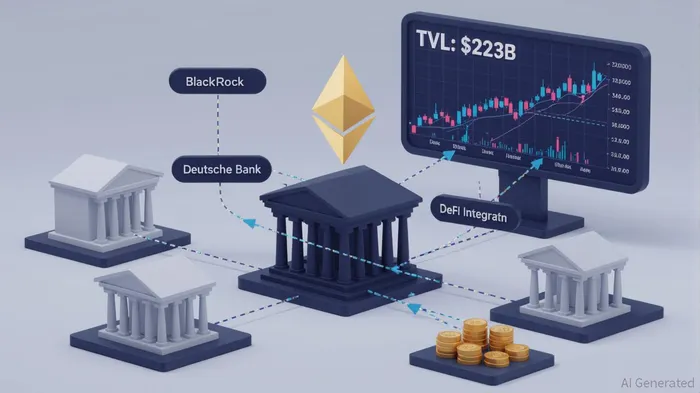
In 2025, EthereumETH-- has emerged not just as a digital asset but as the foundational infrastructure layer for Wall Street’s transition into the blockchain era. With over 50 non-crypto enterprises, including BlackRockBLK-- and Deutsche BankDB--, building on Ethereum’s smart contract platform, the blockchain has become the backbone of decentralized finance (DeFi), stablecoin settlements, and tokenized real-world assets (RWAs) [1]. This shift is driven by Ethereum’s unique combination of institutional-grade security, regulatory adaptability, and technological innovation, positioning it as the strategic choice for financial institutionsFISI-- seeking to future-proof their operations.
Institutional Adoption: From ETFs to Corporate Treasuries
Ethereum’s institutional adoption has reached unprecedented levels, with $27.66 billion in assets under management (AUM) flowing into Ethereum ETFs by Q3 2025 [1]. These ETFs, enabled by the U.S. SEC’s approval of in-kind redemption mechanisms, have attracted $9.4 billion in net inflows during Q2 2025 alone, far outpacing Bitcoin’s $552 million [2]. The CLARITY and GENIUS Acts, which reclassified Ethereum as a utility token, have further accelerated adoption by allowing SEC-compliant staking and reducing regulatory uncertainty [3].
Corporate treasuries are also staking 4.1 million ETH ($17.6 billion) to generate yields of 4.5–5.2%, creating a deflationary pressure on the ETH supply and reinforcing its value proposition [1]. Entities like BitMine Immersion Technologies, with a $7.65 billion ETH treasury, act as stabilizing forces in the market, while 19 public companies have reclassified Ethereum as a strategic asset [2]. This institutional confidence is reflected in Ethereum’s dominance in stablecoin infrastructure, where it processes $28 trillion in transactions annually and hosts 50% of all stablecoin balances [5].
Technological Superiority: Scalability, Efficiency, and Innovation
Ethereum’s technological edge is cemented by its 2025 Pectra and Dencun upgrades, which reduced gas fees by 90% and improved Layer 2 (L2) efficiency, enabling 10,000 transactions per second at fees as low as $0.08 [1]. These upgrades, coupled with proto-danksharding (EIP-4844), have driven DeFi Total Value Locked (TVL) to $223 billion, with Ethereum capturing 61% of the market [4]. The Pectra upgrade also introduced account abstraction, allowing smart-contract wallets to function natively and enhancing security for mainstream users [6].
Energy efficiency is another critical factor. Ethereum’s transition to Proof-of-Stake (PoS) in 2022 reduced energy consumption by over 99%, making it an environmentally viable alternative to Proof-of-Work blockchains and traditional financial systems [4]. This sustainability, combined with Ethereum’s deflationary model (0.5% annual supply contraction via EIP-1559 and staking), creates a compelling narrative for long-term institutional investors [1].
Regulatory Clarity and Macroeconomic Tailwinds
Regulatory clarity has been a game-changer. The reclassification of Ethereum as a utility token under the CLARITY and GENIUS Acts has enabled institutional-grade staking and ETFs, while the SEC’s in-kind redemption framework has boosted liquidity [3]. These developments align with broader macroeconomic trends, including the Federal Reserve’s dovish policy, which has made yield-generating assets like Ethereum more attractive [1].
Ethereum’s institutional appeal is further amplified by its role in tokenizing U.S. Treasuries and RWAs. Major institutions like BlackRock, Deutsche Bank, and SonySONY-- are leveraging Ethereum’s infrastructure to tokenize assets, reducing settlement times and counterparty risk [6]. This integration into traditional finance (TradFi) ecosystems underscores Ethereum’s dual role as both a reserve asset and a programmable infrastructure layer.
The Road Ahead: A $25,000 Price Target by 2028?
With Ethereum’s TVL dominance, institutional inflows, and technological roadmap, major financial institutions are projecting price targets ranging from $7,500 to $25,000 by 2028 [3]. The convergence of regulatory clarity, macroeconomic tailwinds, and Ethereum’s deflationary dynamics creates a self-reinforcing cycle of demand and value accrual. As Wall Street continues to build on Ethereum’s infrastructure, the blockchain is not just a speculative asset but a critical component of the digital economy.
In conclusion, Ethereum’s dominance in the institutional blockchain ecosystem is a result of its unparalleled technological innovation, regulatory adaptability, and strategic alignment with the needs of global finance. For investors, this represents not just an opportunity to participate in a bull market but to stake a claim in the infrastructure of the future.
Source:
[1] The Ethereum ETF Revolution: Regulatory Clarity and Institutional Adoption Reshape Crypto Landscape [https://www.ainvest.com/news/ethereum-etf-revolution-regulatory-clarity-institutional-adoption-reshape-crypto-landscape-2508-62/]
[2] Ethereum's Institutional Inflows and BitcoinBTC-- Rotation [https://www.bitget.com/news/detail/12560604934835]
[3] How High Can Ethereum Go? Expert Analysis Shows $25K Potential as Institutional Adoption Surges [https://yellow.com/research/how-high-can-ethereum-go-expert-analysis-shows-dollar25k-potential-as-institutional-adoption-surges]
[4] Ten Years of Ethereum: The Story You Haven't Heard (2025) [https://aurpay.net/aurspace/ten-years-of-ethereum-history/]
[5] Ethereum's Pectra Upgrade: What Should Investors Know? [https://www.fidelitydigitalassets.com/research-and-insights/ethereums-pectra-upgrade-what-should-investors-know]
[6] Ethereum at a Crossroads | Institutional Outlook [https://www.xbto.com/resources/ethereum-at-a-crossroads-institutional-adoption-vs-market-underperformance]







Comentarios
Aún no hay comentarios