
Ethereum's Dominance in Altcoin Season: A Strategic Entry Point for Institutional Investors
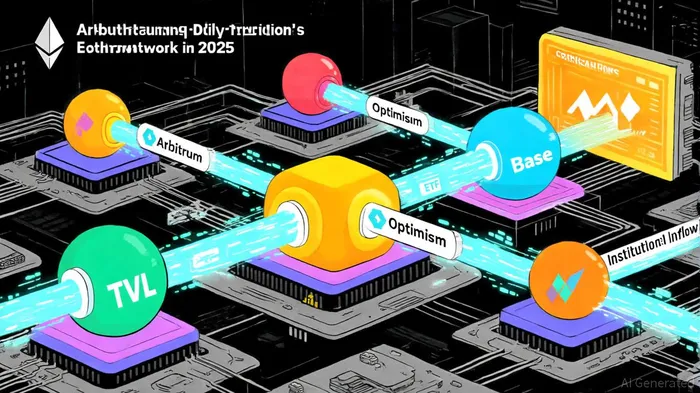
The Case for Ethereum: Network Usage and LayerLAYER-- 2 Scalability
Ethereum's dominance in 2025 is notNOT-- merely a function of price appreciation but a structural shift in blockchain utility. Daily transaction volume has surged past 1.6 million, with smart contract interactions accounting for 62% of activity[1]. This growth is underpinned by Layer 2 (L2) networks like ArbitrumARB-- and Optimism, which now handle 47% of Ethereum's transaction executions[1]. These solutions have reduced gas fees by 90%, making EthereumETH-- accessible for mass adoption while preserving the security of the mainnet[4].
The Dencun upgrade in Q1 2025 further accelerated this trend by slashing data availability costs and enabling scalable use cases[3]. As a result, L2 TVL exploded to $51.5 billion by November 2024—a 205% increase from $16.6 billion in November 2023[5]. Arbitrum and Base alone account for over half of this TVL, with Base processing 1 billion transactions and 106 transactions per second[3]. This infrastructure has positioned Ethereum as the backbone of decentralized finance (DeFi), where TVL now exceeds $223 billion[2].
Institutional Adoption: From ETFs to Corporate Treasuries
Institutional capital is flocking to Ethereum at an unprecedented rate. Ethereum ETFs attracted $33 billion in assets under management by Q3 2025, outpacing BitcoinBTC-- ETF outflows of $1.17 billion[3]. Regulatory clarity under the CLARITY Act normalized Ethereum as a macroeconomic hedge, while staking yields hit 4.8%, offering a compelling alternative to traditional fixed income[2].
Corporate treasuries are also reallocating portfolios to Ethereum. Standard Chartered now holds 10% of all ETHETH-- in institutional treasuries[4], while BlackRock's ETHA fund recorded $12 billion in inflows during July 2025[4]. This shift reflects Ethereum's dual role as both a yield-generating asset and a store of value.
Whale activity reinforces this trend: $5.42 billion in BTC-to-ETH transfers and 22% of Ethereum's supply controlled by whales[3]. These movements signal confidence in Ethereum's deflationary model, driven by EIP-1559 and staking, which has locked 36.15 million ETH—reducing circulating supply and strengthening investor sentiment[1].
Strategic Entry Points for Institutional Investors
For institutional investors, Ethereum's 2025 renaissance presents a unique entry window. The confluence of:
1. Network usage growth (1.92 million daily transactions[1]),
2. Layer 2 scalability (L2s processing six times more transactions than the mainnet[3]), and
3. Institutional inflows ($27.6 billion in ETF assets[2])
creates a flywheel effect. Ethereum's price surged 80% in Q3 2025[2], driven by these factors, but the fundamentals remain robust.
A strategic entry point would prioritize:
- ETF allocations to capture liquidity and regulatory tailwinds.
- Staking yields (4.8%[2]) for passive income generation.
- Layer 2 exposure to platforms like Arbitrum and Base, which are driving real-world adoption[3].
However, risks persist. Liquidity fragmentation across L2s and potential cannibalization of mainnet revenue require careful monitoring[5]. Diversifying across Ethereum's ecosystem—mainnet, L2s, and DeFi—can mitigate these risks while capitalizing on its foundational role in blockchain finance.
Conclusion
Ethereum's dominance in altcoin season is not a speculative bubble but a structural redefinition of blockchain's utility. With institutional adoption accelerating, Layer 2 networks scaling, and TVL surging, Ethereum is no longer just a digital asset—it is the infrastructure of the next financial era. For institutional investors, the question is no longer if to enter, but how to allocate strategically.






Comentarios
Aún no hay comentarios