
Why Ethereum Demand Rises Despite Weak Price Action
Structural Fundamentals: Staking and Institutional Adoption
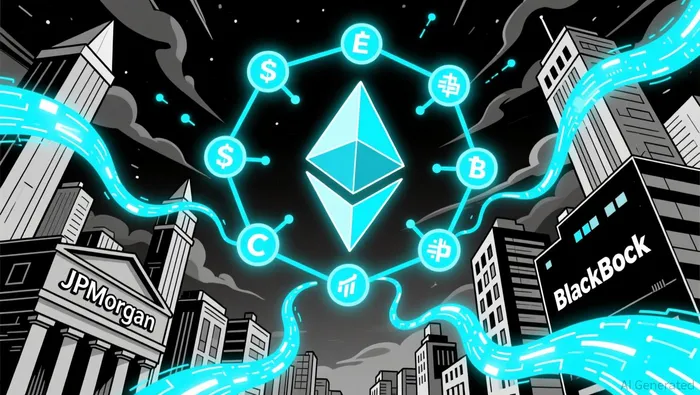
Ethereum's network has become a cornerstone of institutional finance, with over 36 million ETH (nearly 30% of the total supply) staked as of August 2025. This surge in staking participation has been amplified by regulatory clarity, particularly the SEC's recent guidance on liquid staking tokens, which has normalized institutional access to Ethereum's yield-generating mechanisms. Major financial players, including JPMorganJPM--, BlackRockBLK--, and HSBCHSBC--, are now leveraging Ethereum-compatible frameworks for tokenized assets and blockchain-based settlements.
Meanwhile, EthereumETH-- ETF assets under management have grown exponentially, rising from $10.3 billion in July 2025 to $28.6 billion by the end of Q3 2025. This growth underscores institutional confidence in Ethereum's utility, even as macroeconomic factors-such as rising U.S. yields and cooling ETF inflows-weigh on its price. The disconnect here is critical: Ethereum's role as a settlement layer and staking asset is expanding, independent of its price performance.
The Dencun Upgrade and Scalability Breakthroughs
Ethereum's upcoming Dencun upgrade, implemented in March 2024, has already begun reshaping its value proposition. By introducing EIP-4844 (Proto-Danksharding), the upgrade replaced gas-intensive calldata with lightweight blobs, reducing Layer 2 (L2) transaction costs by up to 94%. By early 2026, this innovation has driven Ethereum's combined infrastructure to process an average of 24,192 transactions per second (TPS)-a record high fueled by L2 networks like Arbitrum and Optimism.
The Pectra upgrade in May 2025 further amplified these gains, doubling blob throughput and slashing L2 gas fees by 70%. As a result, L2 transaction fees now average $0.08 compared to the mainnet's $1.85 according to statistics, while L2 total value locked (TVL) reached $51.5 billion in 2025 according to reports. These metrics highlight Ethereum's evolving role as a scalable, low-cost infrastructure for decentralized finance (DeFi) and enterprise applications-a shift that prioritizes utility over speculative demand.
Macroeconomic Headwinds vs. Long-Term Resilience
The current price correction is largely a function of broader market dynamics. In late November 2025, Ethereum's technical breakdown below $3,017 signaled heightened bearish sentiment, exacerbated by a 40% drop in the total crypto market capitalization from its 2024 peak. Institutional players like BitMine, which holds nearly 3% of Ethereum's supply, have also faced significant unrealized losses, with its stock price plummeting 81% despite continued ETH accumulation.
However, historical patterns suggest that Ethereum's structural strengths-such as its deflationary dynamics and institutional adoption-can act as a floor for demand. While the network's daily gas fee revenue has fallen from over $30 million to $500,000 due to L2 migration, this shift reflects a strategic evolution rather than a crisis. By reducing costs and improving scalability, Ethereum is positioning itself to capture a larger share of the global financial infrastructure market, even if its price remains volatile in the short term.
Conclusion: A Foundation for Future Growth
Ethereum's weak price action in late 2025 masks a deeper narrative of structural innovation and institutional adoption. The Dencun and Pectra upgrades have unlocked unprecedented scalability, while regulatory clarity and ETF growth have solidified Ethereum's role in institutional finance. These developments suggest that demand for Ethereum is being driven by its utility as a settlement layer and infrastructure platform, rather than speculative fervor.
For investors, the key takeaway is clear: Ethereum's long-term fundamentals are outpacing short-term volatility. While macroeconomic headwinds will likely persist into early 2026, the network's upcoming catalysts-including the full realization of EIP-4844's potential-position it to reclaim dominance in the crypto ecosystem. In this context, the current price weakness may represent a buying opportunity for those aligned with Ethereum's vision of a decentralized financial future.





Comentarios
Aún no hay comentarios