
Ethereum's Recent Decline and Systemic Risks in Crypto Markets: A Macro-Driven Liquidity Analysis
The Liquidity Conundrum: Ethereum's Stagnant Price and Structural Constraints
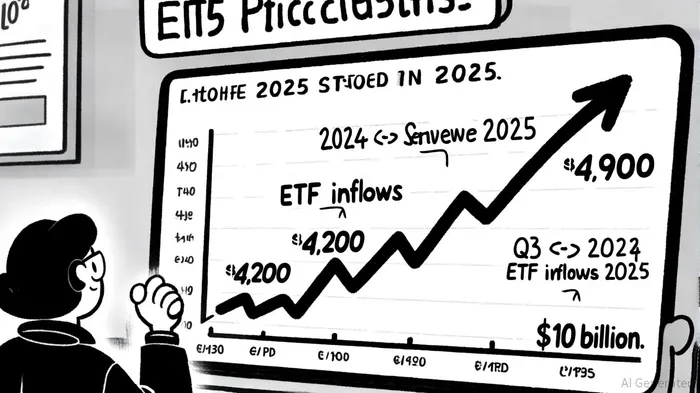
Ethereum's price has languished below the $5,000 thresholdT-- since late 2025, consolidating in a narrow range of $4,200–$4,900, according to a Coinpedia analysis. This stagnation reflects a tug-of-war between Ethereum's foundational upgrades and systemic headwinds. While on-chain metrics like daily active addresses and mainnet transaction volume have plateaued, a significant portion of activity has migrated to Layer-2 solutions, according to the same Coinpedia analysis. Meanwhile, spot EthereumETH-- ETFs-approved in early 2025-have driven modest inflows, but these remain insufficient to catalyze a breakout, per the Coinpedia analysis.
The root of Ethereum's liquidity challenges lies in capital concentration. Bitcoin's dominance index surged to 52% in Q1 2025, siphoning institutional and retail capital away from altcoins, as noted in the Coinpedia analysis. Institutional investors, wary of regulatory uncertainty around staking and re-staking mechanisms, have adopted a risk-averse posture, according to a Forbes article. This dynamic is exacerbated by Ethereum's own structural constraints: despite deflationary mechanisms like EIP-1559 and staking yields of 4–6%, the network's utility as a smart contract platform faces stiff competition from faster blockchains like SolanaSOL--, the Forbes article argues.
Systemic Risks: From Smart Contract Vulnerabilities to Macroeconomic Shocks
Ethereum's ecosystem is rife with systemic risks. The proliferation of Layer-2 solutions and re-staking protocols has created new attack vectors. A single smart contract exploit could trigger cascading failures, particularly as re-staking mechanisms lock up significant ETHETH-- reserves, according to the Forbes article. For instance, the Dencun hard fork's EIP-4844 upgrade, while reducing Layer-2 data costs by 90%, also centralizes validation power among a few staking pools, according to a Crowdfund Insider report.
Macroeconomic factors further amplify these risks. U.S. Treasury yields, which stabilized at 4.1% in Q3 2025, signal lingering inflation concerns and fiscal uncertainty, per a Twelve Points review. Higher yields increase the cost of capital, dampening speculative activity in volatile assets like Ethereum, as noted in the Crowdfund Insider report. Meanwhile, the Federal Reserve's easing cycle-culminating in a 0.25% rate cut in September 2025-has created a mixed environment. While lower rates stimulate risk-on behavior, the Fed's cautious tone (emphasizing inflation remains above 2%) has curbed excessive optimism, according to the Coinpedia analysis.
Ethereum's correlation with traditional markets underscores its macro sensitivity. The asset now exhibits a 0.77 correlation with the S&P 500 and a growing link to the Russell 2000, suggesting it behaves more like a cyclical equity than a store of value, according to a Phemex analysis. This alignment exposes Ethereum to broader economic downturns, as seen in Q3 2025 when gold prices hit $3,800/oz, signaling a flight to safety, per the Twelve Points review.
Macro-Driven Investment Strategies: Navigating Liquidity and Volatility
Investors must adopt a dual approach to Ethereum: hedging against macroeconomic shocks while capitalizing on liquidity tailwinds.
ETF Inflows as a Proxy for Institutional Confidence
Ethereum's ETF inflows in Q3 2025 ($10.2 billion) outpaced Bitcoin's early ETF performance, indicating strong institutional demand, according to the Crowdfund Insider report. However, these inflows are concentrated in a few large providers, creating liquidity imbalances. For example, Bitget overtook Binance as the leader in ETH liquidity within the +/- $15 price range, while Binance retained dominance at wider depths, per the Twelve Points review. This fragmentation highlights the need for diversified exposure to avoid overreliance on single exchange dynamics.Rate Cuts and the "Risk-On" Narrative
The Fed's September 2025 rate cut (4.00–4.25%) provided a short-term boost, pushing Ethereum above $4,600, the Coinpedia analysis notes. However, the gains were limited as the market had already priced in the move. A more aggressive easing cycle-e.g., 100 bps of cuts in 2025-could drive Ethereum toward $6,000, mirroring Bitcoin's trajectory, per the Coinpedia analysis. Investors should monitor inflation expectations: Ethereum's price has historically spiked during periods of de-anchored expectations, such as the March 2025 surge noted in the Phemex analysis.Regulatory Tail Risks and DeFi Resilience
Regulatory clarity remains a double-edged sword. While U.S. legislation promoting stablecoins and DeFi boosted Ethereum's TVL to $88 billion in Q3 2025, according to the Crowdfund Insider report, unresolved questions about staking's legal classification could trigger a sell-off. A prudent strategy involves allocating a portion of Ethereum holdings to private custody or staking protocols, reducing exposure to exchange-specific risks, the Forbes article recommends.
Conclusion: A Delicate Balance Between Innovation and Instability
Ethereum's 2025 trajectory hinges on three variables: the success of its network upgrades, the pace of ETF inflows, and the Fed's inflation-fighting resolve, the Forbes article concludes. While the asset's deflationary mechanics and DeFi ecosystem position it for long-term growth, near-term volatility will persist due to liquidity imbalances and macroeconomic fragility. Investors must weigh these factors against a backdrop of rising systemic risks, from smart contract vulnerabilities to the "Reverse Conundrum" of elevated Treasury yields, as highlighted in the Twelve Points review.
For now, Ethereum remains a high-conviction play for those willing to navigate its liquidity challenges and macroeconomic sensitivities.






Comentarios
Aún no hay comentarios