
Ethereum at a Crossroads: Whale Accumulation vs. Fragile Market Fundamentals
Whale Accumulation: A Signal of Institutional Confidence
The third quarter of 2025 saw a surge in EthereumETH-- accumulation by institutional players. BitMine ImmersionBMNR-- Technologies alone acquired $137 million in ETH, while Ethereum Treasury Companies collectively increased their holdings by 260% to 4.36 million ETH, according to an Oak Research report. This trend is not merely speculative: these entities are leveraging staking and restaking to generate yields, positioning ETH as a productive asset.
Spot Ethereum ETFs further underscore this institutional shift. Despite a $837 million outflow in early November, Q3 2025 saw ETF assets under management (AUM) balloon from $10.13 billion to $27.63 billion, according to the same Oak Research report. BlackRock's dominance in inflows and the broader approval of Ethereum ETFs in July 2024, as noted in the MarketWatch report, have normalized institutional exposure to the asset.
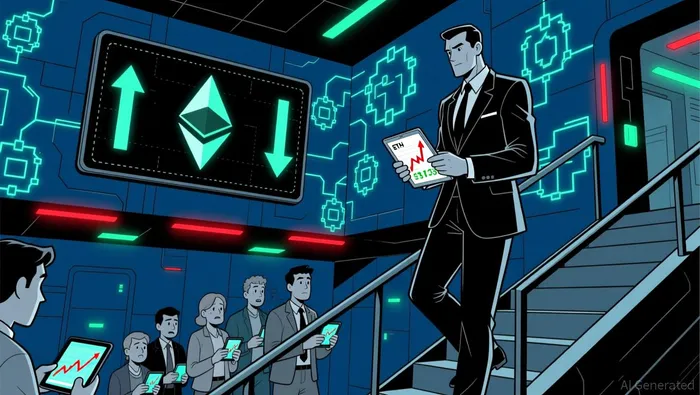
Fragile Fundamentals: The Hidden Risks
While accumulation trends are bullish, Ethereum's on-chain metrics tell a more nuanced story. DeFi total value locked (TVL) hit $119 billion in Q3 2025, according to a Coinotag report, but daily active wallets for AI and SocialFi DApps fell by 22.4% compared to Q2, according to the same Coinotag report. This divergence highlights a critical issue: institutional liquidity is propping up TVL, but retail participation-a barometer of network health-is waning.
Transaction volumes, meanwhile, remain mixed. Daily transactions averaged 1.65 million in Q1 2025, according to a Coinlaw report, but net inflation for ETH persisted due to reduced burn rates from low fees, according to the Oak Research report. The Ethereum Foundation's treasury, valued at $974.4 million by Q3's end, according to the Oak Research report, reflects growing institutional interest, yet developer activity-while robust-has not translated into user growth.
Strategic Entry Points in a Bearish Environment
For institutions, the key lies in balancing these dynamics. Here are three actionable strategies:
Leverage ETF Volatility: The recent outflows from spot ETFs, particularly BlackRock's ETHA, as noted in the MarketWatch report, suggest short-term bearish sentiment. However, historical patterns show that ETF outflows often precede accumulation by whales. Institutions could use these dips to add to positions, especially as the Fusaka upgrade in late 2025 promises scalability improvements, according to a PowerDrill AI blog.
Focus on Staking Yields: With 30.4% of ETH staked by Q3 2025, according to the Oak Research report, institutions can capitalize on restaking protocols to generate passive income. Companies like BitMine and SharpLink Gaming are already demonstrating how staking can offset bear market losses, according to the Oak Research report.
Monitor Regulatory Catalysts: The potential approval of Ethereum ETF staking yields in early 2026, according to the PowerDrill AI blog, could unlock new inflows. Institutions should position themselves to benefit from this regulatory clarity, which may attract traditional finance players like UBS, as noted in the MarketWatch report.
Conclusion: Navigating the Crossroads
Ethereum's 2025 landscape is defined by a tug-of-war between institutional optimism and fragile user metrics. For strategic investors, the bearish environment offers a unique opportunity to acquire ETH at discounted prices while hedging against volatility through staking and ETF exposure. The Fusaka upgrade and regulatory developments will likely determine whether this accumulation trend translates into sustained price appreciation.
As the market awaits these catalysts, institutions must remain agile-balancing long-term conviction with tactical precision.





Comentarios
Aún no hay comentarios