
Ethereum's Crossroads: Navigating Near-Term Volatility Amid Long-Term Protocol Breakthroughs
Near-Term Challenges: Volatility and Security Risks
Ethereum's price has historically exhibited sharp swings around major upgrades. The Shanghai upgrade in 2023, for instance, initially triggered concerns about increased ether supply due to validator withdrawals, though the broader market eventually absorbed the shock as confidence in Ethereum's proof-of-stake model solidified, as noted in a Yahoo Finance analysis. Similarly, the Fusaka upgrade, while promising, introduces untested mechanisms like PeerDAS (EIP-7594), which could face unforeseen bottlenecks during mainnet activation, according to an Axon Trade report.
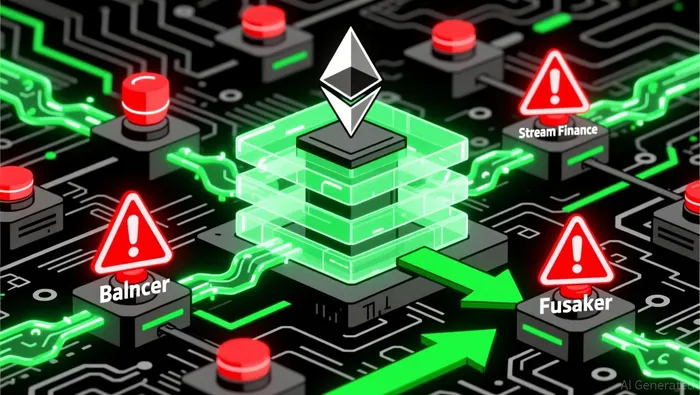
Security remains a critical vulnerability. The BalancerBAL-- and Stream Finance exploits in 2025-resulting in over $200 million in losses-highlight the fragility of DeFi protocols, even as Ethereum's core infrastructure strengthens, as detailed in a Coinotag report. These incidents underscore the need for robust risk management, particularly for investors exposed to decentralized finance (DeFi) and tokenized assets.
Long-Term Growth: Scalability and Institutional Adoption
Ethereum's "Surge" roadmap is delivering tangible results. The Fusaka upgrade's 150 million gas limit increase and blob data optimizations are projected to double Layer 2 throughput, enabling daily transactions exceeding 5 million by mid-2026, according to an Axon Trade report. This scalability, combined with EIP-4844's 90% reduction in Layer 2 data costs, positions EthereumETH-- as the backbone of a modular blockchain ecosystem, as noted in a TradingView summary.
Institutional adoption is accelerating. Major players like BlackRock and Societe Generale have launched tokenized funds on Ethereum, while the EU's MiCA framework and U.S. SEC guidance are fostering regulatory clarity, as noted in a TradingView summary. Validator count has surpassed 1 million, securing 28% of the total supply, and staking yields remain attractive at 4.1% for solo validators, as noted in a TradingView summary. These metrics suggest Ethereum's network effect is maturing, even as it navigates short-term turbulence.
Strategic Positioning for Investors
- Diversification and Hedging: Allocate 40% of crypto portfolios to BitcoinBTC-- and Ethereum, 30% to narrative-driven assets (e.g., ArbitrumARB--, zkSync), and 15% to stablecoins, as advised in an Axon Trade report. Hedging with USDC or USDT during upgrade periods can mitigate sudden drawdowns.
- Dollar-Cost Averaging (DCA): Given Ethereum's volatility, DCA mitigates the risk of entering at peak prices. For example, investing $500 monthly into ETH since 2023 would have averaged costs during the Shanghai and Dencun cycles, as noted in a Yahoo Finance analysis.
- AI-Driven Risk Management: Tools like Token Metrics can identify protocol-related risks (e.g., gas limit adjustments) and opportunities (e.g., Layer 2 adoption trends), as advised in an Axon Trade report.
- Security First: Hardware wallets and 2FA are non-negotiable for holding significant ETH or DeFi positions, especially post-exploit, as detailed in a Coinotag report.
Conclusion: Balancing Optimism and Prudence
Ethereum's long-term potential is undeniable, with Fusaka and future upgrades like Pectra (mid-2025) addressing scalability while preserving decentralization, as noted in a TradingView summary. However, near-term volatility and security risks necessitate disciplined strategies. Investors who combine technical analysis of protocol milestones with prudent risk management-such as hedging and DCA-will be best positioned to capitalize on Ethereum's next phase of growth.






Comentarios
Aún no hay comentarios