
Ethereum at the Crossroads: Decentralization Risks vs. Institutional Growth
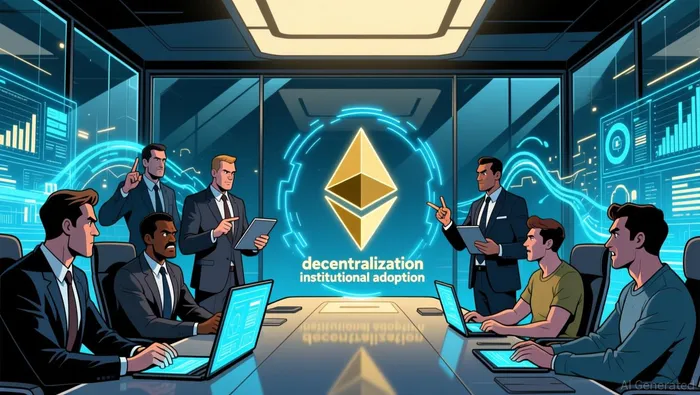
Ethereum stands at a pivotal juncture in 2025, where its foundational principles of decentralization clash with the gravitational pull of institutional adoption. As the second-largest cryptocurrency by market capitalization, EthereumETH-- has become the backbone of decentralized finance (DeFi), tokenized real-world assets (RWAs), and enterprise-grade blockchain infrastructure. However, this growth has come at a cost: rising centralization risks in staking, sequencer operations, and Layer 2 (L2) fragmentation. For investors, the challenge lies in balancing Ethereum's institutional promise with its protocol-level vulnerabilities.
Decentralization Under Pressure
Ethereum's post-Merge validator landscape reveals a mixed picture. By mid-2025, approximately 1.04–1.06 million validators were active, with 30–34 million ETH staked (28–30% of total supply). While validator uptime remains robust at 99.2–99.5%, concerns persist over stake concentration. Liquid staking protocols like Lido control 29–31% of staked ETH, creating a single point of failure that could undermine the network's resilience.
 Distributed Validator Technology (DVT) has emerged as a countermeasure, splitting validator duties across multiple operators to reduce centralization risks. Yet, the dominance of staking pools remains a critical vulnerability. For investors, this tension between scalability and decentralization demands scrutiny: while high staking yields (3–4%) attract institutional capital, over-reliance on centralized staking services could expose portfolios to systemic risks.
Institutional Adoption: A Double-Edged Sword
According to market data, institutional adoption has surged, with corporate treasuries and ETFs holding over 10 million ETH ($46.22 billion by August 2025). Ethereum's role in tokenized RWAs and stablecoin settlements has further cemented its relevance. Over 50 global enterprises, including BlackRock, Deutsche Bank, and Sony, are building on Ethereum and its L2s, leveraging smart contracts for programmable finance (https://www.xbto.com/resources/ethereum-at-a-crossroads-institutional-adoption-vs-market-underperformance).
However, November 2025 saw Ethereum's price drop by 21.16%, reflecting broader market volatility and weak on-chain activity. Despite this, Ethereum's infrastructure remains resilient: 72% of its supply is staked or locked in smart contracts, while L2s process the majority of transactions. Institutional-grade ETPs faced redemptions in November, but these outflows were deemed manageable.
The key question for investors is whether Ethereum's institutional traction can translate into sustained valuation growth. While the platform's market cap ($224 billion as of April 2025) underscores its dominance, its price performance has lagged behind Bitcoin and Solana. This divergence highlights the need for strategies that decouple Ethereum's utility from its speculative price action.
Protocol Complexity and L2 Fragmentation
Ethereum's Dencun upgrade (EIP-4844) has revolutionized L2 scalability, slashing data costs by 90% and enabling rollups like ArbitrumARB-- and Optimism to handle billions of transactions monthly. These advancements have shifted value growth expectations from L1 to L2 ecosystems, with L2 TVL projected to surpass L1 DeFi TVL by Q3 2026.
Yet, this progress comes with trade-offs. The proliferation of L2s has led to severe fragmentation, creating isolated liquidity islands and complicating cross-chain transfers. Security vulnerabilities in bridges and the rise of restaking protocols like EigenLayerEIGEN-- introduce new risks, including financial interdependence and potential chain liquidations.
For investors, the challenge lies in navigating this complexity. While L2s offer cost efficiency and scalability, their fragmentation necessitates diversified exposure across multiple rollups. Additionally, the Ethereum Foundation's EcoDev strategy-funding universal standards and developer toolkits-aims to mitigate these risks, but its success remains unproven.
Strategic Investment Considerations
Investors must adopt a dual strategy to balance Ethereum's institutional potential with its protocol risks:
1. Focus on L2 Ecosystems: Allocate capital to L2s with strong enterprise partnerships (e.g., Arbitrum, Optimism) and robust TVL growth. These networks are projected to capture 40% of global tokenization flows by 2030.
2. Hedge Against Centralization: Prioritize staking solutions that integrate DVT or decentralized sequencer operations to mitigate validator concentration risks (https://blog.bitium.agency/measuring-decentralization-metrics-trends-in-2025-db51aef04d0c).
3. Monitor Regulatory Clarity: Ethereum's institutional adoption hinges on regulatory frameworks for staking and tokenization. Favor jurisdictions with clear guidelines, such as the U.S. and EU.
The staking market itself is a growth vector, projected to expand to $200 billion by 2030 as participation rises from 28% to 40%. However, investors must remain cautious about overexposure to restaking protocols, which amplify leverage and systemic risk.
Conclusion
Ethereum's 2025 trajectory is defined by a delicate balancing act: leveraging institutional adoption to drive utility while preserving decentralization. For investors, the path forward lies in strategic diversification across L2s, hedging against centralization risks, and capitalizing on Ethereum's role in tokenized infrastructure. As the platform navigates protocol complexity and market volatility, its ability to adapt will determine whether it remains the bedrock of Web3 or cedes ground to emerging competitors.






Comentarios
Aún no hay comentarios