
Ethereum's Critical Technical Levels: A Strategic Buy Opportunity Amid $3,000 Threat?
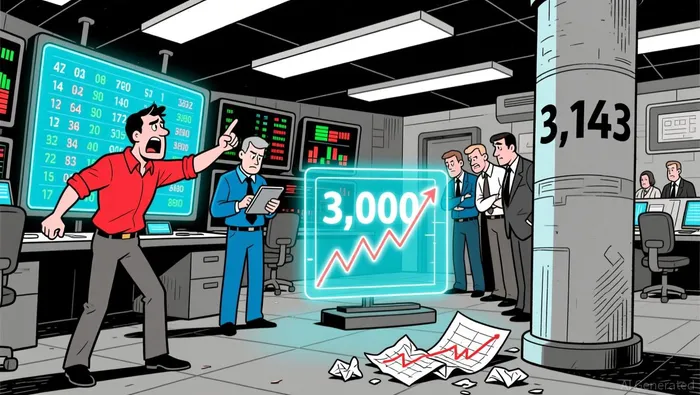
Ethereum's price action in late 2025 has painted a complex picture of resilience and vulnerability. As the asset consolidates near the $3,000 psychological level, traders and investors are scrutinizing key technical inflection points: the $3,143 rejection, the $3,425 failed auction, and the $3,000 support zone. These levels, combined with on-chain data and market sentiment, offer a compelling case for contrarian investors to assess whether EthereumETH-- is poised for a bullish reversal or a deeper correction.
The $3,143 Rejection: A Structural Floor in a Corrective Pattern
Ethereum's rejection at $3,143 has emerged as a critical technical target within a broader Elliott Wave (c) structure of a corrective pattern according to technical analysis. This level, aligned with Fibonacci extensions, represents a confluence of historical support and on-chain accumulation. Notably, Ethereum's record-breaking 8.7 million smart contract deployments in Q4 2025 according to on-chain data suggest robust developer activity, which could reinforce the asset's long-term fundamentals even as short-term price action remains volatile.
The rejection at $3,143 has not been a clean bounce but rather a grinding consolidation phase. On-chain volume profiles indicate that this level has absorbed significant selling pressure, with buyers stepping in to defend it. If Ethereum can hold above $3,143, it may signal the completion of a corrective wave and open the door to a retest of the $3,900–$4,000 resistance zone according to market analysis. However, a breakdown below this level could trigger a cascade of stop-loss orders, testing the $2,700 support area according to bearish analysis.
The $3,425 Failed Auction: A Bullish Signal Amid Structural Weakness
The failed auction at $3,425 has become a focal point for technical analysts. A failed auction occurs when price breaks below a key support level but is then rejected lower, indicating exhausted selling pressure and potential buyer interest. In Ethereum's case, the rejection at $3,425 has been accompanied by a surge in validator queue dynamics, with 745,000 ETH awaiting staking-a sign of renewed institutional and retail participation according to market data.
Order book depth analysis reveals a liquidity concentration around $3,425, suggesting that this level could act as a magnet for buyers if price revisits it. However, the path to $3,425 is fraught with overhead supply. The Cost Basis Distribution Heatmap shows 2.83 million ETH accumulated between $3,151 and $3,172, forming a heavy resistance zone according to on-chain indicators. Overcoming this supply wall would require sustained bullish momentum and a shift in macroeconomic sentiment, particularly as global economic concerns-such as U.S. government shutdowns and poor consumer sector earnings-continue to weigh on risk appetite according to macroeconomic analysis.
The $3,000 Psychological Support: A Battle for Market Control
The $3,000 level is more than a technical target-it is a psychological battleground. Ethereum has spent much of late 2025 consolidating within a $2,800–$3,000 range, with neither bulls nor bears gaining full control according to market reports. On-chain data reveals that this zone is the Point of Control (POC) for the current trading range, where the highest volume has been traded according to on-chain data.
Validator queue dynamics further complicate the picture. The fact that Ethereum's entry queue has surpassed the exit queue for the first time in six months according to validator data signals a tightening supply profile. This structural shift could act as a tailwind for price if the asset manages to reclaim $3,000. However, a breakdown below $2,870 could trigger $862 million in long position liquidation intensity on mainstream exchanges according to risk analysis, amplifying downside risk.
Market Sentiment: Neutral Ground Amid Contrarian Signals
Ethereum's Fear and Greed Index currently sits at a neutral 56–58 according to sentiment data, reflecting a market in transition. While this neutrality suggests a lack of extreme fear or greed, it also indicates that neither bulls nor bears are driving the narrative. This is a classic setup for a breakout or breakdown, as sentiment remains uncommitted.
Whale activity, however, tells a different story. Ancient whales with a cost basis below $400 have repeatedly sold large volumes when Ethereum broke above $4,000, realizing billions in profits according to on-chain activity. These actions suggest that long-term holders are taking profits at higher levels, potentially setting the stage for a retest of lower support zones. Meanwhile, spot Ethereum ETFs have seen net outflows of $72 million in 2025 according to financial reports, signaling reduced institutional confidence.
Strategic Implications for Contrarian Investors
For contrarian investors, the interplay between these technical levels and market sentiment creates a high-conviction entry opportunity. The $3,143 rejection and $3,425 failed auction suggest that Ethereum's bearish momentum is waning, while the $3,000 support zone offers a clear risk-reward profile.
Key entry points to consider include:
1. $3,143–$3,172: A breakout above this zone could signal the completion of a corrective pattern and open the path to $3,900.
2. $3,425: A retest of this failed auction level could trigger a bullish reversal if buyers defend it.
3. $3,000: A clean close above this psychological level would confirm a shift in market control and validate the accumulation phase.
However, investors must remain cautious. A breakdown below $2,870 or $2,700 would invalidate the bullish case, necessitating a reassessment of risk. Position sizing and stop-loss placement should reflect the volatile nature of the market, particularly as Ethereum navigates a macroeconomic environment marked by uncertainty.
Conclusion
Ethereum's critical technical levels-$3,143, $3,425, and $3,000-represent a crossroads for the asset. While the bearish pressure of 2025 has been formidable, the structural shifts in on-chain activity, validator dynamics, and whale behavior suggest that Ethereum is not out of the fight. For contrarian investors, the current consolidation phase offers a unique opportunity to position for a potential bullish reversal, provided they remain disciplined and vigilant in managing risk.







Comentarios
Aún no hay comentarios