
Ethereum's Critical Support and Resistance Levels: Tactical Entry Points for Long-Term Investors in 2025
Ethereum (ETH) has long been a cornerstone of the crypto market, and as of September 2025, it remains a focal point for both retail and institutional investors. With the asset consolidating near critical support and resistance levels, long-term investors have a unique opportunity to assess tactical entry points. This analysis synthesizes technical and fundamental insights to outline a strategic approach for those seeking to position themselves for Ethereum's next phase of growth.
Key Support and Resistance Levels: A Technical Overview
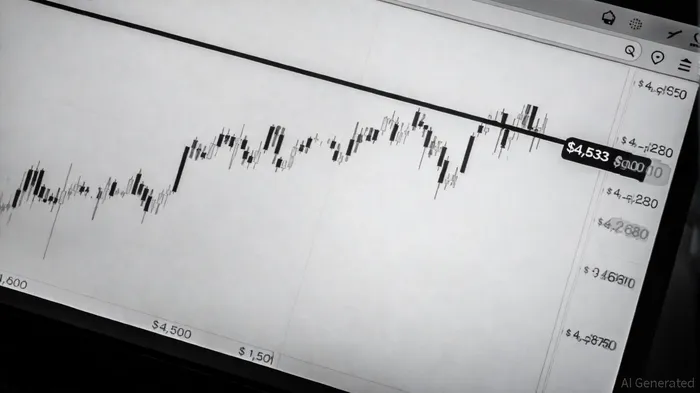
Ethereum is currently trading near $4,533, with $4,500 acting as a pivotal support level[2]. Below this, immediate support zones include $4,460 and $4,495[1], while a deeper support range of $3,875–$4,000 serves as a critical psychological and technical floor[2]. On the resistance side, $4,650 is a key threshold[2], with additional hurdles at $4,220–$4,280[2].
Technical indicators paint a mixed picture. The Relative Strength Index (RSI) and Stochastic Oscillator suggest overbought conditions, hinting at potential short-term corrections[2]. Meanwhile, the Moving Average Convergence Divergence (MACD) remains bullish, indicating sustained buying pressure[2]. This duality underscores a market in equilibrium, where a breakout above $4,650 could trigger a rally toward $5,000 and even $5,500 by mid-October[2]. Conversely, a breakdown below $4,500 risks a pullback to $4,000[2].
Fundamental Catalysts: Why Ethereum's Foundation Remains Strong
Despite short-term volatility, Ethereum's fundamentals are robust. Institutional inflows have accelerated, driven by growing demand for Ethereum-based assets in DeFi and NFTs[2]. Network upgrades like EIP-4844 (Proto-Danksharding) and the upcoming Fusaka upgrade are enhancing scalability and reducing gas fees, making the ecosystem more attractive for developers and users[4].
Regulatory clarity is another tailwind. With the U.S. SEC's tentative approval of EthereumETH-- ETFs and the EU's MiCA framework nearing implementation, institutional adoption is poised to accelerate[2]. These developments create a flywheel effect: stronger utility, higher demand, and increased capital inflows.
Tactical Entry Points for Long-Term Investors
For long-term investors, Ethereum's current price action offers multiple entry opportunities:
- Breakout Above $4,650: A sustained close above this level would validate bullish momentum. Investors could consider entering at $4,650–$4,700, with a target of $5,000 and a stop-loss below $4,500[2].
- Support Re-test at $4,500: If Ethereum consolidates near this level, dips to $4,460–$4,495 present a high-probability entry for those comfortable with short-term volatility[1].
- Deep Value at $4,000–$3,875: A breakdown to this range would likely trigger panic selling, creating a contrarian buying opportunity for long-term holders. Historical data suggests Ethereum has historically rebounded from such levels[2].
Dollar-cost averaging (DCA) is recommended for risk-averse investors, with incremental purchases at each support level. Given Ethereum's role as a “blue-chip” crypto asset, even a 5–10% allocation in a diversified portfolio could capture its long-term upside.
Risks and Mitigations
While the outlook is optimistic, risks persist. Regulatory headwinds in key markets (e.g., China or the U.S.) could disrupt momentum[2]. Additionally, macroeconomic factors like rising interest rates might pressure risk assets. To mitigate these, investors should:
- Diversify across crypto and traditional assets.
- Use stop-loss orders to limit downside risk.
- Monitor on-chain metrics (e.g., active addresses, gas usage) for early signs of weakness[4].
Conclusion: Positioning for the Next Bull Cycle
Ethereum's confluence of strong fundamentals and strategic price levels makes it a compelling case for long-term investors. Whether through breakout plays, support re-tests, or deep-value entries, the key is to align tactics with a long-term thesis. As the Fusaka upgrade looms and ETF inflows materialize, Ethereum is well-positioned to reclaim its status as the leading smart-contract platform—and its price could reflect that reality in the months ahead.






Comentarios
Aún no hay comentarios