
Ethereum's Critical Price Threshold: Assessing $9 Billion in Liquidation Risks
The Fragile Equilibrium: Ethereum's Price Volatility and Systemic Risks
Ethereum's price in October 2025 has become a focal point for institutional investors and regulators alike, as the asset teeters between bullish momentum and bearish headwinds. Trading near $4,100, ETHETH-- has recently reclaimed the $4,000 psychological threshold, buoyed by regulatory tailwinds such as streamlined EthereumETH-- ETF approvals and increased institutional staking activity . However, this recovery is shadowed by a precarious $9 billion liquidation risk tied to a 5% price movement-a vulnerability that could trigger a self-reinforcing cycle of forced selling or buying, destabilizing broader market conditions, according to an Observer analysis.
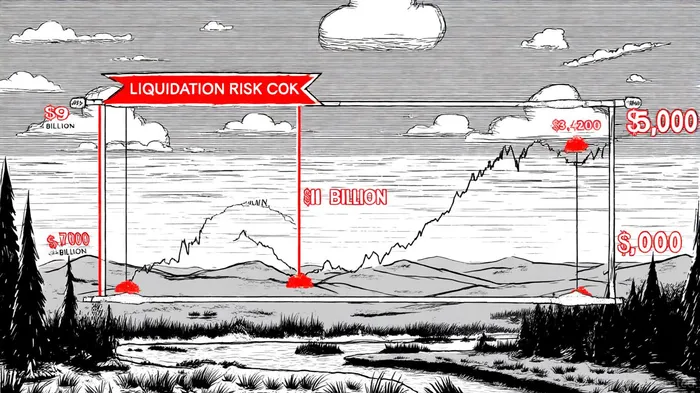
The critical price thresholds of $4,200 and $5,000 represent linchpins for systemic stability. A 10% rally to $21,000 could liquidate $10 billion in short positions, while a dip below $5,000 risks $12 billion in long liquidations, as reported by The Market Periodical and Currency Analytics. These figures underscore the fragility of leveraged positions across major exchanges, where concentrated bets amplify the potential for cascading failures. For instance, a 15% price correction in August 2025 already triggered $4.7 billion in liquidations, with 83% of affected positions being long trades, according to Currency Analytics. Such events highlight the interconnectedness of Ethereum's derivatives markets and the systemic risks posed by high leverage.
Institutional Strategies: Hedging and Risk Mitigation in a Volatile Ecosystem
Institutional investors are navigating these risks through a combination of hedging tools, diversified portfolios, and dynamic risk management frameworks. Futures and options markets have emerged as critical instruments for managing exposure. For example, Ethereum's derivatives platforms-such as CME and Deribit-offer liquidity and tighter spreads, enabling institutions to deploy protective puts or covered calls to limit downside risk while preserving upside potential, a point noted by The Market Periodical. This shift mirrors traditional finance's risk management practices, with 72% of institutional investors in 2025 adopting real-time credit monitoring tools and enhanced custodial solutions, as discussed in the Observer piece.
Staking and liquid staking tokens (LSTs) like stETH further illustrate institutional strategies. While staking yields have compressed to under 3% APY, Currency Analytics reports that institutions are leveraging these mechanisms to generate passive income while maintaining liquidity. However, the systemic risks of LSTs-such as stETH's $13 billion in TVL and 42-day withdrawal delays-pose liquidity constraints that could destabilize DeFi markets during a crisis, according to Currency Analytics. To mitigate this, firms are diversifying their treasuries into alternative tokens like AVAXAVAX-- and MNT, reducing overexposure to ETH's price swings (the Currency Analytics analysis referenced above).
Systemic Exposure: Interdependencies and Protocol Risks
Ethereum's systemic vulnerabilities extend beyond price volatility to its interconnected protocols and DeFi infrastructure. The Ethereum Leverage Ratio (ELR) of 0.53-a historically elevated level-reflects the concentration of leveraged positions across platforms like AaveAAVE-- and EigenLayerEIGEN--, a trend highlighted by Currency Analytics. These protocols, while innovative, introduce single points of failure. For instance, EigenLayer's restaking mechanisms could cascade risks across multiple services if a node or smart contract fails, a scenario explored in Currency Analytics' coverage.
Moreover, Ethereum's role as the backbone of the stablecoin ecosystem-where 63% of USDCUSDC-- circulates on its blockchain-amplifies its systemic importance, as the Observer analysis notes. A shock to Ethereum's price could ripple through stablecoin pegs, triggering broader financial instability. This is compounded by the rise of real-world asset (RWA) tokenization on Ethereum, which has increased institutional demand for ETH as a settlement asset, according to an OKX guide.
Strategic Positioning for Institutional Investors
To navigate these challenges, institutions are adopting multi-layered strategies:
- Dynamic Collateral Management: Platforms are implementing partial liquidation protocols to prevent bad debt accumulation, allowing incremental adjustments to insolvent positions without overwhelming the system, as described by Cyfrin.
- Stress Testing and Scenario Analysis: DeFi protocols are conducting simulations to prepare for oracle failures, bridge exploits, and regulatory shocks, refining risk controls to withstand extreme conditions (see Cyfrin's coverage for more detail).
- Regulatory Compliance and Custody Solutions: Institutions are prioritizing MiCA-compliant custody frameworks and institutional-grade key management to secure assets while adhering to evolving regulations, a priority underscored in the Observer piece.
For example, World Liberty FinancialWLFI-- (WLFI) diversified its Ethereum treasury into alternative tokens to hedge against ETH's volatility, according to Currency Analytics, while SharpLink Gaming secured its holdings with multi-signature wallets and cold storage, a measure recommended in the Observer analysis. These approaches reflect a broader trend toward balancing yield generation with risk mitigation.
Conclusion: Navigating the Precipice
Ethereum's critical price thresholds in October 2025 represent both an opportunity and a warning. While institutional adoption and regulatory clarity have driven treasury growth to $11.32 billion, per Currency Analytics, the $9 billion liquidation risk at a 5% price movement underscores the ecosystem's fragility. Institutions must continue refining their hedging strategies, diversifying exposures, and stress-testing protocols to avoid cascading failures. As Ethereum's role in DeFi and TradFi converges, the balance between innovation and stability will define its trajectory in the months ahead.






Comentarios
Aún no hay comentarios