
Ethereum's Critical $2,900 Support Level and the Implications for Leveraged Traders and Institutional Capital
Ethereum's price action around the $2,900 support level has become a focal point for market participants, with systemic risks and leveraged capital positioning creating a precarious equilibrium. As of late December 2025, EthereumETH-- (ETH) hovers near this psychological threshold, having repeatedly tested it since November. The implications for leveraged traders and institutional capital are profound, as the market structure reveals a fragile balance between short-term resilience and long-term vulnerability.
Liquidation Risks and Leverage Ratios: A Double-Edged Sword
The $2,900 level is not merely a technical support zone but a liquidation hotspot. According to Coinglass data, a breakdown below this level could trigger $802 million in long liquidations on centralized exchanges (CEXs), while a breakout above $3,000 might unleash $228 million in short liquidations. These figures underscore the asymmetry in risk exposure, with longs facing significantly higher systemic pressure. The Ethereum Leverage Ratio, a metric calculated as open interest divided by coin reserves, has reached a record high, surpassing even Bitcoin's levels. This ratio currently approaches 0.76-a threshold historically associated with cascading liquidations according to market analysis. Such elevated leverage amplifies the potential for abrupt price swings, particularly in low-liquidity environments.
Order Book Depth and Institutional Accumulation: A Tug-of-War
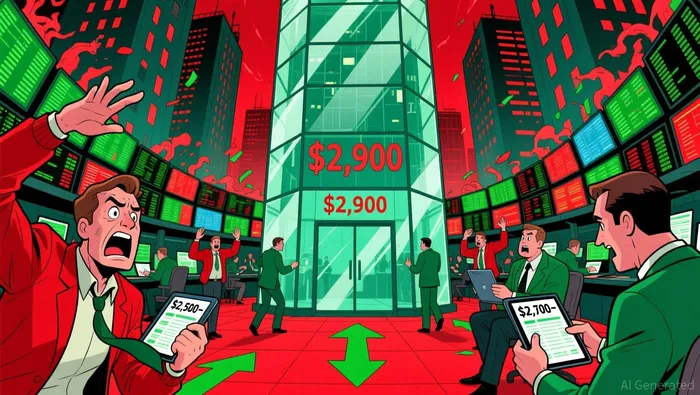
Order book depth at $2,900 reveals a mixed picture. While the $2,500–$2,700 zone has emerged as a critical floor, absorbing heavy selling pressure, the immediate support at $2,900 appears thin. Institutional activity, however, offers a counterbalance. BitMine, a major institutional player, has accumulated over 64,622 ETH, signaling long-term confidence in Ethereum's value proposition despite near-term volatility. Similarly, whale accumulation of 138,000 ETH over a week has reduced exchange reserves, suggesting a strategic shift toward off-chain holdings. These actions imply that institutional capital views the $2,900–$2,700 range as a strategic entry point, even as retail sentiment remains bearish.
Technical Indicators and Market Sentiment: A Precarious Equilibrium
Technical indicators further highlight the market's fragility. The Relative Strength Index (RSI) sits at 46, indicating weak-to-neutral momentum, while the Moving Average Convergence Divergence shows a bearish crossover, signaling waning upward momentum. The compression pattern between $2,900 and $3,000 suggests a high probability of a decisive move once liquidity stabilizes or shifts.
Meanwhile, the Crypto Fear & Greed Index has plummeted to 21, reflecting extreme fear among retail investors. This sentiment is compounded by ETF outflows exceeding $560 million in December 2025, which have exacerbated downward pressure.
Systemic Risk Indicators: A Looming "Prisoner's Dilemma"
Systemic risks are further amplified by on-chain metrics. Exchange reserves have surged to 16.6 million ETH, indicating increased selling pressure as tokens are moved onto exchanges for liquidation. The Coinbase Premium, a measure of US investor sentiment, has turned deeply negative at -0.08, reflecting discounted selling. Additionally, the recent forced liquidation of 24,291 ETH by corporate treasury firm ETHZilla has exposed structural vulnerabilities. Large-scale holders now face a "Prisoner's Dilemma," where balance sheet constraints may force premature sales during volatile periods, exacerbating downward spirals.
Conclusion: A Critical Juncture for Leveraged Capital
Ethereum's $2,900 support level represents a critical inflection point for leveraged traders and institutional capital. The interplay of order book depth, leverage ratios, and institutional accumulation creates a high-stakes environment where a minor price deviation could trigger cascading liquidations. For leveraged traders, the risk-reward asymmetry is stark: longs face a potential $802 million loss if the level breaks, while shorts have a smaller but still significant $228 million exposure on the upside. Institutions, meanwhile, are betting on the $2,500–$2,700 zone as a floor, but their confidence may be tested if ETF outflows and declining spot volumes persist.
As the market approaches this pivotal moment, the fragility of Ethereum's structure becomes increasingly apparent. The coming weeks will likely determine whether this support level holds-or collapses under the weight of systemic risk.







Comentarios
Aún no hay comentarios