
Ethereum's Critical $2,900 Support Level and Its Implications for CEX Liquidation Risk
Ethereum's $2,900 support level has emerged as a pivotal battleground for market stability in late 2025, with its psychological and technical significance amplified by surging liquidation risks on centralized exchanges (CEXs). As the cryptocurrency grapples with macroeconomic headwinds and intensified competition from smart contract platforms like SolanaSOL--, the fragility of this support level underscores the need for strategic risk management. This analysis examines Ethereum's price behavior around $2,900, the cascading liquidation risks on CEXs, and actionable strategies for navigating short-term volatility.
The Strategic Importance of Ethereum's $2,900 Support Level
Ethereum's price action around $2,900 has been marked by repeated tests of resilience and vulnerability. In late 2025, the asset briefly dipped to this level amid heightened selling pressure, driven by a surge in exchange deposits-particularly from U.S. retail traders-and leverage short-term positioning. A 5–7% decline over 24 hours in mid-December 2025 further highlighted the level's precariousness, with the $2,900–$2,950 acting as a temporary floor.
The $2,900 threshold is not merely a technical benchmark but a psychological linchpin. According to a report by MEXC, a break below this level could trigger a cascade of long liquidations estimated at $630 million. This risk is compounded by Ethereum's reliance on leveraged futures flows, as evidenced by a single-day liquidation spike of nearly $600 million during a sharp sell-off below $3,000. The Relative Strength Index (RSI) and Moving Average Convergence Divergence (MACD) indicators have remained bearish, signaling sustained seller dominance.
Volatility and Liquidation Dynamics
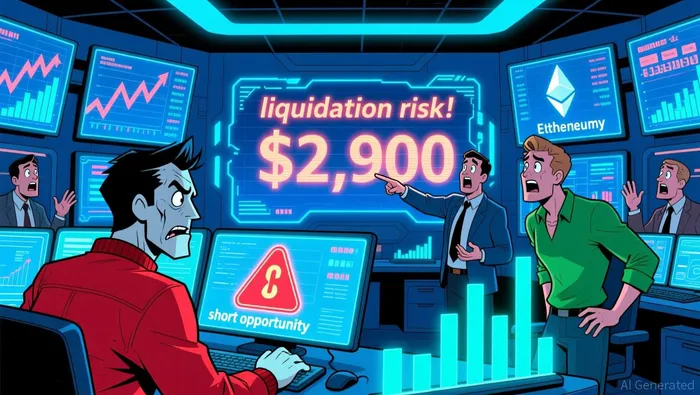 The interplay between Ethereum's price volatility and CEX liquidation risks is stark. Data from WeEX and Lookonchain indicates that if EthereumETH-- drops below $2,900, cumulative long liquidation intensity on major CEXs could reach $395 million to $850 million, depending on the exchange. Conversely, a breakout above $3,000 or $3,050 could trigger short liquidations of $228 million to $951 million. These figures reflect the concentration of leveraged positions at these price clusters, visualized as "bars" on liquidation charts, where higher bars denote greater liquidity cascade potential.
The December 2025 price dip below $2,900, as reported by MEXC, also revealed a decline in Ethereum's on-chain activity, including reduced weekly active addresses and transaction volumes. This suggests a waning of speculative interest during risk-off periods, further exacerbating the asset's vulnerability to downward spirals. Analysts at Binance and HTX have warned that a sustained breach of $2,900 could accelerate capital flight to alternative platforms like Solana, compounding Ethereum's bearish momentum.
Risk Management in a Fragile Market
For investors and traders, the $2,900 level demands a recalibration of risk management strategies. First, avoiding high-leverage positions is critical. As stated by Binance, the fragility of Ethereum's price structure necessitates a cautious approach to margin trading, given the potential for rapid liquidations. Second, monitoring key technical indicators-such as the 200-week moving average at $2,765-can provide early signals of deeper corrections.
Whale activity also offers a counterpoint to bearish narratives. In late December 2025, large holders accumulated 138K ETH ($503 million) within a week, suggesting a potential floor to further declines. However, this bullish bias remains fragile, contingent on macroeconomic stability and renewed institutional demand.
Looking Ahead: Navigating the Path Forward
Ethereum's near-term trajectory hinges on its ability to hold above $2,900. A successful defense of this level could reignite algorithmic buying driven by oversold conditions, as observed in December 2025. Conversely, a breakdown would likely trigger a self-reinforcing cycle of liquidations and capital flight, with CEXs bearing the brunt of the fallout.
Investors must also consider broader market dynamics, including the Federal Reserve's monetary policy and the performance of competing blockchains. For now, strategic risk management-through position sizing, stop-loss orders, and diversification-remains paramount. As the cryptocurrency market enters a new year, Ethereum's $2,900 support level will serve as both a test of resilience and a barometer for the sector's evolving volatility.






Comentarios
Aún no hay comentarios