
Ethereum's Critical $2,800–$3,000 Battleground: Is Now the Time to Buy the Dip?
Ethereum's price action in the $2,800–$3,000 range has become a focal point for traders and investors in Q4 2025, as technical indicators, on-chain metrics, and macroeconomic shifts converge to define the asset's near-term trajectory. This price corridor represents a psychological and structural battleground, where bulls and bears are locked in a tug-of-war over Ethereum's dominance in the post-ETF era.
Technical and On-Chain Dynamics: A Fragile Equilibrium
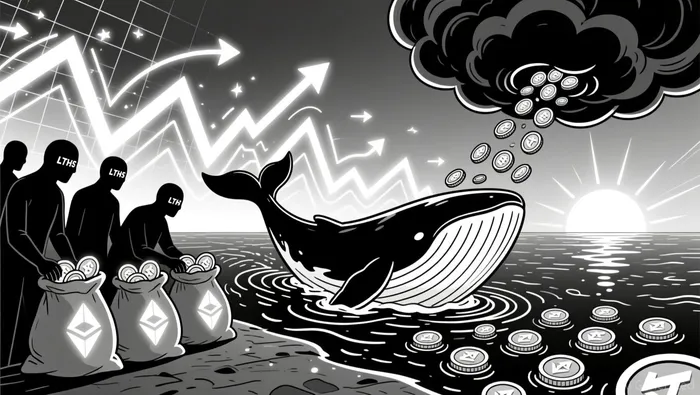
Ethereum's $2,800 level has historically acted as a critical support zone, reinforced by long-term holder (LTH) accumulation and a growing order book depth. According to a report by Brave New Coin, approximately 4.95 million ETH was acquired at this price level, creating a "cost basis buffer" that could stabilize further declines. However, the $3,000 threshold remains a contested psychological barrier. Technical analysts using Elliott Wave theory suggest the recent pullback below $3,000 is part of a Wave 2 correction, historically preceding bullish expansions.
On-chain data reveals mixed signals. While LTHs are strengthening their positions-indicating confidence in Ethereum's value-new inflows from retail investors remain subdued. Exchange reserves for ETH have hit a 9-year low, signaling a structural tightening of supply that could support future price recovery. Yet, the same data highlights ETF outflows of $1.4 billion in November 2025, forcing funds to sell ETH and reducing bid depth. This liquidity crunch has pushed Ethereum into an ascending channel, where a retest of $2,850–$2,870 with sustained upward momentum could propel the price toward $3,450–$3,550.
Whale activity adds another layer of complexity. According to a report, institutional investors and high-net-worth entities have accumulated nearly 400,000 ETH during the selloff, with BitMine Immersion Technologies alone adding 82,353 ETH ($300 million) to its holdings. Such accumulation suggests a strategic, long-term position, despite a 12% monthly price decline. Conversely, major whale holders are also selling large quantities of ETH, contributing to bearish sentiment.
Macroeconomic Sentiment: Fed Policy and Global Liquidity
The Federal Reserve's potential rate-cut cycle in December 2025 has emerged as a pivotal macroeconomic driver. As of November 2025, the probability of a 25-basis-point cut at the December 10 meeting rose from 30% to over 80%, alleviating macroeconomic pressures on digital assets. A Fed easing cycle typically boosts risk-on sentiment, which could benefit EthereumETH-- and other cryptocurrencies priced in U.S. dollars. However, liquidity constraints persist due to ETF outflows and treasury sell-offs, which have pressured the price below $3,000.
Global liquidity trends also play a role. Ethereum's alignment with rising M2 money supply growth suggests a broader macroeconomic tailwind, as increased global money supply supports upward price pressure. Meanwhile, institutional adoption-bolstered by clearer regulatory frameworks like the EU's MiCA and Asia's MAS stablecoin regime-has created structured environments for participation. These developments are complemented by Ethereum's deflationary supply dynamics and upcoming network upgrades, such as the Fusaka hard fork on December 3, 2025, which aims to enhance scalability and reduce Layer-2 fees.
The Case for Caution and Opportunity
While the technical and macroeconomic landscape is mixed, several factors suggest Ethereum could rebound from the $2,800–$3,000 range. First, the MVRV Z-Score is approaching levels historically associated with accumulation zones. This implies Ethereum may be forming a local bottom, supported by LTHs and whale activity. Second, the Fusaka upgrade could catalyze renewed institutional interest by improving Ethereum's efficiency and competitiveness against other blockchains.
However, risks remain. A sustained close below $3,200 could open the path toward $2,800 and deeper historical support zones. Additionally, the absence of substantial new investment has kept Ethereum sideways below $3,000, and a sustained rally will likely require renewed inflows from new capital.
Conclusion: A Calculated Buy-the-Dip Strategy
Ethereum's $2,800–$3,000 battleground reflects a delicate balance between structural support and macroeconomic uncertainty. For investors considering a "buy the dip" strategy, the key lies in monitoring three factors:
1. Whale Accumulation: Continued institutional buying at discounted prices could signal a bottoming process.
2. Fed Policy: A confirmed rate cut in December could unlock liquidity and drive a broader market rebound.
3. Fusaka Upgrade: The December 3 upgrade's success in reducing gas fees and enhancing scalability may attract new capital flows.
While the near-term outlook remains volatile, Ethereum's strong fundamentals-coupled with a potential supply squeeze and institutional confidence-suggest the $2,800–$3,000 range could serve as a catalyst for a multi-month rally. As always, investors should weigh these dynamics against their risk tolerance and portfolio diversification needs.






Comentarios
Aún no hay comentarios